


Your internship resume is your professional handshake. It is the first impression a potential employer has of you. This one page is your chance to show your potential. Highlight your education, skills, and any projects you have completed. A great resume convinces a recruiter you have the drive to be an asset to their team.
Why Your Internship Resume Is So Critical
Your resume is more than just a piece of paper. It is your ticket into the professional world. You do not have a long career history. So, your resume must do the heavy lifting. It needs to communicate your potential clearly.
Recruiters are busy. They spend only a few seconds on each application. This means a clean, professional layout is essential. That first glance determines if they keep reading or move on.
The competition is fierce. A polished resume is a key filter for companies. They use it to sort through hundreds of applicants. In 2023, there were an estimated 4.1 million internships in the U.S. However, only about 21.5% of college students landed one.
Once you get an internship, your odds are good. Internship-to-job conversion rates are around 66.9%. The effort you put into this document now can pay off later.
Nailing the Core Sections of Your Resume
To build a resume that gets noticed, focus on a few key areas. Each section tells part of your story. It gives the recruiter a reason to be interested.
Here are the essential parts of a standout internship resume. This table explains what makes each one important.
Internship Resume Sections at a Glance
| Section | What to Include | Why It Matters for an Intern |
|---|---|---|
| Contact Information | Full name, professional email, phone number, and LinkedIn URL. | This makes it easy for recruiters to contact you. A professional email and updated LinkedIn show you are serious. |
| Summary/Objective | A short 2-3 sentence pitch tailored to the specific role. | This is your elevator pitch. It tells the recruiter who you are and what you want. It hooks them to read more. |
| Education | University name, major, expected graduation date, and GPA (if 3.0+). | As a student, your education is your most relevant experience. It is the foundation of your qualifications. |
| Projects & Experience | Academic projects, volunteer work, part-time jobs, or previous internships. | This is where you prove you can apply what you have learned. It shows real-world skills, even without a formal job. |
| Skills | A list of your technical (hard) skills and relevant soft skills. | This section is a goldmine for keywords. It helps you pass automated screening systems (ATS). It also quickly shows recruiters your capabilities. |
Each section works together to paint a complete picture of you. Do not just fill them in. Think about how each part adds to your overall story.
The biggest mistake students make is sending a generic resume. You must customize it every time. Highlighting skills and experiences that match the job description boosts your chances of an interview.
Do not stop with just a PDF. To really stand out, you might create your own online CV website. This space lets you build a detailed portfolio. You can show off projects with visuals. It demonstrates your skills in a way a static document cannot.
Getting the foundation right is your first step. A clean, organized, and targeted resume is the most important step toward landing that internship.
Making Your Education and Projects Shine
For students, the education section is powerful. It is not just a formality. It is often the first place a hiring manager looks. It helps them understand your background and your drive. Getting this section right is a big opportunity to make a great impression.
Start with the basics. Include your university's full name, your degree, and your expected graduation date. If your GPA is 3.0 or higher, include it. A strong GPA is a clear signal that you are a dedicated student.
Highlighting Relevant Coursework
Do not just list your major. Do more. Add a subsection for "Relevant Coursework." This lets you spotlight classes that line up with the internship. This small detail proves you have the theoretical knowledge they need.
Think about it from their point of view. For a software engineering internship, which looks better? Just "Computer Science," or this:
- Data Structures & Algorithms: Gained a deep understanding of core programming principles and efficiency.
- Object-Oriented Programming: Developed proficiency in Java and C++ through hands-on coding assignments.
- Database Management Systems: Learned SQL and database design fundamentals by building a relational database.
This approach turns your transcript into a compelling argument. It shows you have started building the specific skills they need.
Turning Projects into Proof of Your Skills
Academic and personal projects are your secret weapon. This is especially true when you lack formal work experience. They provide concrete proof of your abilities and passion. The trick is to describe them like a mini-work experience. Focus on what you accomplished.
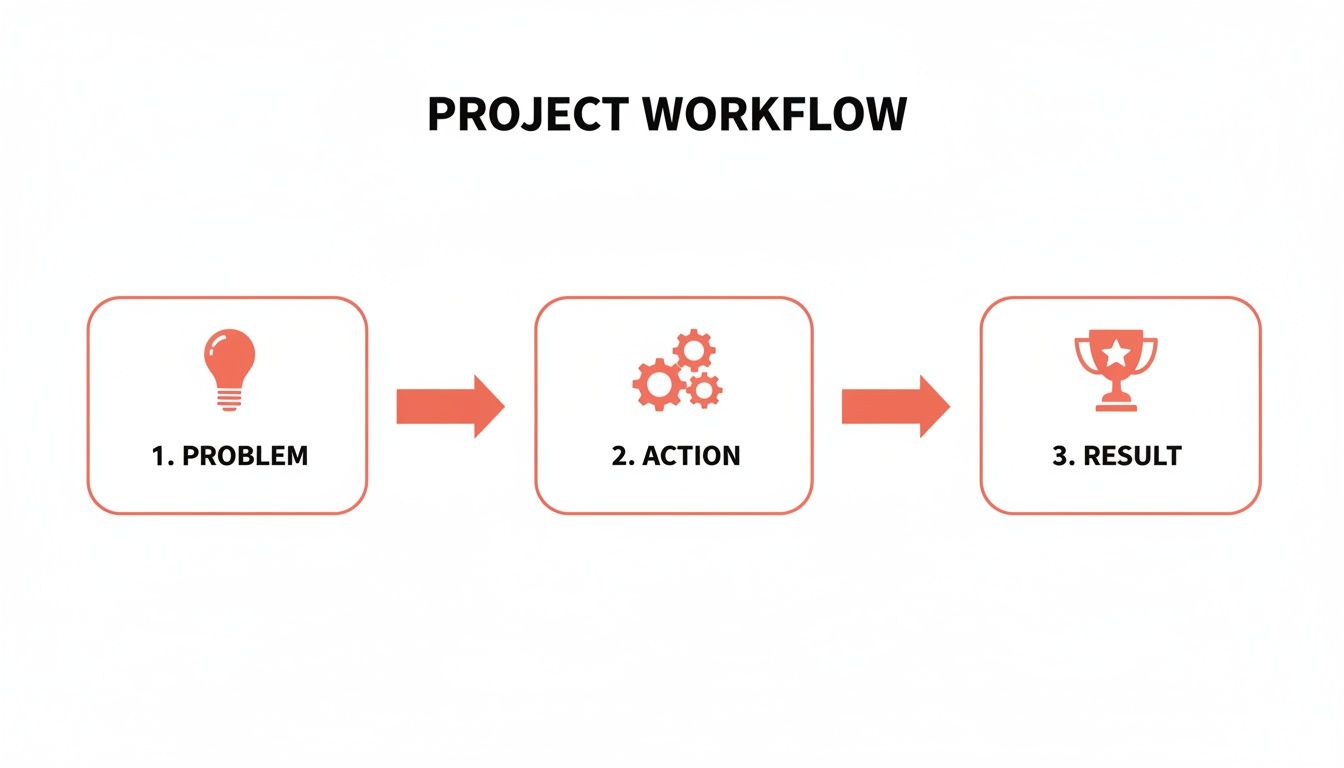
A simple and effective framework is Problem-Action-Result.
Problem: What was the challenge or goal of the project?
Action: What specific steps did you take? What tools or skills did you use?
Result: What was the outcome? Did you meet the goal, build a product, or find a key insight?
Let's see this in action. Instead of a bland entry like "Marketing Class Project," you could write:
- Marketing Campaign Analysis Project
- Analyzed the digital marketing strategy of a local coffee shop (Problem) to find growth opportunities.
- Conducted competitor research and used SEO tools like SEMrush to develop a new content strategy (Action).
- Presented a final report with a plan projected to increase web traffic by 15% in three months (Result).
This method clearly communicates your skills. It shows your ability in research, analysis, and strategic thinking. It turns a school assignment into a powerful example of your professional potential.
How to Quantify Your Experience
Your experience is more than a list of past jobs. When building a resume for an internship, everything counts. Volunteer work, club leadership, a part-time retail job, or a personal project all matter. The trick is to show your impact. The best way to do that is with numbers.
Quantifying your achievements turns vague statements into hard evidence. It proves you are a results-focused person. That is what hiring managers want.
The Power of Numbers
Numbers make your accomplishments feel real. They grab a recruiter’s attention quickly. They provide a clear measure of what you contributed. This is a game-changer when your experience is not from a formal job.
Look at the difference between these two bullet points:
- Vague: "Managed social media for a student club."
- Quantified: "Grew the club's Instagram following from 50 to 250+ in one semester by creating three engaging posts per week."
The second one is much better. It uses specific data (50 to 250+ followers, three posts per week). It shows you can drive growth and handle a content schedule. It tells a story of success.
Thinking Like a Storyteller
Every bullet point on your resume should tell a mini-story. Think about the problem, the action you took, and the result. This simple framework helps you find the numbers that matter.
This is the basic flow you should follow for every experience you list.
When you frame your accomplishments this way, you connect your actions to a real outcome. That is the secret to a great resume bullet point.
Finding the Numbers in Your Experience
Maybe you did not track every metric. That is okay. You can often find numbers by thinking about "how much" or "how many." Did you serve customers? Organize files? Plan an event? The data is there if you look for it.
Here are a few examples to get you started:
- Retail/Customer Service: Instead of "Helped customers," try "Assisted 30+ customers daily, resolving issues and contributing to a 95% positive feedback score."
- Club Leadership: Do not say "Organized meetings." Say, "Coordinated bi-weekly meetings for 15 members, managing agendas and increasing attendance by 20%."
- Volunteer Work: "Helped with a fundraiser" becomes "Managed event check-in for 150+ attendees, contributing to $5,000 raised for the charity."
Every number you add strengthens your resume. It transforms your responsibilities into achievements. It proves you did the work well. This is how you stand out.
Choosing the Right Skills to Highlight
Your skills section is more than just a list. For an internship resume, it is a strategic tool. It is your weapon against automated screening systems (ATS). It is also a quick summary for a busy hiring manager. To make it count, you must be selective. Highlight only what matters for the role.
Recruiters look for two things: what you can do, and how you do it. This breaks down into hard skills and soft skills. A strong candidate shows a solid mix of both.
Hard Skills vs. Soft Skills
First, let's understand the difference. Knowing which is which helps you tell your professional story.
-
Hard Skills: These are technical, teachable abilities. You learned them in class, at a job, or through a project. They are specific and can be measured. For an intern, this could be programming languages like Python or Java. It could also be software like the Adobe Creative Suite, or fluency in another language.
-
Soft Skills: These are about your character. They show how you work with others. They are your professional habits. Examples include communication, problem-solving, teamwork, and time management.
Your hard skills prove you have the technical ability for the job. Your soft skills show you will be a great team member. They show you can adapt and contribute to the company culture. Research shows that over 40% of recruiters believe applicants lack these crucial soft skills. Highlighting them can give you an edge.
How to Pinpoint the Right Skills
How do you know which skills to list? The company gives you a cheat sheet: the internship description.
Read the job description carefully. Pull out every keyword related to skills, both hard and soft. The company is telling you what they want to see.
For example, a marketing internship post might mention "creating social media content" or "working in a fast-paced team." Your skills section needs to mirror that language directly.
Tailoring your skills is not optional. It is a must. If the job description asks for SQL, and you know SQL, that word must be on your resume. This direct keyword matching helps you get past the ATS bots.
After you find the keywords, organize them. Do not just dump them into a list. Use clean, scannable categories. A recruiter should understand your skills in seconds.
Here is a simple way to group them:
- Technical Skills: Python, Java, SQL, Microsoft Excel (Advanced)
- Software: Adobe Creative Suite, Salesforce, Google Analytics
- Languages: English (Native), Spanish (Conversational)
Customizing Your Resume for Every Application
Sending the same resume for every internship is a fast way to get ignored. Companies do not hire a "general intern." They hire a marketing intern, a software intern, or a finance intern. Each role has specific needs. Your resume has to say, "I am the solution to your specific problem."
Tailoring your resume is non-negotiable. A customized resume proves you read the job description. It shows you understand what the company wants. It proves you are interested in that role, not just any role. This small step puts you ahead of the crowd.
Deconstructing the Job Description
First, you need to be a detective. The internship posting is your treasure map. It has clues that tell you what the hiring manager wants to see.
Read the description carefully. Highlight or copy the key responsibilities and qualifications. Pay attention to specific skills, software, or action verbs they use often.
- Responsibilities: What are the core tasks? Examples are "conduct market research," "assist with code reviews," or "prepare financial reports."
- Qualifications: What are the must-have skills? This could be "proficient in Python," "strong communication skills," or "experience with Adobe Creative Suite."
This list is your personal checklist. Your mission is to mirror this language in your resume. Use it in your summary, skills, and experience sections.
Your resume is a direct response to the company's needs. When you use their own language, you make it easy for them to see you as the perfect fit.
Adding Your Unique Edge
Matching keywords is just the start. You need to add something that makes you stand out. One powerful way to do this is with social proof.
Put a link to your Gainrep profile in your contact information. This is where you can collect endorsements from professors, mentors, and peers. When a recruiter sees that others have vouched for your skills, it adds credibility. It is more powerful than a simple list on a resume.
Customizing also means connecting your past experiences to the future role. The effort pays off. Employers use resumes to predict future performance. This helps explain why internship conversion rates are high, around 66.9% according to Standout-CV. Nailing this stage gets you the chance to land that full-time offer.
To make this easier, do not start from scratch every time. Build your resume on a professional template designed for easy customization. You can find excellent options to get started at Gainrep's resume builder.
Using AI to Accelerate Your Internship Search

Once your resume is polished, the next hurdle is applying. Hunting for internships and filling out forms is a slow task. It can burn you out before you even start.
Modern tools can make your job search faster and smarter. This is where AI helps. It turns a manual chore into a strategic advantage.
Automate Your Applications
Instead of spending all your time on job boards, let AI do the work. Platforms with AI-powered features can save you a massive amount of time. Applying to jobs becomes much more efficient.
Here is how it works:
- Smart Matching: The AI scans thousands of open roles. It finds internships that are a perfect fit for your skills and experience.
- Automated Submissions: It applies to these high-quality positions for you. It handles all the different application portals automatically.
- Customized Content: Many tools can generate a draft of a tailored cover letter for each job. This makes every application feel personal.
This automated approach lets you apply to more relevant positions in less time. When using AI in your search, knowing how to ask AI key questions for deeper insights can improve your research and application process.
By automating the repetitive parts of your search, you can focus your energy on what matters: prepping for interviews and networking. This is how you work smarter, not harder.
This strategy greatly increases your chances of landing interviews. If you are ready to put your new resume for internship to work, explore tools like Gainrep's AI Auto-Apply feature. This will get your job search into high gear.
Your Top Internship Resume Questions Answered
As you get ready to send your resume, a few questions always come up. Do not worry, everyone has them. Let's clear up the most common ones. This will help you finalize your resume with confidence.
How Long Should an Internship Resume Be?
One page. That is it.
Recruiters look at hundreds of applications. They do not have time to read a long document. A single, focused page is the standard for students. It is what employers expect to see.
This limit is a good thing. It forces you to include only your most relevant experiences, projects, and skills. A powerful one-page resume will always beat a rambling two-page document.
Should I Put My GPA on My Resume?
Yes, but only if it is 3.0 or higher (on a 4.0 scale). If you have a strong academic record, show it off. A good GPA is a quick signal to employers that you are dedicated.
If your GPA is under 3.0, leave it off. There is no need to draw attention to it. Instead, make the rest of your resume shine. Highlight your hands-on projects, relevant skills, or leadership roles.
What if I Have Zero "Real" Experience?
"Experience" is more than just a paid job. Recruiters looking for interns know you are just starting. They do not expect a long career history.
Focus on what you do have. Build a strong resume by showcasing:
- Relevant Coursework: Name specific classes that gave you the knowledge for this role.
- Academic Projects: Describe projects where you solved a real problem or used key technical skills.
- Volunteer Work: Detail your responsibilities and the impact you made. Organizing an event or managing social media for a non-profit is experience.
- Extracurriculars: Showcase leadership, teamwork, or organizational skills from clubs, sports, or student government.
Ready to build a resume that gets noticed? Gainrep has professional templates and tools to help you stand out. Check out our resources and create your perfect resume at https://www.gainrep.com/resumes.
