A job interview is your chance to shine. It can feel like a high-stakes test. Hiring managers ask specific questions. They want to gauge more than just your skills. They want to understand your personality. They also want to see your problem-solving abilities. They need to know how you would fit into their company culture. Knowing what to expect is the first step. It helps you walk in with confidence. You can leave a lasting, positive impression.
This guide is your complete playbook. We will break down common interview questions for interviewee you will likely face. This includes "Tell me about yourself" and "Do you have any questions for me?". For each question, we explore the real reason behind it. We look at what interviewers truly want to see. We show you how to structure a great response. You will find actionable tips. You will also see sample answers for different career levels. We will point out common mistakes to avoid. Mastering these questions is key to showing your value. You can prove you are the right candidate. Good preparation turns anxiety into an advantage. It lets you clearly communicate your skills and goals.
Our goal is to give you specific strategies for each question. This guide focuses on individual questions. You can find more general advice on how to answer interview questions to build a solid foundation. Think of each question as a chance to tell your professional story, not a hurdle. With the right preparation, you can turn a tough interview into a successful conversation. This can help you land the job offer you deserve. Let's dive in and get you ready for your next big opportunity.
1. Tell Me About Yourself
This classic opening is a very common interview question. It is more than just an icebreaker. It is your first chance to make a strong impression. The interviewer uses this question to check your communication skills. They also check your confidence and your ability to tell a concise professional story. It sets the tone for the entire conversation.
A weak answer rambles through your personal history. It might list your work timeline without a clear focus. A strong response is a polished "elevator pitch." It connects your past experiences directly to the job's future needs.
Why It's Asked
Interviewers ask this to see how you state your value. They look for a summary of your professional background. They want to know your key skills and career goals. Most importantly, they want to see if your story matches what the company needs.
How to Prepare a Winning Answer
Your goal is to give a compelling 60 to 90-second summary. Avoid just reciting your resume. Instead, create a story. This story should highlight your most relevant skills and accomplishments.
Structure Your Story: Use a simple three-part formula:
- Present: Briefly state your current role and a major accomplishment.
- Past: Connect your previous experiences and skills to the role you're applying for.
- Future: Explain why you are excited about this specific opportunity and what you bring to the company.
Tailor It to the Job: Analyze the job description. Find the top three required skills or qualifications. Weave them into your response. For example, if the role needs project management, mention a successful project you led.
Practice, Don't Memorize: Rehearse your answer until it sounds natural. It should be conversational, not robotic. Practicing can help you refine your professional story. It helps you deliver it with confidence.
Pro Tip: End your answer with a transition. This invites more conversation. For example, "…and that's why I was so excited to see this role. It perfectly aligns with my skills in data analysis and my passion for sustainable tech. I'm eager to learn more about how I can contribute to your team."
2. Why Do You Want to Work Here?
This is a very important interview question. It shows your motivation and level of interest. Interviewers ask this to separate candidates. They want to find people who are genuinely excited about the company. They want to weed out those who are just looking for any job. It is your chance to show you did your research. You see a real future for yourself at the company.
A weak answer is generic and self-focused. It might only mention salary or the company’s reputation. A strong answer is specific and enthusiastic. It connects your personal values and career goals directly to the company's mission, products, or culture.
Why It's Asked
Hiring managers want to confirm your investment in this opportunity. They are checking your cultural fit. They are seeing if you understand their business and your long-term potential. This question helps them see if your passion goes beyond the job description to the company itself.
How to Prepare a Winning Answer
Your response should prove your interest is real and well-researched. Aim to show a clear link. Connect what the company does with what you want to achieve professionally.
Do Your Homework: Go beyond the company's homepage. Read recent news articles. Study their latest projects or product launches. Check their social media. Understand their mission, values, and market position.
Find a Personal Connection: Identify three specific reasons the company appeals to you. Is it their innovative technology? Their commitment to sustainability? Their company culture? A specific product you admire? Connect these points to your own experience and values.
Focus on Contribution: Frame your answer around how you can add value. Explain how your skills and ambitions align with the company's direction. Show how you can help them tackle challenges or achieve goals.
Pro Tip: Structure your answer by connecting the company, the role, and your own goals. For example: "I've been following your company's work in renewable energy. Your recent project in community solar aligns perfectly with my background in sustainable development. This role seems like a unique opportunity to apply my project management skills to a cause I am passionate about."
3. What Are Your Strengths?
This is a classic interview question for a good reason. It lets you directly highlight your most relevant skills. You can prove your value to the company. The interviewer is not just looking for a list of adjectives. They want to see if your key skills align with the job's demands. They also want to know if you can back up your claims with evidence.

A weak answer is generic and not supported by facts. An example is saying, "I'm a hard worker." A strong answer is specific, relevant, and supported by a real example. This example should show your strength in action. This is your chance to connect your abilities directly to the employer's needs.
Why It's Asked
Interviewers ask this question to check your self-awareness and confidence. They want to understand what you think are your most valuable professional assets. Most importantly, they are listening to see if your strengths match what is needed to succeed in the job.
How to Prepare a Winning Answer
Your goal is to present two to three of your most relevant strengths. Each one should be backed by a brief, compelling story. Avoid clichés and focus on achievements you can measure.
Align with the Job Description: Look closely at the job description. Identify the top required skills. Choose strengths from your own experience that directly match these needs. If the role requires managing multiple projects, a key strength would be organization or prioritization.
Provide Concrete Evidence: Use a short story or a specific example to illustrate each strength. For instance, instead of just saying you have strong analytical skills, describe a time you used those skills to solve a problem.
Quantify Your Impact: Whenever possible, use numbers. Numbers show the result of your actions. Stating that you "increased sales by 15% in six months" is much more powerful than simply saying you are "good at sales."
Pro Tip: Structure your answer by stating the strength. Then provide a brief example (Situation, Action, Result). Finally, connect it back to the role. For example: "One of my core strengths is analytical problem-solving. In my last role, I found a process bottleneck. It was costing the company $50K annually. I designed a new workflow that cut processing time by 30%. I am confident I can bring this same problem-solving approach to your team."
4. What Are Your Weaknesses?
This classic interview question tests your self-awareness. It also tests your honesty and commitment to professional growth. It is not a trap. It is a chance to show your character and emotional intelligence. The interviewer wants to see if you can admit areas for improvement. They also want to see that you have a proactive mindset.
A weak answer is either a cliché like "I'm a perfectionist" or denying any weaknesses. A strong response, however, thoughtfully identifies a real, minor weakness. It focuses on the specific steps you have taken to improve. This turns a potential negative into a story of personal development.
Why It's Asked
Interviewers ask this question to check your humility and self-awareness. They want to know if you are coachable. They want to see if you are dedicated to continuous improvement. How you handle this question reveals your problem-solving skills. It also shows your ability to learn from past experiences. These are crucial traits for any role.
How to Prepare a Winning Answer
Your goal is to be genuine without disqualifying yourself. Choose a real weakness that is not a core requirement for the job. Frame it as a learning opportunity.
Structure Your Answer: Use a clear structure.
- Situation/Task: Identify a genuine, manageable weakness you have recognized.
- Action: Describe the specific actions you have taken to address it. This could be taking a course, seeking feedback, or adopting new strategies.
- Result: Explain the positive outcome of your efforts. Show how you've grown professionally.
Be Strategic, Not Dishonest: Avoid critical flaws. Do not say "I'm not a team player" or "I struggle with deadlines." Instead, choose something like public speaking anxiety or trouble with over-delegating. For example, "Early in my career, I struggled with delegating tasks. I wanted to maintain quality control. I realized this was limiting my team's growth. I have since learned to create clear guidelines and trust my colleagues. This has improved our team’s overall productivity."
Focus on Growth: The most important part of your answer is showing that you are actively working to improve. This shows initiative. It shows a commitment to being the best professional you can be.
Pro Tip: Never frame a strength as a weakness, such as "I work too hard." Recruiters have heard this many times. It sounds insincere. Instead, show genuine self-reflection. For instance, "I used to get bogged down in the small details of a project. This sometimes affected my speed. I've since learned to better prioritize tasks based on their impact. This has helped me become much more efficient."
5. Tell Me About a Challenge You Faced and How You Overcame It
This behavioral question is common in many interviews. It tests more than just your skills; it reveals your character. An interviewer uses this prompt to check your problem-solving abilities. They also check your resilience under pressure and your ability to grow. It is a chance to show how you handle professional challenges.
A weak answer is vague. It might blame others or describe a minor issue, like dealing with an annoying coworker. A powerful response shows a significant professional challenge. Your direct actions led to a positive, measurable outcome. This highlights your competence and maturity.
Why It's Asked
Hiring managers want to understand your thought process when things go wrong. They are evaluating your resourcefulness. They check your critical thinking and accountability. This question helps them predict how you might handle future challenges in their workplace. It shows if you learn from difficult experiences.
How to Prepare a Winning Answer
The key is to select a relevant story. You need to structure it clearly. Choose a real professional challenge that demonstrates skills needed for the job.
Structure Your Story: Use the STAR method for a clear and impactful story:
- Situation: Briefly describe the context. What was the challenge?
- Task: What was your specific responsibility or goal in that situation?
- Action: Detail the specific steps you took to address the challenge. This is the most important part.
- Result: Explain the positive outcome. Quantify it with numbers (e.g., saved 15% on costs, completed the project on time) if possible.
Choose the Right Example: Select a story where you were a key player in the solution. Avoid stories that focus too much on team efforts without highlighting your individual contribution.
Focus on the Lesson: Conclude by mentioning what you learned from the experience. This shows self-awareness and a commitment to continuous improvement.
Pro Tip: Your story should be a testament to your skills. It should not be a complaint session. Avoid speaking negatively about former employers or colleagues. Frame the challenge professionally. Keep the focus on your actions and the successful resolution.
6. Where Do You See Yourself in 5 Years?
This forward-looking question is common in many interviews. It helps interviewers understand your career ambitions. It also shows your long-term goals. They want to know if you see a future with their company. They use it to see if your goals align with the growth opportunities at their company. This reveals your motivation and potential for long-term commitment.
A weak answer is vague or non-committal. It might suggest you see the role as a short-term step. A strong answer shows you have a clear career direction. It shows you have thoughtfully considered how this specific role fits into your professional journey.
Why It's Asked
Hiring managers ask this common interview question to gauge your ambition and realism. They want to see if you have thought about your career path. They want to know if that path is compatible with the company's structure and goals. It helps them determine if you are likely to be a motivated, engaged employee. They want to know if you will grow with the company, rather than leaving after a short time.
How to Prepare a Winning Answer
Your goal is to present a vision that is ambitious yet realistic. It should be grounded in the reality of the role and company. Show enthusiasm for growing within their specific framework.
- Align Your Vision: Research the company's structure. Look into potential career paths for someone in this role. Frame your five-year plan in a way that shows you growing with them.
- Be Specific but Flexible: Talk about the skills you want to develop. Mention the type of responsibilities you hope to take on. For example, mention wanting to become a subject matter expert or leading key projects.
- Show Your Commitment to Growth: Mention concrete steps you are taking to achieve your goals. This could be pursuing certifications or taking on challenging projects. This demonstrates proactivity.
Pro Tip: Connect your personal goals directly to the company's success. For example, "In five years, I aim to be a senior analyst here. I want to use my deep understanding of your business to help drive key data strategies. I'm excited by the opportunity to grow my expertise and contribute to this team's long-term success."
7. Why Are You Leaving Your Current Job?
This question is a crucial test of your professionalism and emotional intelligence. Hiring managers ask this common interview question to understand your motivations. They also want to spot potential red flags. They want to ensure you are running toward a new opportunity, not just away from a bad situation. Your answer reveals a lot about your maturity, accountability, and attitude toward your work and colleagues.
A weak answer is negative. It blames a former boss, company, or coworkers for your departure. A strong answer frames your decision in a positive, forward-looking light. It emphasizes career growth and alignment with the new role's opportunities.
Why It's Asked
Interviewers use this question to assess your reasons for making a career move. They listen for your tone. They listen to the reasons you provide to gauge your work ethic, loyalty, and how you handle professional challenges. They look for a logical and positive motivation for change. They want to ensure you won’t bring negativity or unresolved issues into their workplace.
How to Prepare a Winning Answer
Your goal is to be honest without being negative. Craft a concise, professional response. Focus on your future goals and what this new role offers that your previous one did not.
- Frame It Positively: Always focus on the pull of the new opportunity. Do not focus on the push from your old job. Talk about what you are moving toward. This could be new challenges, skill development, or better alignment with your career goals.
- Be Honest but Diplomatic: If you were part of a layoff or restructuring, state the facts briefly. Be professional without placing blame. For example, "My role was eliminated due to a company-wide reorganization." Then, quickly pivot to why you are excited about this new opportunity.
- Focus on Growth: Connect your departure to your professional development. Explain that you have learned a great deal in your current role. But now you are seeking new responsibilities or challenges that are not available there. For instance, you might be looking to move from an individual contributor to a leadership role.
Pro Tip: Keep your answer brief and end on a positive note. A great example is: "I’ve truly valued my time at my current company. I have grown my project management skills significantly. I'm now seeking an opportunity where I can apply those skills to larger-scale projects and take on more strategic responsibilities. That is why this role at your company is so compelling."
8. Describe a Time You Disagreed With Your Manager or Colleague
This behavioral question tests your emotional intelligence. It also tests your conflict-resolution skills. It is not about proving you were right. It is about showing how you handle professional disagreements constructively. The interviewer wants to see if you can advocate for your ideas while respecting others. They want to see you work toward a positive outcome for the team.
A weak answer involves blaming others. It might focus on personality clashes or portray the other person as stubborn or incompetent. A strong response showcases your maturity and communication skills. It shows your ability to navigate workplace challenges with professionalism and respect.
Why It's Asked
Hiring managers use this question to evaluate your collaboration style. They also check your workplace maturity. They want to know if you can challenge ideas respectfully. They want to know if you can listen to different viewpoints and work towards a compromise. Your answer reveals your ability to handle pressure. It shows how you communicate effectively and maintain positive working relationships even when opinions differ.
How to Prepare a Winning Answer
The key is to tell a story that highlights your problem-solving skills, not your stubbornness. Focus on a real, work-related disagreement rather than a petty dispute.
Use the STAR Method: Structure your response clearly to cover all the important details.
- Situation: Briefly set the scene. Describe the project and the specific point of disagreement.
- Task: Explain your goal or what needed to be accomplished.
- Action: Detail the steps you took. Did you gather data? Did you schedule a one-on-one meeting? Emphasize listening and collaboration.
- Result: Share the outcome. Explain the resolution, the compromise reached, and what you learned from the experience.
Choose a Good Example: Select a real professional disagreement where you handled the situation well. You should have reached a positive or neutral resolution. Avoid stories where you "won" and the manager was proven wrong. Instead, focus on a compromise that benefited the company.
Focus on Professionalism: Keep your tone respectful and objective. Avoid emotional language. Do not make the other person sound unreasonable. Emphasize that you valued their perspective, even if you disagreed with it.
Pro Tip: Frame the outcome in terms of what you learned. Conclude by mentioning how the experience improved your communication skills. You can also say it taught you the value of considering different approaches. For example, "This experience taught me to always support my suggestions with data. I learned to approach disagreements as a collaborative problem-solving session, not a confrontation."
9. What Are Your Salary Expectations?
This compensation question is often one of the most nerve-wracking interview questions for an interviewee. It is a critical moment. It assesses your market knowledge, confidence, and financial motivations. Interviewers use it to see if your expectations align with their budget. They also want to see if you have researched industry standards for the role.
A weak answer is either too aggressive or too passive. It might also be completely unprepared. A strong response shows you know your worth based on data. It also shows flexibility and a focus on the total opportunity, not just the base number.
Why It's Asked
Hiring managers ask this to screen candidates efficiently. They want to ensure financial alignment. They want to know if they can afford you. They also check if your expectations are realistic for the position and industry. This question also reveals how you value your skills and experience. It sets the stage for future salary negotiations.
How to Prepare a Winning Answer
Your goal is to provide a well-researched, confident answer. This answer should keep the conversation open. Avoid giving a single, rigid number or undervaluing yourself. Instead, present a thoughtful range backed by evidence.
Do Your Homework: Research salary ranges using sites like Glassdoor and PayScale. Also check the Bureau of Labor Statistics. Factor in your location, company size, industry, and specific experience level. This data is your best tool for justification.
Provide a Strategic Range: Offer a salary range rather than a fixed number. This provides room for negotiation. Aim to have the bottom of your range be a number you are still happy with. For example: "Based on my research for this role in this city and my experience, I'm targeting a range of $65,000-$75,000."
Consider Total Compensation: Remember that salary is just one part of the package. Acknowledge this by mentioning your flexibility. This could be based on benefits, bonuses, equity, and opportunities for growth. This shows you are evaluating the entire offer.
Pro Tip: If possible, try to delay the question. You can also ask for their budgeted range first. You can say, "I'd love to learn more about the role's specific responsibilities and the full benefits package first. Could you share the salary range you have budgeted for this position?" This puts you in a stronger negotiating position.
10. Do You Have Any Questions for Me?
This closing question is a crucial part of any interview. It might seem like a simple formality. But it is a powerful opportunity for you to turn the tables. The interviewer uses this to check your level of engagement and curiosity. They want to see how seriously you are considering the role. It is your chance to evaluate if the company is the right fit for you.
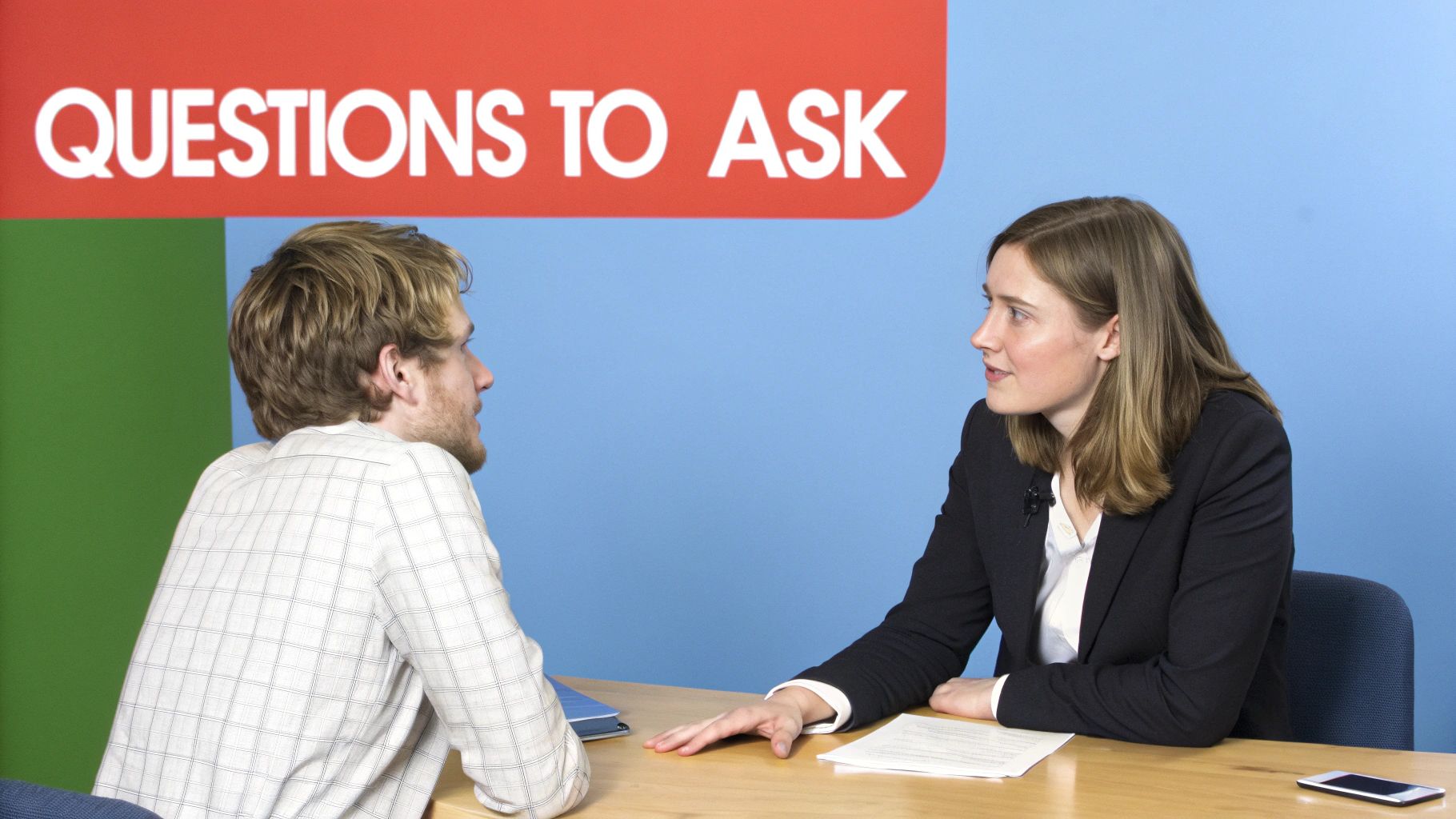
A weak response, like saying "No, I think you've covered everything," can signal disinterest. A strong response involves asking insightful, well-researched questions. These questions reinforce your enthusiasm. They demonstrate your strategic thinking. This moment can significantly strengthen your candidacy. It can leave a lasting positive impression.
Why It's Asked
Interviewers ask this question to gauge your genuine interest. They want to see your interest in the position and the company. The quality of your questions reveals how much you have prepared. It also shows whether you have been actively listening. They want to see if you are thinking deeply about the role's challenges. They are interested in your thoughts on team dynamics and how you can contribute to their success.
How to Prepare a Winning Answer
Your goal is to have a list of 3-5 thoughtful questions ready to go. Avoid questions about salary or benefits in early-stage interviews. Do not ask unless the interviewer brings it up. Instead, focus on questions that show your commitment and long-term vision.
Structure Your Questions: Organize your questions into key categories. This ensures you cover all your bases:
- The Role: Ask about expectations and success metrics. Example: "What does a successful first 90 days look like in this position?"
- The Team: Inquire about team culture and collaboration. Example: "How would you describe the team's working style and dynamics?"
- The Company: Show you are interested in the bigger picture. Example: "How does this role contribute to the company's broader strategic goals for this year?"
Demonstrate Your Research: Frame questions that include something you learned about the company. For instance, "I read about your recent expansion into the European market. How will this role support that initiative?"
Practice and Prepare: Come prepared, but also listen actively during the interview. Sometimes the best questions come from the conversation itself. You can find out which questions other professionals have found most effective in their interviews.
Pro Tip: Always end by asking about the next steps. A simple "What is the timeline for the next steps in the hiring process?" shows you are organized. It also shows you are eager to move forward. This provides clarity for you and reinforces your strong interest in the role.
Top 10 Interview Questions Comparison
| Question | 🔄 Complexity | ⚡ Prep Effort | 📊 Expected Outcomes | Ideal Use Cases | ⭐ Key Advantage / 💡 Tip |
|---|---|---|---|---|---|
| Tell Me About Yourself | Medium — open‑ended | Medium — prepare 60–90s script | Baseline communication, priorities | Initial phone screens, first interviews, panels | Control your narrative; structure background → achievements → goals |
| Why Do You Want to Work Here? | Medium — requires research | Medium‑High — company research needed | Demonstrates motivation, cultural fit | All stages (esp. any interviewer assessing fit) | Shows alignment; cite 3 specific company reasons or recent news |
| What Are Your Strengths? | Medium — self‑assessment | Medium — select 3–4 strengths + examples | Reveals competencies and fit to role | All stages, behavioral/competency interviews | Highlight relevant strengths with STAR examples and metrics |
| What Are Your Weaknesses? | High — delicate framing | High — choose real weakness + remediation | Shows self‑awareness and growth mindset | Behavioral, second/final rounds | Pick a non‑critical weakness and show concrete improvement steps |
| Tell Me About a Challenge You Faced and How You Overcame It | Medium‑High — storytelling + impact | Medium‑High — prepare STAR story with metrics | Assesses problem‑solving, resilience, learning | Behavioral, competency, senior roles | Use STAR; quantify outcome and emphasize learning |
| Where Do You See Yourself in 5 Years? | Medium — goal alignment | Medium — align ambitions with company path | Reveals ambition and retention likelihood | Second/final interviews, hiring manager meetings | Be specific and realistic; mention steps you’re taking toward goals |
| Why Are You Leaving Your Current Job? | Medium‑High — sensitive framing | Medium — craft forward‑looking rationale | Reveals motivation and potential red flags | All stages, esp. initial interviews | Stay positive; focus on opportunity sought rather than complaints |
| Describe a Time You Disagreed With Your Manager or Colleague | High — requires diplomacy | High — pick substantive, constructive example | Shows emotional intelligence and conflict resolution | Behavioral, leadership or team roles | Demonstrate listening, evidence‑based advocacy, and resolution |
| What Are Your Salary Expectations? | Medium‑High — negotiation nuance | High — research market + total compensation | Determines budget fit and negotiation starting point | Phone screens and later stages before offer | Provide a researched range; factor location, benefits, and flexibility |
| Do You Have Any Questions for Me? | Low‑Medium — preparation shows engagement | Low‑Medium — prepare 3–5 thoughtful questions | Reveals curiosity, priorities, and fit | All stages, especially final rounds | Ask about success metrics, team culture, and next steps; avoid benefits first round |
Turn Your Interview Into a Job Offer
Walking out of an interview feeling confident is the result of strategic preparation. It is not luck. This guide has broken down the top ten most common interview questions for interviewee candidates. We moved beyond generic advice to provide a clear roadmap. We have explored the "why" behind each question. We covered the common pitfalls to avoid. We also provided actionable frameworks like the STAR method. This helps you structure compelling, authentic responses.
The goal is not to memorize a script. It is to build a toolkit of personal stories and professional achievements. You can adapt these to any question that comes your way. You might be explaining your strengths. You could be discussing a past challenge. Or you could be stating your five-year plan. Your answers should form a cohesive story that paints you as the ideal candidate.
The Core Strategy: Connect, Prove, and Inquire
Mastering your interview performance comes down to three critical actions. Think of these as the pillars of your approach.
- Connect with the Company's Mission: Your response to "Why do you want to work here?" is a prime opportunity. It shows you have done your research. It proves your interest goes beyond just needing a job. You align with their values. You are excited by their products. Or you see a future in their industry. This connection makes you a more memorable and invested candidate.
- Prove Your Value with Evidence: Questions like "Tell me about a challenge you faced" or "What are your strengths?" are direct invitations. They ask you to showcase your abilities. Avoid simply listing skills. Instead, use specific examples from your past experiences. Quantify your achievements whenever possible. Did you increase efficiency by 15%? Did you help your team complete a project two weeks ahead of schedule? This evidence-based approach makes your claims credible and impactful.
- Inquire with Purpose: The final question, "Do you have any questions for me?" is your chance. You can turn the interview into a two-way conversation. Asking thoughtful, well-researched questions shows your engagement and critical thinking. It also gives you vital information. You can decide if the company is the right fit for you. This moment transforms you from a passive interviewee into a proactive potential colleague.
Beyond the Questions: A Holistic Approach
Your success begins long before you shake the interviewer's hand. It starts with a resume that powerfully communicates your value. A strong resume secures you the interview in the first place. A professionally crafted resume is your first impression. It is your ticket through the door. For guidance on creating a document that stands out, you can explore the templates and tools available at https://www.gainrep.com/resumes.
Once your resume is polished, the next step is navigating the application process efficiently. Applying to multiple positions that align with your skills can be a full-time job. Streamlining this process allows you to dedicate more time to what truly matters. You can focus on preparing for the interviews you land. To accelerate your job search, an AI-powered tool can help. It can identify and apply to relevant roles, saving you time and effort. You can learn more about this approach at https://www.gainrep.com/ai-auto-apply.
Each step in the job-seeking process builds on the last. A strong resume leads to more interviews. Efficient application strategies give you more opportunities. And solid interview preparation turns those opportunities into job offers. By mastering these common interview questions for interviewee candidates, you are not just learning to answer questions. You are learning to confidently tell your professional story. You are learning to prove why you are the best person for the job.
Ready to build a career profile that gets you noticed and supports you every step of the way? Gainrep helps you consolidate your professional achievements, gather powerful endorsements, and create a comprehensive portfolio that you control. Visit Gainrep to start building the professional presence that opens doors to your next great opportunity.
