



You can put your minor on your resume in the education section. Just add it after your major. For example, write Bachelor of Science in Biology, Minor in Statistics.
The real question is not how to list it, but when and why.
Deciding if Your Minor Belongs on Your Resume
Think like a hiring manager before adding your minor. Every word on your resume must earn its place. Your minor is no exception.
Your minor is a potential secret weapon. It shows a wider skill set. It paints a fuller picture of you as a candidate. The most important word is relevance.
Start by analyzing the job description. Look for secondary skills the company wants. Does the job mention data analysis, communication, or creative problem-solving? An unrelated minor might become your biggest asset here.
Connecting Your Minor to the Job
Think about the skills your minor gave you, not just the title.
- A Psychology minor is not just about theory. It helps you understand people. This is valuable for sales, marketing, or HR roles.
- A History minor teaches more than dates. You learned research, analytical, and writing skills. These are critical for jobs in law, consulting, or content strategy.
Do not just list your minor. You need to sell it. Frame it as a strategic choice. It should complement your major and make you a more capable professional. Consider how broader education issues impacting careers might affect how you present your academic background.
A Real-World Scenario
Imagine a Computer Science graduate applying for an AI developer role. The role focuses on natural language processing. The CS degree is a great start.
But what if they also have a minor in Linguistics? Their application is now at the top of the pile. That minor shows they understand language structure. This is directly applicable to the job. It is a powerful advantage that another CS-only graduate will not have.
This flowchart can help you decide if your minor is a "yes," "no," or "maybe" for your resume.
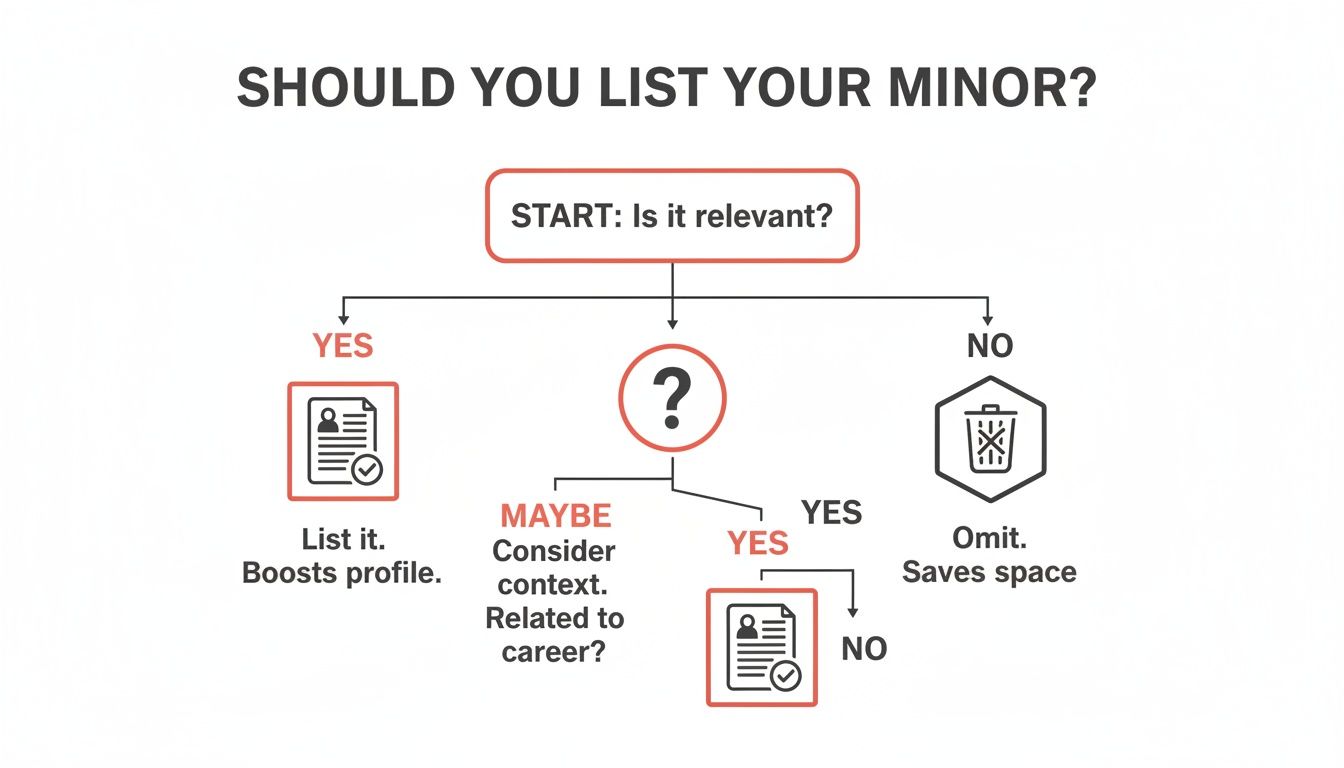
The decision is straightforward. If there is a direct link, it is an automatic "yes." If it is completely unrelated and you need space, leave it off.
You decided your minor is worth including. That's great. But where does it go? Placing it randomly will not help. The right placement can make a hiring manager see a valuable skill. The wrong placement can make them miss it.

The most common spot is your Education section. Recruiters expect it there. It keeps your academic details organized.
The Go-To Spot: The Education Section
This is the best option for almost everyone, especially recent graduates. List it right next to your major. This approach is clean and professional.
Here is how it looks in practice:
University of California, Berkeley – Berkeley, CA
Bachelor of Science in Business Administration, Minor in Data Science
It's simple. It clearly states your main focus. It also shows a complementary skill set. You can easily build a resume with this format to highlight your academics. If you need help with the layout, a professional GainRep resume builder can help you get it just right.
When Your Minor is the Star of the Show
The Education section is the default, but not the only option. What if your minor is highly relevant to the job you want? It might deserve a better spot.
Consider these high-impact alternatives:
- Your Resume Summary: This is the first thing a recruiter reads. If your minor is a game-changer, mention it here. For example: "Recent marketing graduate with a minor in Graphic Design, offering a strong mix of strategic and visual communication skills."
- Your Skills Section: You can list specific hard skills from your minor here. Someone with an Economics minor could list "Statistical Analysis (R, Stata)" or "Econometric Modeling." This makes sure those keywords get noticed.
Displaying academic achievements goes beyond paper. Some even view a graduation stole as a wearable résumé.
Your job is to connect the dots for the recruiter. Do not just list a History minor for a research role and hope they understand. Spell it out. Feature skills like "Archival Research" or "Primary Source Analysis" in your skills list.
Weaving Your Minor into Your Story
The goal is to integrate your minor naturally. If your foreign language minor is a major asset for an international role, do not bury it. Mention it in your summary. Then detail your proficiency level in the skills section.
It all comes down to relevance. If your minor is just a supporting detail, keep it in the Education section. If it’s a main selling point for this specific job, bring it to the front. This is good resume practice. Focusing only on what matters for the role is always the right move.
Formatting Examples for Every Situation
How you write your minor on your resume matters. The right phrasing makes its relevance clear. The wrong choice can bury it in details. Let's look at clear, real-world examples for any situation.
The goal is to be clean and easy to read. It must be consistent with the rest of your resume. Small details like capitalization and punctuation make your document look professional.
For a Completed Degree and Minor
This is the most common situation. It is also the simplest. You list your minor in the education section, right after your major. This gives recruiters context in a single glance.
There are two main ways to do this. Both are fine. Pick the one that looks best with your resume's design.
-
Using a comma: This is what you will see most often. It’s clean, simple, and effective.
- Bachelor of Science in Biology, Minor in Chemistry
- Bachelor of Arts, Major in Political Science, Minor in Economics
-
Using parentheses: This creates a visual break between your major and minor.
- Bachelor of Arts in English (Minor in History)
- Bachelor of Science in Computer Science (Minor in Mathematics)
A quick tip: Always capitalize the word "Minor" and the name of the field. This gives it the same visual weight as your major. It keeps your formatting consistent.
Listing a Minor on a Separate Line
This is less common. But giving your minor its own line can be a smart move. This format gives it more visual weight. It is a great idea if your minor is very relevant to the job.
Think about this option if:
- You want your minor to catch the hiring manager's eye.
- Your degree and major names are long and look crowded on one line.
- You have extra white space in your resume design.
Here’s how that would look:
New York University – New York, NY
Bachelor of Science in Marketing
Minor in Graphic Design
This clean separation makes both credentials stand out.
How to List an In-Progress Minor
If you are still a student, you should list your minor. Do not wait until you graduate. It gives recruiters a clear picture of your academic focus. It shows them the skills you are actively building. You just need to make it clear that your degree is not finished yet.
Add your expected graduation date. You can even add a note that the minor is "in progress."
-
Example 1: The Standard Way
University of Texas – Austin, TX
Bachelor of Business Administration, Minor in Spanish (Expected May 2026) -
Example 2: A More Detailed Approach
University of Florida – Gainesville, FL
Bachelor of Arts in Journalism (Expected December 2025)
Minor in Progress: Political Science
If you want to remove the guesswork from formatting, you can use a tool like the GainRep resume builder. It helps you create a polished, professional resume without worrying about small details.
Getting Your Minor Past the Applicant Tracking Systems
A robot usually sees your resume before a human does. That robot is the Applicant Tracking System, or ATS. Its job is to scan your resume for keywords from the job description. If it does not find a good match, your application is rejected.
A well-placed minor can be your secret weapon here. By adding keywords related to your minor, you can boost your resume. This helps it pass the scan and reach a recruiter.

Aligning Your Minor with Job Keywords
First, you need to be a detective. Get the job description you are targeting. Read it carefully. Look for specific skills, tools, or qualifications. Find the keywords they repeat.
Imagine you majored in Communications with a minor in Data Analytics. You apply for a Digital Marketing Specialist role. The job post is full of terms like:
- Data analysis
- A/B testing
- Google Analytics
- SEO/SEM principles
- Market research
Your minor is not just "nice to have." It is directly relevant. Your next step is to add these exact phrases to your resume. Link them to your experience from that minor, like a class project or coursework.
Key takeaway: The ATS is a matching game. Do not just list your minor's title. Use the exact language from the job description to highlight your skills. This creates a clear connection for the software.
Formatting Your Education for ATS Success
How you format your resume is as important as what you write. The ATS can be confused by fancy layouts or strange fonts. It can also miss information in headers and footers. The goal is simple: keep it clean.
Stick to a standard format when you add your minor. Do not put your education details in a table or use complex graphics. The software cannot read it properly.
Here are a few tips to make your resume ATS-friendly:
- Use Standard Fonts: Stick with classics like Arial, Calibri, or Times New Roman.
- Simple Punctuation: A basic comma is all you need to separate your major and minor (e.g., Bachelor of Arts in English, Minor in Technical Writing).
- Avoid Images and Tables: Never put essential details like your education inside an image or a complex table.
Your resume needs to be readable by both machines and humans. Simple formatting ensures your qualifications are clear to both the software and the recruiter. This aligns with hiring trends focused on unbiased screening. You can learn more in this report on Equity, Diversity and Inclusion Data. A simple, keyword-rich resume is your best chance of getting noticed.
When You Should Leave Your Minor Off Your Resume
Knowing what to add to your resume is a skill. Knowing what to leave off is a masterstroke. A minor can boost your profile, but sometimes it just adds clutter. Be ruthless about relevance.
Think of your resume as valuable real estate. Every line has to earn its spot. If your minor has no connection to the job, it is best to cut it. This keeps the hiring manager focused on the qualifications that matter.
It's Completely Unrelated
You must think critically. A minor in Ancient Greek is impressive. But it probably offers nothing to a recruiter hiring for a software engineering role. Including it is a distraction, not an asset. It might even make them question your career focus.
Your goal is a targeted application. Anything that does not support your main message should be removed. Your message is that you are the perfect person for this specific job. This is especially true for technical roles where specialized skills are everything.
You Need to Save Space
As your career grows, your resume will fill up. You will have more experience, certifications, and projects. For a seasoned professional, work history is more important than old academic details. A one-page resume is still the standard in most fields.
If you struggle to fit your relevant experience on one page, your minor should be one of the first things to go. Freeing up that line lets you add another strong bullet point about a key achievement. This is always more impactful. Experience wins that trade-off every time.
A packed resume is not impressive; a focused one is. Always prioritize information that speaks to the employer's needs. Show them you can deliver results.
Online resume advice can be confusing. Many sources discuss broad hiring practices and diversity goals. They often lack specific guidance on details like minors.
Deciding what to include is about tailoring your application. Our AI Auto-Apply tool is built to streamline this process. It helps you create perfectly targeted applications for every job.
Common Questions About Listing a Minor
Even if you know the basic rules, tricky questions can still come up. Nailing these small details makes your resume look sharp and professional. It helps you get noticed by hiring managers.
Let's review some of the most common situations.
Can I List More Than One Minor on My Resume?
Yes, you can. List both, especially if they are relevant to the jobs you want. The trick is to keep your education section clean and easy to read.
The cleanest way is to list them right after your major. You have a couple of good options:
- On the same line: This is perfect for saving space. Just use a comma to separate them.
- Example: Bachelor of Science in Business Administration, Minors in Finance, Marketing
- On separate lines: If you have more room or want each minor to stand out, you can stack them.
- Example:
Bachelor of Arts in Communication
Minor in Public Relations
Minor in Digital Media
- Example:
A quick tip: Always put the most relevant minor first. This is the one you want a recruiter to see immediately.
What if My Minor Is More Relevant Than My Major?
This is a great problem to have. It means you can highlight unique skills other candidates might lack. If your minor is the star of the show, do not let it get lost.
Your job is to make your most relevant qualifications impossible to miss. Do not hope a recruiter will connect the dots for you. You have to draw the line yourself.
Here is how to make a relevant minor stand out:
- Feature it in your resume summary: This is valuable space at the top of the page. For example: "Recent graduate with a strong foundation in data analysis from a Statistics minor, eager to apply quantitative skills to a market research role." This gets the point across instantly.
- Create a "Relevant Coursework" or "Skills" section: Do not just list the minor. Prove it. Pull out specific classes or projects from that minor. Make sure they align with what the job description asks for. This gives them hard evidence of what you can do.
Should I Include a Separate GPA for My Minor?
My advice is almost always no. You want the education section of your resume to be streamlined. Listing your overall GPA is standard, but only if it's impressive (like 3.5 or higher).
Adding a separate GPA for your minor can do more harm than good. It might look like you are distracting from a lower overall grade. It also adds clutter. The only time you might consider it is if the minor is very relevant and your GPA in it was excellent, while your overall GPA was much lower. Even then, it is a risky move. Simplicity is your best bet.
How Do I List a Minor from a Different School?
It is common to finish a minor at a different college. This might happen through a study abroad program or a local university agreement. When listing this, clarity and honesty are key.
Create a separate entry for the other school under your main degree. Include the school's name, location, and the dates you attended. Then clearly state the minor or specific coursework you completed. This keeps your academic history clear and easy for a recruiter to understand.
Crafting the perfect resume is your first big step. With Gainrep, you can take it to the next level. Our AI Auto-Apply feature finds jobs that are a perfect match for your skills. It automatically applies for you and even generates a tailored cover letter. Stop sinking hours into applications and start lining up more interviews. Check out our AI Auto-Apply tool to see how it works.
