

Getting more job offers starts with a great first impression. In a job search, your resume is that impression. Think of it as a sales pitch. It needs to grab a recruiter’s attention fast. It must prove you are the solution to their problem.
Craft a Resume That Gets You Called Back
Your resume is often the only thing a hiring manager sees. It helps them decide if they should call you. They only spend a few seconds scanning it. Every word must count.
To pass this quick scan, avoid generic templates. A big mistake is sending the same resume everywhere. This is a fast way to get ignored. Customizing your resume is essential. It helps you stand out from other applicants. For expert help, you can explore tools to build a powerful resume.
Analyze the Job Description Like a Detective
Before you write, act like a detective. The job description is your cheat sheet. It is full of clues about what the employer wants. Read it carefully. Then read it again. Highlight the key skills, duties, and qualifications they mention often.
These are the exact keywords their Applicant Tracking System (ATS) looks for. Your goal is to use their language in your resume.
- Find Core Skills: Look for phrases like "required skills" or "experience with." These are the most important things you need.
- Note Action Verbs: Pay attention to how they describe the job. They might use words like "managed," "developed," or "analyzed." Use these same verbs to describe your experience.
- Understand Their Problems: Read between the lines. What problem is the company trying to solve with this new hire? Show how your experience is the solution.
Tailor Every Section for Maximum Impact
After you know what they want, it is time to customize. This does not mean making things up. It means showing the parts of your experience that fit this specific role.
Data shows this works. One study of over 10 million job applications found something interesting. Candidates who customized their resumes were 40% more likely to get an interview. The same study showed that using keywords from the job description increased the odds of passing an ATS by up to 70%. It is important to know what recruiters actually look for in resumes.
This table shows why tailoring your resume is so important.
Resume Customization Impact on Getting Interviews
| Action Taken | Impact on Interview Rate | Key Takeaway |
|---|---|---|
| Sending a generic, one-size-fits-all resume | Baseline (Low) | This is the most common way. It gives the lowest results. You are just hoping for luck. |
| Tailoring the resume with keywords from the job description | 40% increase | Matching your language to the job post helps a lot. It boosts your chances of passing the ATS and getting seen by a person. |
| Quantifying achievements and aligning them with company goals | Up to 70% increase | This is the expert move. It shows you have the skills. It also shows you know how to create value for their company. |
As the table shows, a little effort makes a big difference. Candidates who take time to match their application to the job description are the ones who get calls.
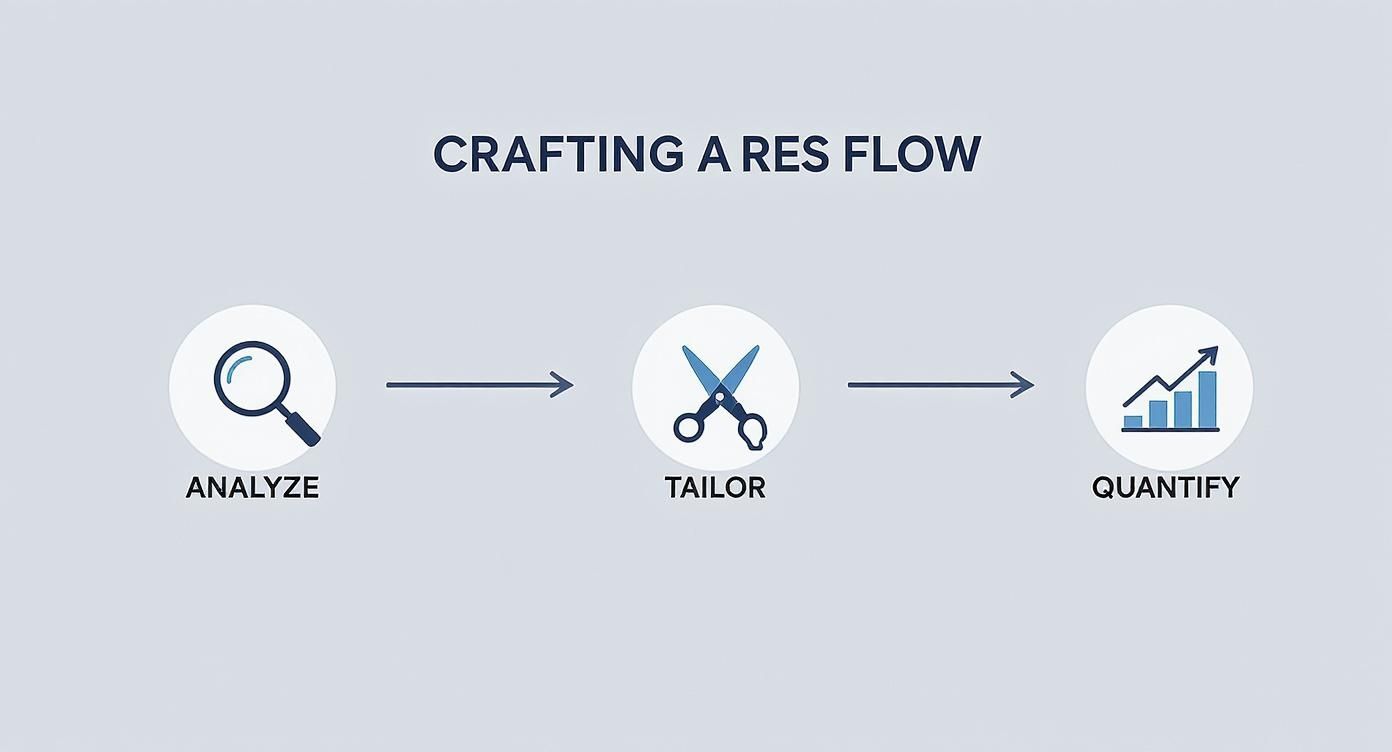
This simple process of analyzing, tailoring, and quantifying is the secret.
Quantify Your Achievements with Numbers
Many resumes list duties, not results. This is a mistake. The best resumes turn responsibilities into measurable achievements. Numbers make your claims stronger. They help a recruiter quickly see the value you can bring.
Key Takeaway: Vague statements describe your job duties. Specific data proves what you accomplished. Hiring managers want to see results.
Let’s change some common duties into powerful, quantified accomplishments:
-
Instead of: "Responsible for email marketing campaigns."
-
Try: "Grew the email subscriber list by 25% in six months by launching a targeted weekly newsletter, which drove a 15% increase in lead conversions."
-
Instead of: "Improved customer service processes."
-
Try: "Slashed average customer ticket resolution time from 48 hours to just 12 hours by rolling out a new streamlined workflow."
Do you see the difference? One is a job description. The other is a success story. A clean, professional template helps recruiters spot these wins easily.
Unlock Hidden Jobs Through Smart Networking
Only using public job boards is like fishing in a very crowded pond. The best jobs are often filled before they are ever advertised. This is the "hidden job market." You get access to it through people, not websites. Networking is not about collecting contacts. It is about building real relationships that lead to job offers.
Many people misunderstand networking. They think it is asking strangers for favors. It is much simpler. The goal is to connect with people in your field. You can learn from them and build trust. When a job opens up at their company, you might be the first person they think of.
A strong referral can move your resume to the top of the pile. Companies trust their employees' judgment.

Start With Who You Know
Your professional network is likely bigger than you think. You do not need to start by messaging CEOs. A better way is to start with people you already know. Then, you can build from there.
This method is less scary and more effective. A warm introduction from a mutual friend is much better than a cold email. Think about former coworkers, old classmates, and friends of friends. They can be great helpers in your job search.
Start by making a simple list. List people you know who work in your target industry or at companies you like. Send a friendly, low-pressure message just to say hello and catch up.
Leverage LinkedIn for Genuine Connections
LinkedIn is a powerful tool for networking. But you must use it the right way. Stop sending generic connection requests. Always write a personal message. Explain why you want to connect.
Your goal is to start a real conversation. Do not just add another number to your connections list.
- Find Common Ground: Look for shared connections, school groups, or similar interests on their profile. Mentioning this makes your message feel more personal.
- Engage with Their Content: Before you reach out, interact with their posts. A thoughtful comment shows you are interested in their work.
- Be Specific and Respectful: Say why you are reaching out. If you want advice, be direct but polite. Never ask for a job in your first message.
A study by the Society for Human Resource Management (SHRM) found that 88% of HR professionals think referrals are the best source for good hires. This shows how much a personal recommendation matters inside a company.
This data proves why networking is a key part of a successful job search. Employee referrals are a major way companies hire. They account for 30–40% of all hires. Also, candidates who get referred are 25–50% more likely to get a job offer. You can review global employment figures to learn more.
The Power of the Informational Interview
An informational interview is a casual chat. You talk with someone in a job or industry that interests you. It is not a job interview. It is a chance to get inside information, ask for advice, and build a relationship.
This is a great way to get a company's attention. You learn about the company culture. You find out about possible job openings. You also get your name in front of a key team member. Many professionals are happy to spend 15-20 minutes sharing their experience.
Here is a simple template you can use to ask for one:
Subject: Quick Question from a [Your Profession/Alumni]
"Hi [Name],
I saw your profile on LinkedIn. I was really impressed by your work in [Their Field/Project]. As a fellow [Your Profession], I’m looking at new opportunities in the [Industry] field.
Would you be open to a short 15-minute chat next week? I'd love to hear about your experience at [Their Company] and get your advice on entering the field.
Thanks,
[Your Name]"
This message works well. It is respectful of their time. It is specific about your request. It focuses on asking for advice, not a job. By building these real connections, you put yourself in a great position when the right job opens up.
Use Smart Technology to Accelerate Your Job Search
Applying to jobs one by one is very tiring. You scroll through job boards and fill out the same forms again and again. It is easy to burn out. There is a smarter way to find and apply for jobs that fit you well. This saves your time for more important tasks.
The secret is not just applying to more jobs. It is about applying to more of the right jobs, and doing it fast. Modern tools help you find opportunities that match your specific skills. This frees you from boring manual work. It lets you focus on networking and preparing for interviews. To learn more about how technology can help, visit our page on AI-powered job applications.
Work Smarter, Not Harder
Think of your job search as a marketing campaign. You need a precise strategy. Do not just send your resume out and hope for the best. Smart automation helps you be precise on a large scale.
This is not about sending hundreds of generic applications. It is about using tools that can read your resume. These tools understand your career story. They then find job postings that are a good match. This strategic method increases the relevance of the jobs you apply for. It leads to more callbacks and better offers.
The goal of automation is to handle the repetitive, low-value tasks of a job search. It frees up your time and energy for the human parts that technology cannot replace: building connections, telling your story in an interview, and negotiating your salary.
By letting technology do the heavy lifting, you can focus on the parts where you can truly shine.
Streamline Your Application Process
Managing many applications can get messy. You might forget which jobs you applied to or when. A spreadsheet can help, but special tools make it much easier.
These platforms are designed to organize your entire job search.
- Centralized Tracking: See all your applications in one place, with a clear status for each.
- Automated Suggestions: Get alerts for new jobs that fit your profile. You do not have to search job boards all day.
- Time Savings: Stop typing your work history and contact info for every single application.
This is what a central dashboard can look like. It is designed to manage your job search without all the manual work.
A system like this keeps you organized. It makes sure you never miss a follow-up. It lets you see your progress easily. Applications are found and sent for you, keeping you informed without the manual effort.
Platforms like Gainrep's AI Auto-Apply tool are built for this. It does more than send alerts. It finds jobs that match your resume and automatically applies for you. It can even help you tailor your cover letter with AI to better fit the job description. This automated, targeted approach means you can apply to hundreds of relevant jobs with little effort. This greatly boosts your chances of getting an interview.
Master Your Interviews and Secure the Offer
An interview invitation means your resume worked. Now, it is your turn to impress them. This is the final and most important step. You must convince the company that you are the right person for the job. Good preparation separates the candidates who get offers from those who do not.
Just showing up is not enough. You need to show real interest. Tell good stories about your skills. Prove you can solve their specific problems. A little research beforehand will build your confidence. It helps you make a great impression.

Research the Company and Role Thoroughly
Walking into an interview without knowing the company is a big red flag. Your goal is not just to repeat facts. You need to understand their mission, recent successes, and challenges. This helps you tailor your answers. It also helps you ask smart questions that show you are already thinking like a team member.
Spend time on their website. Look at the "About Us" and "News" sections. Check their LinkedIn page to see recent posts and learn about the people who work there.
- Understand Their Mission: What is the company trying to do? How does this job help them achieve it?
- Check Recent News: Did they just launch a new product or win an award? Mentioning a recent positive event shows you are paying attention.
- Know Their Culture: Do they seem formal or casual? Is the work style collaborative or independent? This helps you match your tone during the interview.
This research matters. A global survey found that 78% of interviewers said a candidate's preparation was a top-three factor in their hiring decision. Doing your homework directly improves your chances of getting an offer. You might also consider accent coaching for job interview preparation to improve your communication skills.
Structure Your Answers with the STAR Method
An interviewer might say, "Tell me about a time when…" This is a behavioral question. They want a real story, not a general answer. The best way to answer these questions is with the STAR method.
This simple structure helps you tell a clear and memorable story about your achievements. It stops you from rambling. It ensures you cover all the key points the interviewer wants to hear.
STAR Method Breakdown for Behavioral Questions
Using a structure like STAR makes your answers strong and easy to follow. Here is how it works.
| Component | What to Describe | Example Snippet |
|---|---|---|
| Situation | Set the scene. Briefly describe the context and the challenge. | "In my last job as a project manager, our team was behind schedule on a major client project…" |
| Task | Explain your specific role. What was the goal you had to achieve? | "…my task was to get the project back on track without losing quality or going over budget." |
| Action | Describe the steps you took to solve it. Focus on your own contributions. | "I set up a team meeting to re-prioritize tasks. I also automated some reporting to save time…" |
| Result | Share the outcome. What happened because of your actions? Use numbers to show your success. | "…As a result, we delivered the project two days ahead of the new deadline and got great feedback from the client." |
Practicing this method is very helpful. Candidates who use structured stories like STAR are 35–45% more likely to get an offer. For tech jobs, the numbers are even better. Those who did mock technical interviews were 2.3 times more likely to be hired by top companies.
Prepare for Common Questions and Ask Your Own
You cannot predict every question. But you can prepare for the most common ones. You should have strong, STAR-based answers ready. Be prepared for questions about teamwork, problem-solving, leadership, and handling failure.
Key Takeaway: The interview is a two-way street. Asking good questions shows you are interested. It also helps you decide if the company is a good fit for you.
The interviewer will almost always ask, "Do you have any questions for us?" Never say no. This is your chance to show you did your research. It shows you are thinking seriously about working there.
Great Questions to Ask:
- What does success look like in this role in the first 90 days?
- What are the biggest challenges the team is facing right now?
- Can you describe the team's culture and daily work style?
- What are the opportunities for professional growth here?
Mastering these three areas—deep research, good storytelling, and asking smart questions—will give you the confidence to prove you are the best candidate.
Navigate Job Offers and Negotiation
Getting a job offer is a big accomplishment. All your hard work has paid off. But do not celebrate just yet. This final step requires careful thought to make sure you get a role that is a great fit.
This is not just about the salary. It is about understanding the whole package. You need to know your value and handle the conversation professionally. A smart approach here can get you a better deal. It also sets a positive tone for your new job.
Look Beyond the Base Salary
It is easy to focus only on the salary. But that is just one piece of the puzzle. A great offer is a complete compensation package. You need to see the full value before you think about negotiating.
You have to look at the offer from all sides. Some benefits can add thousands of dollars in hidden value. This can make an offer with a slightly lower salary a much better choice.
- Bonuses and Stock Options: Is there a performance bonus? Does the company offer stock options? These can greatly increase your total yearly pay.
- Health and Wellness Benefits: Look at the details of the health, dental, and vision plans. See if they offer wellness money, gym memberships, or mental health support.
- Retirement Plans: Does the company offer a 401(k)? Do they match your contributions? That is free money you should not ignore.
- Paid Time Off: Do not forget the value of vacation days, sick leave, and holidays. A good PTO policy helps with work-life balance.
How to Negotiate a Better Offer
Negotiating can feel uncomfortable. But most companies expect it. A polite, well-reasoned talk is a normal part of hiring. It shows you are confident and know your value. The key is to be prepared and professional, not demanding.
Always start by saying how excited you are about the job and the company. You want them to know it is your top choice. After you set a positive tone, you can gently start a talk about compensation.
A respectful negotiation shows you are a confident professional. Base your request on the value you bring. Back it up with research on industry salaries for your role and experience.
Here is a simple script you can use for a phone call or email:
"Thank you so much for the offer! I am very excited about the opportunity to join the team and help with [Company's Goal]. Based on my research for similar roles in this area and my experience in [Your Key Skill], I was hoping we could discuss the base salary. Would you be open to a figure closer to [Your Target Salary]?"
This approach feels like a team effort, not a fight. It keeps the conversation positive. It focuses on finding a number that works for everyone.
Managing Multiple Offers
What happens when you get more than one offer? First, congratulations! That is a great problem to have. But it requires careful handling to keep your professional relationships strong. The first step is to compare the offers side-by-side.
Do not just look at the numbers. Think about your long-term career goals and what is important to you.
- Which job offers more room to grow and learn?
- Which company’s culture seems like a place you would enjoy?
- Does one offer better work-life balance or an easier commute?
After you decide, you can sometimes use another offer as leverage. Be careful how you do it. Be open and professional. Never make it seem like an ultimatum.
Gracefully Declining an Offer
After you accept a position, you must decline any other offers politely. The professional world is small. You never know when you will meet these people again. Always leave a good impression.
A short, polite email is all you need. Thank the hiring manager for their time and the offer. Let them know you have accepted another opportunity. Wish them luck in their search. This simple act keeps the door open for the future.
Common Questions About Getting Job Offers
A job search brings up many questions. Getting clear answers can make the process feel less confusing. Let's answer some of the most common questions.
How Many Jobs Should I Apply to Each Week?
There is no magic number. The "right" amount depends on your industry, experience level, and how much time you have. A better approach is quality over quantity.
Aiming for 10-15 high-quality, targeted applications a week is a good goal for most people. This pace allows you to customize your resume for each role. This is much more effective than sending out 100 generic resumes. One study found that tailoring your resume can increase your chances of getting an interview by 40%. This proves a targeted approach works better.
How Should I Handle Job Rejection?
Rejection is a normal part of the job search. It is important not to take it personally. A company might pass on you for many reasons that have nothing to do with your skills.
Maybe they had an internal candidate. Maybe the budget for the job was cut. Or maybe another applicant had a very specific skill they needed. You will never know the reason, so do not worry about it.
Here is a simple way to handle it and move on:
- Take a moment. It is okay to feel disappointed. Acknowledge the feeling, then let it go.
- Look for a lesson. Could you have answered an interview question better? Was your resume not a perfect fit for that role? Use it as feedback, not a failure.
- Look forward. Shift your focus back to the other opportunities. Thinking about a "no" stops you from getting to the next "yes."
Every rejection is one step closer to the right opportunity. It is not a measure of your worth. It just means that specific job was not the right fit at that time.
When you treat rejection as feedback, you protect your confidence and keep your momentum.
When Is the Right Time to Follow Up After an Interview?
Following up shows you are still interested and professional. But timing is important. If you follow up too soon, you might seem pushy. If you wait too long, they might think you are no longer interested.
A good rule is to send a thank-you note within 24 hours of the interview. It is a simple, polite action that keeps you on their mind. It also shows you want the job.
If they gave you a timeline, like "We'll be in touch by the end of next week," wait for it. If you have not heard back, it is fine to send a short follow-up email. Just wait a day or two after their deadline passes.
Keep your follow-up short and professional.
Here's a quick template:
"Hi [Interviewer's Name],
I hope you're having a great week. I'm just checking in on the status of the [Job Title] position I interviewed for on [Date].
I really enjoyed our conversation and remain very interested in the opportunity. Please let me know if there's any other information I can provide.
Best regards,
[Your Name]"
This approach keeps you on their radar without being annoying. It is a simple, professional message that shows you are still eager for the role.
Ready to stop scrolling and start getting interviews? Let Gainrep help. Our platform is your complete career tool. We offer tools to build a great resume and an AI that finds and applies to jobs for you. Stop wasting time on the grind and focus on what matters—acing the interview. Explore our AI Auto-Apply tool and see how it can speed up your job search today.
