Answering interview questions well is not a secret. It is about showing your value through clear stories. Do not just list your skills. Instead, show how you used those skills to get real results. You need to use specific examples from your past work. These examples prove you can solve the problems this employer has.
Building Your Foundation for Confident Answers
Facing an interviewer can feel intense. A solid game plan can change that. The key is not to memorize answers. You need to understand what the interviewer really wants to know. They want to know if you have the skills. They want to see if you will fit in with the team. And they want to know if you can deliver results.
True confidence in an interview comes from preparation. This means more than a quick search on the company before you go. It means looking at your own career. Find the powerful stories that show what you can do.
Understand the Interviewer's Goal
Before you can give a great answer, you must understand the question. Interviewers are not just making small talk. They are looking for specific things.
- Behavioral Questions ("Tell me about a time when…"): They ask this to predict how you will act. They look at what you have done in the past. They are looking for proof of problem-solving, teamwork, or leadership.
- Situational Questions ("What would you do if…"): This tests your judgment. They want to see how you think on your feet. It involves challenges you would see in the job.
- Technical Questions: This part is simple. They need to know if you have the specific skills to do the job.
Every question is an opportunity. It is your chance to connect your skills to the company's needs. Think of yourself as a consultant. Show the client exactly how you will solve their problems.
The Power of a Strong Resume
Your resume is like the script for the interview. A good resume does not just list jobs. It highlights your biggest wins. It sets the stage for the stories you will tell. Every bullet point should be a potential topic you can talk more about. To build a resume that stands out, you can explore tools at https://www.gainrep.com/resumes.
Having proof of your skills is a game-changer. With GainRep, you can feature verified endorsements from colleagues and managers right on your resume. This adds credibility before you say a word. It gives you solid proof you can use in your answers.
A strong resume is your opening statement. It is the first piece of evidence that tells the interviewer you are a serious candidate.
The job market is competitive. Employers get around 180 applicants for every hire. The applicant-to-interview ratio is only 3%. This means just three out of every 100 people who apply get a call. Once you get an interview, your odds are better. The interview-to-hire ratio is 27%. This gives you about a one-in-four chance. These numbers show why every answer must be strong.
Strong communication skills for interviews are the foundation for everything. Your ability to clearly explain your value will make you stand out. Understand the interviewer's goals. Come prepared with powerful examples. Back them up with a great resume. This sets you up to do more than just answer questions. You are ready to have a conversation that gets you hired.
Answering the Most Common Interview Questions
Every interview has classic questions. You know they are coming. Do not be fooled by how simple they sound. How you answer reveals your self-awareness. It shows your understanding of the role. It shows if you can connect your experience to the company's needs.
Your approach to these questions sets the tone. A great opening answer builds instant credibility. A vague, rehearsed answer can make the interview difficult.

Let's break down how to handle three of the most frequent questions. The goal is not to memorize a script. It is to use a flexible plan that lets your own story shine.
Tackling "Tell Me About Yourself"
This is not a request for your life story. Think of it as your professional summary. A great answer is short and relevant. It connects your past experience to the company's needs.
A simple way to structure this is the Present-Past-Future model.
- Present: Start with your current role. Talk about what you are doing now. Mention a key task or a big win. Make sure it relates to the job you want.
- Past: Briefly talk about the past experiences that prepared you. This shows the interviewer a clear career path. It connects the dots for them.
- Future: End by explaining why you are excited about this opportunity. Show them you have done your research. Show how you can contribute.
Here is an example for a Project Manager role:
"Right now, I'm a Project Coordinator at ABC Corp. I manage our software projects from start to finish. I recently led a team that launched a new feature 20% ahead of schedule. Before this, my time in a support role taught me the importance of clear communication. I also learned to manage what stakeholders expect. I'm excited about this Project Manager position. It is the perfect next step for me to take on more leadership. I believe my skills in agile methods could help your team deliver great products."
Responding to "Why Should We Hire You?"
This is your chance to sell yourself. You can share your most relevant qualifications. Prove you understand the company's problems. Avoid generic phrases like "I'm a hard worker." Instead, focus on the specific value you bring.
A great answer should include three key things:
- You have the right skills: Pick 2-3 key skills from the job description. Give a quick example of how you have used them.
- You fit the culture: Show you understand their work environment. Mention something you admire about their values. This proves you have done your research.
- You can solve their problems: Connect your abilities to a company goal. This shows you are not just looking for any job. You want a place to make a real impact.
The best answers prove you are not just a candidate looking for any job. You are the right candidate for this job. Show a deep understanding of the company's unique needs.
This is a great time to mention how endorsements from previous managers support your leadership skills. Professional recommendations add powerful proof that you can back up your claims. You can learn more about gathering strong recommendations on the GainRep platform.
Handling "What Are Your Greatest Weaknesses?"
This classic question tests your self-awareness and honesty. The worst things to do are claim you have no flaws or offer a fake weakness like "I'm a perfectionist." The right way is to be genuine. Show you are working on it. Explain how you manage it.
Frame your answer carefully with these steps:
- Admit a real weakness. Pick something that is not essential for the job. For example, if it is not a public-facing role, you could mention a past discomfort with public speaking.
- Explain the steps you are taking to improve. This is the most important part. It shows you are proactive and committed to growth. Mention a course you took or a technique you are practicing.
- End on a positive note. Briefly explain how this effort is helping. Or describe how you handle the weakness in a professional setting. This turns a possible negative into a story of personal growth.
Decoding Behavioral Questions with the STAR Method
Have you ever gotten a question that starts with, “Tell me about a time when…?” That is a behavioral question. The idea is simple. Your past actions are the best way to predict your future performance. Your job is to tell a real story. It should prove you have the skills they need.
The best way to structure these stories is the STAR method. It is a simple framework. It keeps your answer focused and interesting. It helps you hit all the key points without rambling. Think of it as a tool for showcasing what you can do.

This method is not just about being organized. It is about making your experiences memorable. The interviewer should remember them long after you have left.
Breaking Down Each Part of STAR
STAR is an acronym for the four parts of your story: Situation, Task, Action, and Result. Each part has a specific job.
S – Situation: First, set the scene. Briefly describe the context. What project were you on? Who was on your team? What was the challenge? Keep it short. Just give the interviewer a clear picture.
T – Task: Next, explain your responsibility. What specific goal did you need to achieve? This highlights your role and what was expected of you.
A – Action: This is the main part of your story. Describe the exact steps you took. Use "I" statements, even if it was a team effort. This is where you detail your process, decisions, and skills.
R – Result: Finally, share the outcome. This is where you prove your value. Use numbers, percentages, or concrete examples when you can. Quantifying your results makes your impact clear.
Selecting the Right Stories
Before you use the STAR method, you need a few powerful stories. A great place to start is your own resume. Every achievement you have listed can be a STAR story.
Think of a few examples that show you at your best. Think about times when you:
- Solved a difficult problem
- Led a team through a tough project
- Handled a conflict with a coworker or client
- Delivered great work under a tight deadline
- Made a process more efficient
Make sure your stories are relevant. Read the job description carefully. Pick examples that highlight the skills the employer is looking for.
Your career is a library of stories. The key is to select the right one and tell it in a way that shows you as the solution.
The hiring process takes time. The average time-to-hire is now 44 days. Candidates often go through an average of 5.5 interviews before getting an offer. With some people waiting months, making a strong impression in every conversation is vital. You can learn more about these hiring statistics and trends.
STAR Method in Action
Let’s see how this works with a classic question: "Tell me about a time you had to handle a difficult stakeholder."
A Weak Answer:
"I once had a difficult client. I just kept communicating with them until the project was done. It was tough, but we finished it."
This response is forgettable. It is vague and lacks detail. It does not show how you solved the problem. Now, let’s use the STAR method.
A Strong STAR Answer:
(S)ituation: "In my last role, we were launching a major ad campaign for a key client. The client’s head of sales was a main stakeholder. He was skeptical that our digital approach would generate good leads. This created tension."
(T)ask: "My task was to get his support. I needed to ensure the campaign moved forward smoothly. I had to convince him of the strategy's value and build trust."
(A)ction: "First, I scheduled a meeting to listen to his concerns. He felt the ads did not speak to his customers. I worked with our data analyst to pull reports from similar campaigns. I showed him evidence of a 30% lift in qualified leads. I also set up weekly check-in calls to share progress and get his feedback."
(R)esult: "He became one of our biggest supporters. The campaign was a success. It exceeded its lead generation goal by 15% in the first quarter. This secured our relationship with the client. It also led to them signing a larger contract for the next year."
See the difference? This answer is full of proof. It shows your communication, problem-solving, and data skills. It is a story that leaves a powerful impression.
Applying the STAR Method to Common Behavioral Questions
This table shows how to structure answers for different behavioral questions. It uses the STAR framework to help you prepare compelling stories.
| Behavioral Question Type | Situation (Context) | Task (Your Goal) | Action (What You Did) | Result (The Outcome) |
|---|---|---|---|---|
| Problem-Solving | Describe a significant challenge the team faced. | Explain the specific problem you had to solve. | Detail the steps you took to find the root cause and develop a solution. | Quantify the improvement, like a 20% reduction in errors or a $10,000 cost saving. |
| Teamwork/Collaboration | Set the scene of a project with different teams and competing goals. | Your goal was to align the teams and meet a tight deadline. | Describe how you improved communication, managed disagreements, and assigned roles. | The project was completed on time, under budget, and got positive feedback. |
| Leadership/Initiative | Explain a time when a project was failing or lacked direction. | You needed to step up and get the project back on track. | Outline how you motivated the team, changed the strategy, and got needed resources. | The team's morale improved, and the project met or exceeded its goals by 15%. |
| Handling Pressure/Deadlines | Describe a high-stakes project with a very short timeline. | Your goal was to deliver a high-quality result on time. | Explain how you prioritized tasks, delegated work, and managed your time. | You delivered the project on schedule and earned praise from leadership. |
| Adapting to Change | The company suddenly changed its strategy, affecting your team's project. | You had to change your team’s focus to align with the new goals. | Describe how you communicated the changes, retrained the team, and redesigned the work process. | Your team adapted successfully. It became one of the first to contribute to the new company plan. |
By preparing a few stories for each of these categories, you will be ready for any behavioral question.
Navigating Tricky Questions and Unexpected Scenarios
An interviewer can always ask a tough question. This can happen even if you have prepared for days. These questions are not meant to make you fail. They test how you think under pressure. They show your true character. Staying calm and having a plan is a skill itself.
The trick is to pause. Take a breath. Your goal is to give a thoughtful answer. Keep it professional and positive. How you handle these moments can tell an interviewer a lot about you.
Answering Questions About Salary Expectations
Talking about money can feel awkward. It is a normal part of the hiring process. If you answer poorly, you can price yourself out of the job. Or you could end up underpaid. Your goal is to keep the conversation going without selling yourself short.
Do your homework before the interview. Research the typical salary range for the role. Consider your city and experience level. This gives you a solid starting point. When the question comes up, it is often best to deflect it gently.
Try something like this:
"Right now, I'm most focused on finding the right fit for my skills. I'm confident we can agree on a fair number if we both feel this is a strong match. Could you share the salary range you have budgeted for this position?"
This approach shows you are collaborative. It puts the ball in their court. If they push for a number, give them your researched range, not a single figure. This leaves you room to negotiate later.
Explaining Your Reason for Leaving a Job
This question requires a careful answer. Never speak badly about a former employer, manager, or coworker. It reflects poorly on you. It seems unprofessional. Frame your answer around what you are moving toward. Do not focus on what you are running away from.
Here are a few positive ways to explain your departure:
- You're Looking for Growth: "I learned a lot in my last role. Now I am ready for a new challenge. I want a role that offers more room to grow in [mention a specific area]."
- The Company's Direction Shifted: "The company was making strategic changes. I felt it was the right time to find a role that aligns better with my long-term career goals."
- You're Seeking a Better Fit: "I am looking to join a more collaborative team. I want a place where I can make a bigger impact. Your company culture seems like an excellent match."
The goal is to present your decision as a smart career move. Keep it brief and positive. Keep the focus on the new opportunity.
Addressing Employment Gaps
Resume gaps are very common. The reason could be family, travel, education, or a layoff. The key is to address it with confidence. Do not try to hide it.
You must own the story. Briefly explain the reason for the gap. Then, quickly talk about what you did during that time. Mention how you stayed sharp or developed new skills.
For example:
"After my last contract ended, I took six months to care for a family member. During that time, I stayed current with industry trends. I completed online certifications in project management and digital marketing. I am excited to apply those skills here."
This turns a potential negative into a positive. It shows you are honest, responsible, and committed to your professional growth.
Tackling Brain Teasers and Hypothetical Questions
Questions like, "How many golf balls can fit in a school bus?" are not about the right answer. No one expects you to know. The interviewer wants to see how you think. They want to see how you approach a strange problem.
Walk them through your thought process:
- Clarify the Problem: Ask questions to understand the details. "Are we talking about a standard-sized school bus? Are the seats still inside?"
- State Your Assumptions: Be clear about the assumptions you are making. "I'll assume the bus is empty. I will estimate its dimensions to be X by Y by Z."
- Think Out Loud: Talk through your logic step-by-step. Show them how you break a big problem into smaller pieces.
- Give Your Estimate: End with your final answer. Remind them that the process is more important than the specific number.
Remember, how you get there is more important than what you find.
When You Simply Don't Know the Answer
It happens to everyone. You get a question, and your mind goes blank. The worst thing you can do is try to fake an answer.
Just be honest. It shows integrity and self-awareness. Interviewers respect that.
You could say something like this:
"That's a great question. I do not have direct experience with that specific software. However, I am a very fast learner. In my last role, I had to teach myself a new tool in under a week for a project. I am confident I could get up to speed just as quickly here."
This response admits the knowledge gap. It then pivots to one of your core strengths: your ability to learn. It turns a potential weakness into a story about your resourcefulness.
Going Beyond Words: Body Language and Follow-Up Strategy
How you answer questions is only part of the interview. Your body language, the questions you ask, and how you follow up matter too. These things can be more important than your prepared stories. It is what separates a good candidate from a memorable one.
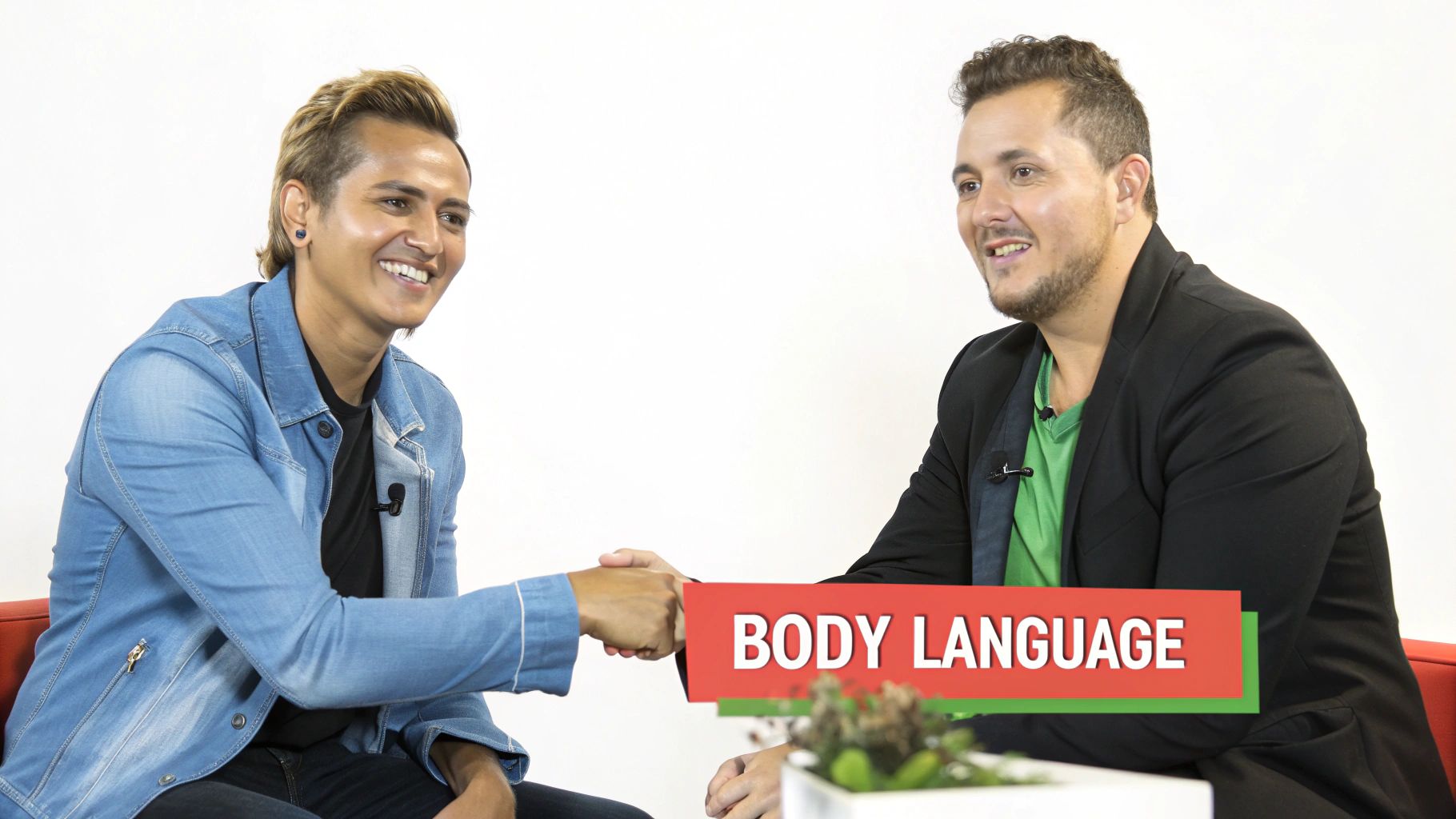
This part of the process shows you are not just capable. It shows you are a poised and interested professional. Let's focus on these details.
What Your Body Language Is Really Saying
Your physical presence sends signals before you speak. Small changes can show confidence. This is true for in-person and video calls.
Here is where to focus:
- Sit Up Straight: Good posture shows you are confident and attentive. Slouching can make you seem tired or uninterested.
- Keep Your Gestures Open: Crossing your arms is a defensive pose. Use your hands naturally when you talk. It makes you seem more approachable.
- Make Real Eye Contact: Steady eye contact builds trust. It shows you are actively listening. For a video interview, look directly into the camera.
These non-verbal cues make you look confident. They also make your words more believable.
Turning the Tables: The Questions You Ask
The interviewer will ask, "Do you have any questions for us?" The only wrong answer is "No." This is your best chance to show you have done your research. It is also a way to see if this is a place you want to work.
Asking smart questions turns the interview into a conversation.
Think of your questions as a final chance to interview the company. The information you get is just as important as the impression you leave.
Come prepared with a few questions. Ask about things you could not find online. Focus on the role, the team, and the company's future.
Try asking questions like these:
- "What does success in this role look like in the first 90 days?"
- "Can you tell me about the team I would be working with?"
- "What are the biggest challenges for the person in this position?"
- "What are the company’s main goals for the next year? How does this role help achieve them?"
Questions like these prove you are already thinking about how you can contribute.
Nailing the Post-Interview Follow-Up
The interview is not over when you leave. A quick, professional thank-you note is essential. It is a simple step that shows your interest. It keeps you on the hiring manager's mind. Learning how to write a thank you email is a critical final step.
Send it within 24 hours. Keep it short and personal.
Your email should do three things:
- Thank the interviewer for their time.
- Mention something specific you enjoyed discussing. This will remind them of your conversation.
- Briefly state your excitement for the role and why you are a great fit.
It is your last chance to make a positive impression. It shows a level of professionalism that can finalize the decision.
Your Interview Questions Answered
Even after preparing, a few questions can remain. This section is a quick list of common concerns for job seekers. Think of it as a final checklist before you enter the interview room.
Having this clarity is a big confidence booster. It lets you focus on the conversation instead of the small details.
How Should I Dress for an Interview?
The old rule to "always wear a suit" is outdated. The real goal is to look polished and professional. Your outfit should also fit the company's culture.
- Research the company culture. A tech startup has a different feel than a law firm. Check their website or social media to see how people dress.
- When in doubt, it is better to be slightly overdressed. Business casual is almost always a safe choice for an office role.
- Video interviews count. Treat it like an in-person meeting. Wear the same professional outfit. Looking sharp on camera shows you are taking it seriously.
Your appearance is your first impression. Make it a good one.
How Many Questions Should I Prepare to Ask?
You should have three to five thoughtful questions ready. Asking zero questions can make you seem uninterested. A long list can feel like you are grilling them.
This is your chance to show you are curious. Ask about the role, the team, and the company's future. It is also your opportunity to interview them. Make sure this job is the right move for you.
Asking good questions shows you are not just looking for a job. You are looking for a place to build a career. It changes the interview from an evaluation to a two-way conversation.
How Do I Handle a Panel Interview?
Sitting across from several interviewers can feel intimidating. The key is to connect with everyone in the room.
When one person asks a question, make eye contact with them as you start your answer. Then, as you speak, look at the other people on the panel. This simple trick makes everyone feel included. It shows you are comfortable in a group.
Also, try to get business cards or write down the names of everyone on the panel. You will need this to send personalized thank-you notes later.
What If the Interview Is Canceled or Rescheduled?
Things happen. If an interviewer needs to reschedule, be understanding. A gracious and flexible response can leave a great impression.
Reply quickly. Let them know you are still very interested. Offer a few new times that work for you. It shows you are professional and easy to work with.
Getting interviews is often the biggest challenge in a job search. If finding and applying to jobs is taking too much of your time, there are tools to help. Our service at https://www.gainrep.com/ai-auto-apply can streamline your job application process.
At Gainrep, we're focused on getting you more of those opportunities. Our AI Auto-Apply service finds jobs that are a great match for your resume and applies for you. This boosts your chances of landing more interviews. Take control of your job search and start sharpening your skills with our AI Auto-Apply tool.
