
Answering a difficult interview question is not about a perfect, rehearsed response. It is about understanding the real question behind the words. You need a strategy. This strategy helps turn tough moments into chances to show your skills. You can showcase your problem-solving, resilience, and personality.
Why Interviewers Ask Tough Questions in the First Place
Have you ever left an interview feeling like you failed a test? Those hard questions are not just to make you nervous. They are a tool for hiring managers. They want to see the real you behind your resume. They care more about how you think than a perfect answer.
Tricky questions reveal traits that a simple Q&A cannot. Hiring managers use them to test a few key areas.
What They Really Want to Know
When an interviewer asks a tough question, they are looking for something deeper. They usually want to measure:
- Problem-Solving Skills: How do you handle a complex challenge? Can you break it down and think on your feet?
- Self-Awareness: A question about your biggest failure is not a trap. It tests your humility. It also tests your ability to learn from mistakes.
- Resilience: How do you react when things go wrong? They want to see if you can stay calm and productive under pressure.
- Cultural Fit: Your answers give them a peek into how you might work with others. They see how you communicate and fit in with the team.
The Modern Interview Landscape
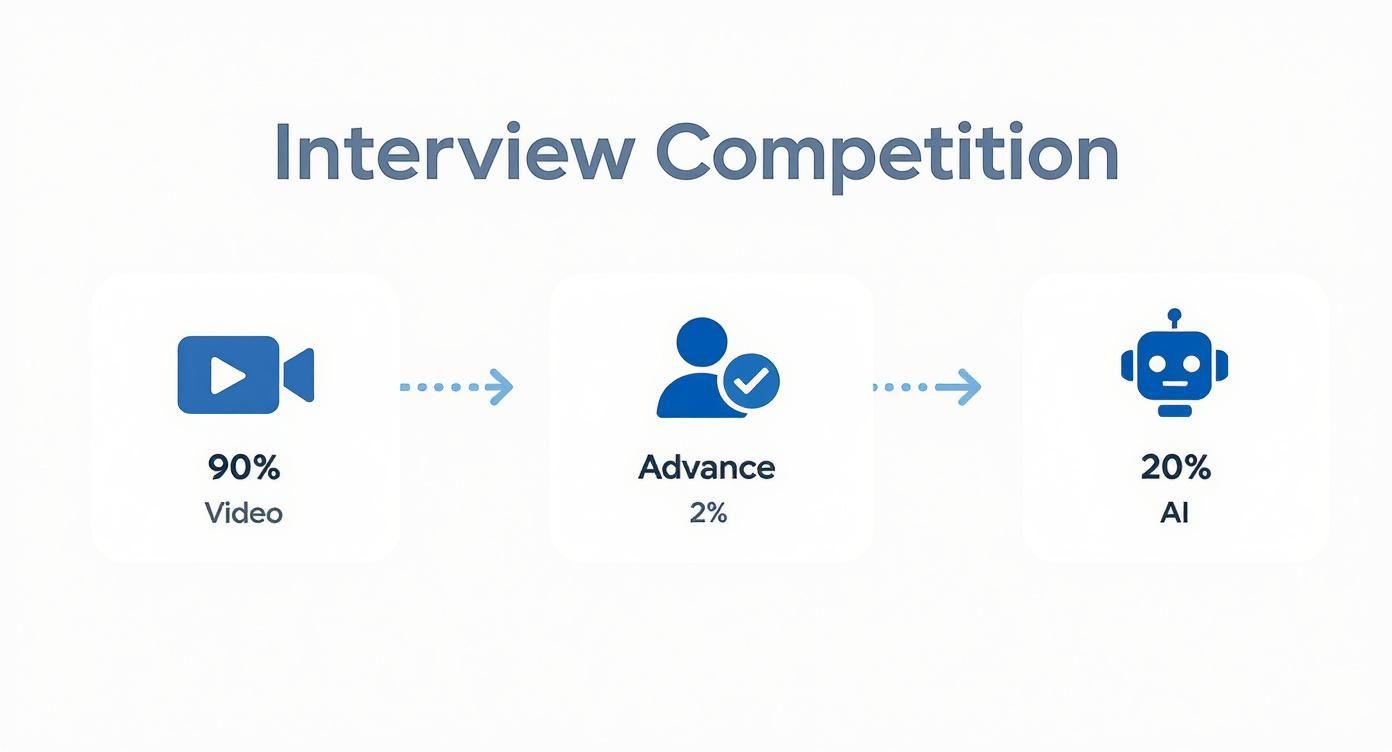
The hiring process is tougher than ever. Recent data shows that only about 2% of applicants get to the interview stage. The hiring process can last for five weeks. With that much competition, every single answer matters. You can look at more job interview statistics to see the changes.
This is what the modern interview process often looks like.
Technology is now a big part of the process.
About 90% of companies now use video for first interviews. Around 20% use artificial intelligence to help screen candidates. This means your ability to connect and communicate clearly is more important than ever. This is true even through a screen.
A great answer does more than just respond. It tells a story that shows your value. Seeing these questions as opportunities is the first step toward mastering the interview.
Understanding the "why" behind a tough question is your secret weapon. It helps you shift from defense to offense. You can proactively show the interviewer that you are the right person for the job.
Using the STAR Method to Tell a Great Story
When you get a behavioral question, your answer needs a solid structure. An example is, “Tell me about a time you failed.” Just talking about the problem is not enough. You need to tell a compelling story. The STAR method is the perfect framework for that. It turns a memory into a powerful example of your skills.
Think of it as your secret weapon for storytelling. STAR stands for Situation, Task, Action, and Result. It is a simple guide to give a complete, impactful answer. It covers all the key details an interviewer wants to hear. This approach keeps you from rambling. It helps you stay focused.
Breaking Down Each Part of STAR
To use this technique well, you must understand each part. Every part builds on the one before it. This creates a clean story that is easy for the interviewer to follow.
Here is a quick guide to using the STAR method. It shows you what to include in each section to build a powerful story.
STAR Method Breakdown
| Component | What to Include | Example Snippet |
|---|---|---|
| Situation | Set the stage. Briefly give the context of the story—the project, the challenge, the team. Keep it short. | "In my last role, we were facing a tight deadline on a major client project…" |
| Task | Explain your specific role and what you had to achieve. What was the goal? | "My task was to streamline the data analysis process to find the key issues causing delays…" |
| Action | This is where you shine. Detail the specific steps you took. Use "I" statements to show you own your work. | "I developed a new Python script to automate data sorting. I then led a training session for the team…" |
| Result | Share the outcome. What happened because of your actions? Use numbers and data to show your impact. | "As a result, we cut data processing time by 40%. We delivered the project three days ahead of schedule." |
The Result is the hero of your story. A great story without a clear outcome is just an anecdote. A story with a measurable result proves the value you bring.
Putting the STAR Method into Practice
Let's see how this works with a tough question: “Tell me about a time you handled a conflict with a coworker.”
Situation: "In my previous role as a project manager, a key designer and I had different ideas. We disagreed on the user interface for a new mobile app. The disagreement was causing delays and team friction."
Task: "My responsibility was to get the project back on track. I needed to find a way for us to work together. We had to deliver a high-quality product before our deadline."
Action: "First, I scheduled a one-on-one meeting with the designer. I wanted to understand their point of view. I listened to their concerns about user experience. Then, I shared my own data on client needs. We decided to create two mockups. We presented both to a small user-testing group to get feedback."
Result: "The user feedback was very clear. We ended up combining the best elements from both designs. Everyone was excited about the final version. We not only met our deadline, but the final app received a 15% higher user satisfaction score than our last one. It also improved how our team communicated on future projects."
This structured story is more effective than a vague answer. It proves you can handle conflict. It shows you make decisions based on data and deliver real results. The best way to prepare is to have a few STAR stories ready for different situations. It is one of the best ways to walk into an interview with confidence.
Tackling Common but Tricky Interview Questions
Certain questions appear in interviews often. Yet, they still confuse people. Questions like "What is your greatest weakness?" are not traps. They are a chance to show you are self-aware and honest. They show you care about professional growth. The key is to understand what the interviewer is really asking.
Instead of a generic answer, a strong response shows you have thought about your skills. You know where you can improve. This is your moment to go beyond your resume and show them who you are.

What Is Your Greatest Weakness
Everyone dreads this question. The interviewer wants to see that you know yourself and are working to get better. This is not the time for fake answers like "I'm a perfectionist" or "I work too hard." They have heard those before. They sound fake.
A better approach is simple and honest.
First, pick a real but manageable weakness. Choose something that will not disqualify you. For example, if you are applying for a project manager role, do not say you struggle with deadlines.
Next, and this is most important, show how you're actively working on it. This turns a negative into a story about your dedication to self-improvement.
Example Answer: "In the past, I sometimes got caught up in the small details of a project early on. This could slow me down. I realized it was impacting my efficiency. I started using time-blocking techniques. I set specific times for high-level planning versus detailed work. It has helped me keep my eye on the big picture while making sure the quality is still there."
This works because it is genuine. It shows you can identify a problem. It proves you are smart enough to find a solution.
Where Do You See Yourself in Five Years
With this question, the hiring manager measures your ambition. They want to see if your career goals match the company's direction. They want to know if you see this role as a meaningful step, not just a temporary job. Your answer needs to show real enthusiasm for the company and the position.
Crafting great answers is one of many essential interview skills that will get you hired.
Example Answer: "Over the next five years, I am focused on becoming an expert in this industry. I see this company as the perfect place to do that. My immediate goal is to master this role's duties. Then I want to start taking on more complex projects. I was drawn to your company's work in [mention a specific area]. I would be excited to contribute to that growth while developing my own leadership skills."
This response is effective because it connects your personal goals to the company's goals. It shows you plan to stick around and grow with them.
Why Should We Hire You
This is your elevator pitch. It is a direct invitation to sell yourself, so be confident. The interviewer is asking for a quick summary of why you are the best person for the job. Your mission is to connect your skills directly to the needs in the job description.
A powerful answer will hit three key points:
- You have the skills to do the work and deliver great results.
- You will be a good fit for the team and the company culture.
- You are a solid choice because you have a proven track record.
Example Answer: "The job description shows you need someone skilled in data analysis and client communication. In my last role, I managed a portfolio of 15 clients. I also built a new reporting system from scratch. That system boosted our client retention by 10%. I am a collaborative person who believes in sharing knowledge. I am confident I can start adding value right away."
Handling Brain Teasers and Technical Challenges
Some interviews feel like a pop quiz. When an interviewer asks a brain teaser or a technical question, they are not always looking for one perfect answer. They want to see how you think.
The real goal is to test your problem-solving process. How do you handle a new challenge? Can you stay calm and think logically on the spot? Showing a clear thought process is often more impressive than just giving the right answer.
Unpacking the Problem Out Loud
The worst thing you can do when faced with a tough question is sit in silence. Your first move should be to start talking. Explain how you are beginning to think about the problem.
Share your initial thoughts and the assumptions you are making. This gives the interviewer a look into your logic. It also allows them to give you a hint if you are on the wrong track.
- Clarify the Question: First, restate the problem in your own words. Ask questions to ensure you understand every detail. "So, just to confirm, you're asking…"
- Break It Down: Explain how you would break the problem into smaller pieces. This shows you have a methodical approach.
- Explore Solutions: Talk through a few potential solutions. Discuss the pros and cons of each idea as you go.
The interviewer is evaluating the journey, not just the destination. A well-reasoned attempt that is not quite right is better than a lucky guess or panicked silence.
Preparing for Technical Deep Dives
For technical roles, you must do the prep work. This is where your deep knowledge is tested. When facing complex technical challenges, specific resources can make a huge difference. For example, materials covering investment banking technical questions can be very helpful. What matters is your ability to apply theory to real-world situations.
One of the biggest hurdles is the statistics portion. This is especially true for data analyst or data scientist roles. At top companies, candidates often face 4-6 statistical questions in one round. These cover everything from hypothesis testing to regression analysis. They do not just want definitions. They expect you to apply these concepts to real business problems. For example, they might ask you to figure out if a new marketing campaign worked. This deep preparation often separates candidates who get offers from those who do not.
The core strategy is the same for any field. Communicate your thought process. Break the problem down logically. Connect your knowledge to real-world applications. This approach proves you are not just someone who can memorize facts. You are a capable problem-solver who can bring value to the team.
What to Do When You're Stumped
No matter how much you practice, a question might surprise you. It happens to everyone. That moment can feel like a disaster, but it is actually an opportunity.
How you react when you're caught off guard says more about you than a rehearsed answer. The key is to stay cool and be honest. Panicking or making up an answer on the spot will make things worse. Instead, see this as a chance to show the interviewer how you handle a curveball with grace.
Buy Yourself a Moment to Think
When a tough question hits, your first instinct should be to pause. Do not feel the need to fill the silence right away. Rushing into a half-formed answer is a common mistake. A few seconds of quiet is fine. It shows you are giving the question real thought.
Here are a few simple phrases to give your brain a second to catch up:
- "That's a great question. Let me think about that for a moment."
- Paraphrase the question back to them. "So, if I understand correctly, you're asking how I would handle a sudden drop in user engagement?"
- Ask for a quick clarification. "When you say 'major project failure,' are you thinking more about a missed deadline, or going over budget?"
These are not just stalling tactics. They are professional ways to make sure you understand the question. This helps you give the best possible response. It shows you are careful and deliberate—two traits every employer wants.
How to Say "I Don’t Know" with Confidence
Sometimes, you genuinely do not have the answer. That is perfectly okay. Honesty is always more impressive than trying to bluff. The trick is how you frame your response.
Your goal is not just to admit you do not know. It is to show them how you would figure it out.
This simple shift turns a knowledge gap into a demonstration of your resourcefulness and proactive mindset.
Let’s say you are asked about a specific software you have never used. A weak response is a flat, "I don't know that software." A strong response, on the other hand, pivots.
Example Pivot: "I haven't had the chance to work with that particular platform yet. However, I am a very quick learner. I have a lot of experience with similar tools like [mention a related software, like Asana or Trello]. Given the overlap, I am confident I could get up to speed on it quickly."
See the difference? You admit the gap but immediately build a bridge to what you do know. You have turned a potential negative into a positive. You highlighted your adaptability and eagerness to learn. You are showing them you are not just a fixed set of skills. You are someone who can grow and tackle new challenges.
Your Questions About Difficult Interviews Answered
Even with the best preparation, you will probably have a few questions. Let's cover the most common ones from job seekers. Think of this as your guide for smoothing out rough edges and walking in with confidence.
How Long Should My Answer Be?
The best length is usually between one and two minutes. That is enough time to tell a compelling story using a framework like STAR. You can do this without losing the interviewer's attention. A focused narrative always beats a long one.
For a complex technical or problem-solving question, it is okay to go longer. They expect you to walk them through your thought process. The key is to practice timing yourself on a few behavioral answers. You will quickly get a feel for the right rhythm.
Is It Okay to Ask for a Moment to Think?
Yes. It is not only okay, but it often makes you look more thoughtful. It is better to pause and structure your thoughts than to rush into a disorganized answer.
A simple, confident, "That's a great question. Let me take a second to think of the best example," is all you need. That short pause gives you the mental space to find the right story and frame it well.
What If I Can't Think of a Work Example?
Do not panic if a professional example does not come to mind. Your experience is not limited to your job. Think about other areas of your life where you have shown that skill.
- Academic projects are great for showing teamwork and problem-solving.
- Volunteer work can showcase leadership and initiative.
- Personal projects often highlight creativity and drive.
If you are truly drawing a blank, be honest and pivot. You could say, "I haven't been in that exact situation, but here's how I would approach it…" Then, talk them through your logic. This shows you can think on your feet, even without direct experience.
How Do I Recover If I Answered a Question Poorly?
We have all been there. Sometimes an answer does not come out right. The best place to fix this is in your thank-you email. You do not need to apologize or make a big deal of it.
Instead, add a quick, clarifying point. Say something like: "After reflecting on our conversation about [topic], I wanted to add one more thought…" Then, provide a short, clear version of the point you wish you had made. It shows you are self-aware and proactive. Use this for one key question only, not for a complete interview do-over.
Finding the right job takes time. The right tools can make it much easier. You can use technology to streamline your job search and focus on what matters—acing the interview. Discover how AI can find jobs that perfectly match your resume and automatically apply for you, landing you more interviews with less effort. Learn more about how to get a job faster with our AI Auto-Apply feature and take the next step in your career.
