Answering interview questions well is not about memorizing answers. It is about telling a great story. Your story should show off your skills. Using a simple framework like STAR can help. Your ability to give clear, thoughtful answers often decides if you get the job.
Why Your Interview Answers Define Your Success

Just getting an interview is a big step. The job market is tough. Your resume made it through the first filter. This means the company sees your potential. They think you might be the right person.
Now, things change. Your resume got you in the door. Your answers will get you the offer. This conversation is your chance to bring your experience to life. It is your chance to connect with the hiring manager.
The Interview Is Your Proving Ground
Every question an interviewer asks is to figure out three things:
- Can you do the job? They want proof of your skills and experience.
- Will you be happy and motivated here? They want to see your passion for the work.
- Will you fit in with the team? This is about your personality and how you work with others.
Your answers are the evidence. A strong answer does not just state a fact. It tells a story that proves your value. It is the difference between saying "I'm a team player" and describing a specific time you helped your team on a tough project.
Here is a quick guide to the core ideas behind every great interview answer. Keep these in mind as we go through different question types.
Quick Guide to Answering Any Interview Question
| Principle | Why It Works |
|---|---|
| Be Specific, Not Vague | Numbers and details make your accomplishments real and easy to remember. |
| Tell a Story | Stories create an emotional connection and are more persuasive than a list of facts. |
| Focus on Impact | Show how your actions made a difference to the team, project, or company. |
| Align with the Role | Directly connect your experience to what the company needs right now. |
| Stay Positive | Talk about challenges as learning opportunities, not complaints. |
This table is your quick reference guide. The goal is not just to answer the question. The goal is to show the interviewer you are the solution they need.
Standing Out in a Competitive Field
Competition for jobs is intense. A typical corporate job opening gets around 250 resumes. Only four to six of those people will get an interview. That means a tiny 2% of applicants get a chance to make their case in person. You can discover more insights about job interview statistics to see how selective the process is.
With odds like that, every moment of your interview is important. Your answers must be sharp, confident, and focused on the role. Good preparation is your biggest advantage.
A great interview answer does more than list what you have done. It builds a bridge between your accomplishments and the company's biggest challenges. It tells the interviewer, "I'm not just looking for a job—I'm looking for this job."
When you prepare strong, compelling answers, you are not just another qualified candidate. You are proving you are the best fit for the role and the team. This guide will show you how to structure your responses to make that happen.
Nailing the 'Tell Me About Yourself' Question

The first question, "Tell me about yourself," seems simple. It can make or break an interview. It is your first real chance to connect with the interviewer. It sets the tone for the rest of the conversation. But it is also very easy to answer poorly.
Many people make one of two mistakes. They either read their resume out loud or get too personal. The interviewer does not want your life story. They need a sharp, professional summary that connects your experience directly to the job.
The Present-Past-Future framework is a great tool. It is a simple but effective way to structure your answer. It turns your answer into a compelling story that is easy to follow.
Use the Present Past Future Framework
Think of this framework as a guide to creating a professional story in under two minutes. It keeps you focused on what is important. It makes sure your answer is relevant and powerful.
Here is how to break it down:
- Present: Start with your current role. What are you doing right now? Mention a key accomplishment to show your value immediately.
- Past: Briefly mention the past experiences that led you here. Connect the dots. How did the skills you learned in the past prepare you for this opportunity?
- Future: End by explaining why you are excited about this role and this company. Show them you have thought about your career path. Explain how this job is the next logical step.
This structure turns a list of jobs into a meaningful story. It shows exactly why you are the right person for this role, right now.
Think of your answer as a 90-second movie trailer for your career. It should be engaging, highlight the best parts, and make the interviewer want to know more.
Tailoring Your Answer for Different Roles
The Present-Past-Future model is flexible. You can adapt it to any industry, role, or experience level. Your main job is to pull specific details from your background that match the job description.
A software developer should focus on technical projects and results. A marketing manager might talk more about campaign numbers and team leadership.
Let's look at a few real-world examples.
Example for a Software Developer:
- Present: "Currently, I'm a Senior Software Developer at TechCorp. I lead the front-end development of our main customer app. I recently led a project to refactor our codebase, which improved app performance by 30%."
- Past: "Before TechCorp, I was at Innovate Solutions. I worked on a team that built a scalable microservices architecture from scratch. That experience taught me the importance of clean code and collaboration, which I see are priorities for this role."
- Future: "I was excited when I saw this position because it focuses on building new AI-driven features. That is an area I am passionate about. I am eager to bring my backend skills to a team that is pushing boundaries like yours."
Example for a Marketing Manager:
- Present: "Right now, I'm the Marketing Manager at BrightFunnel. I manage our entire digital marketing strategy. This past year, my team launched a new content marketing plan that increased our organic lead generation by 45%."
- Past: "I started my career as a social media coordinator. That gave me a great foundation in community building and brand voice. From there, I moved into a broader digital role where I worked with SEO, PPC, and email campaigns to drive growth."
- Future: "I want to bring my skills to a larger company like this one, where I can have a bigger impact. Your focus on international market expansion caught my eye. I believe my experience could help drive that forward."
Example for a Recent Graduate:
- Present: "I just graduated from State University with a degree in Communications. For my final year, I was a PR intern at a local agency. I helped with three major client campaigns, drafting press releases and media kits."
- Past: "Throughout college, I focused on digital media. I managed the university's official social media accounts and grew follower engagement by 20% in one semester. I also volunteered for a local nonprofit, which taught me to work under tight deadlines."
- Future: "I am eager to start my career in a role where I can learn from an experienced team. Your company's reputation for great mentorship is what drew me to apply. I am excited for the chance to contribute my energy and fresh ideas."
Answering Behavioral Questions with the STAR Method
Questions that start with "Tell me about a time when…" are behavioral questions. Hiring managers use them to see how you have handled real-world challenges. The idea is simple: your past performance predicts your future success.
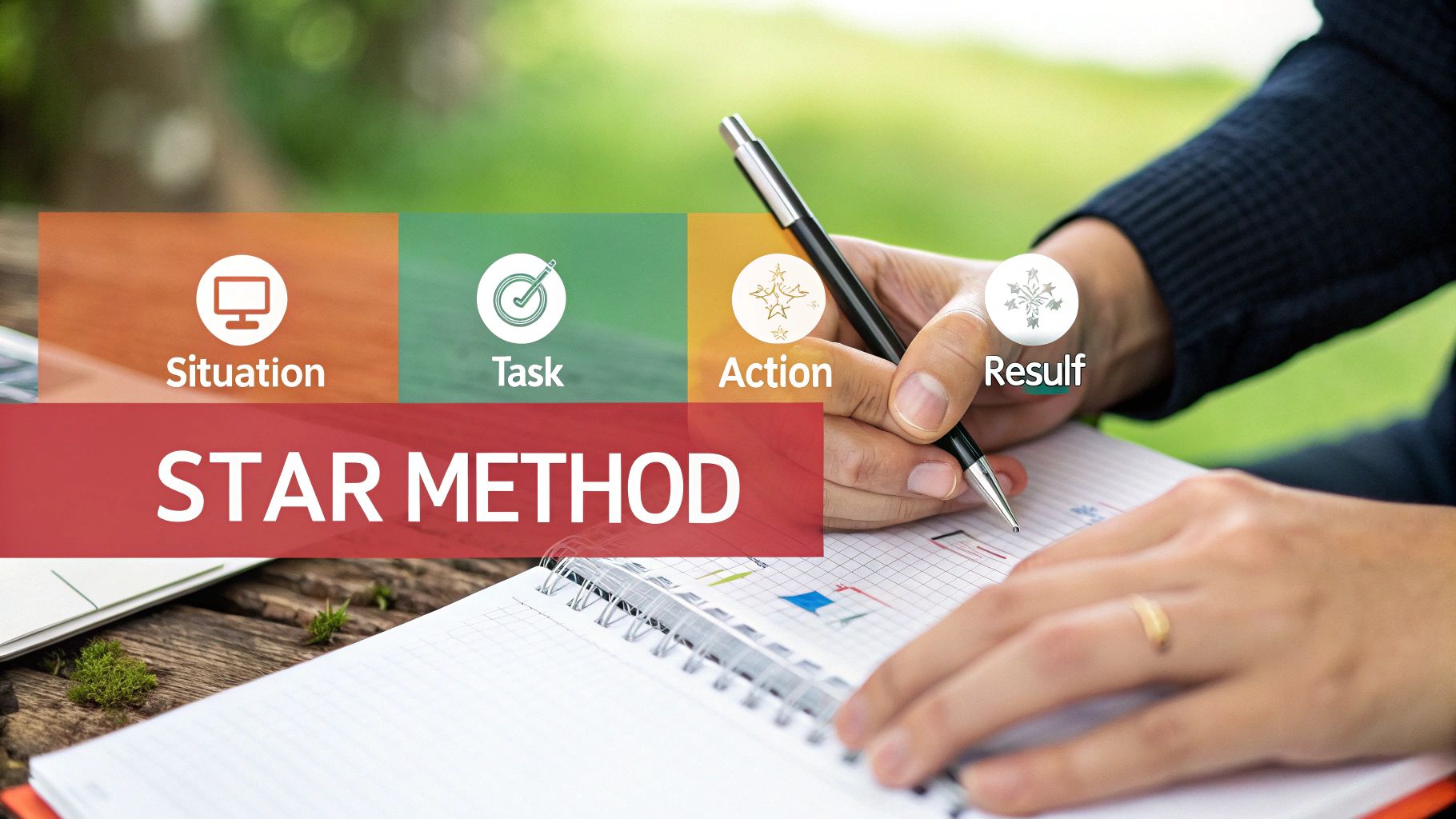
These questions force you to prove your skills with a real story. To make sure your stories are clear and compelling, you need a framework. The STAR method is the best way to structure your answers and make a lasting impression.
Companies are using structured interviews more often. It is a core strategy for reducing bias. 72% of companies use this approach globally. A framework like STAR helps you give the focused, evidence-based answers that modern interviewers look for. You can discover more insights about recruiting statistics to learn how hiring is changing.
Breaking Down the STAR Method
The STAR method turns a memory into a sharp, convincing story. It is a simple four-part structure that gives your answer a beginning, a middle, and a powerful end.
-
Situation: Briefly set the scene. What was the context? Where were you working and what was the challenge? Keep it short and to the point.
-
Task: What was your specific responsibility? What goal were you trying to achieve? This narrows the focus to your direct involvement.
-
Action: This is where you shine. Describe the exact steps you took. Use strong, active verbs. Even if it was a team effort, focus on what you did.
-
Result: What was the outcome? Always end with the positive impact of your actions. If you can, use numbers to quantify your success. A concrete result is more memorable.
STAR Method in Action: Handling a Conflict
Let's use a common question: "Describe a time you handled a conflict with a coworker." The interviewer wants to see if you can handle friction professionally.
Situation: "In my last role as a project manager, a key graphic designer and I had a major disagreement. We were two weeks from a client deadline. He wanted to use a new, untested design template that I felt was too risky for our timeline."
Task: "My job was to deliver the project on time and at high quality. I also needed to keep a strong working relationship with the designer. The goal was to find a solution that did not delay the project or harm our team dynamic."
Action: "I set up a one-on-one meeting to listen to him. Instead of just saying 'no,' I asked him to explain the benefits of the new template. He said it would be more efficient for future projects. I acknowledged his points, then explained my concerns about the immediate deadline. We agreed on a compromise: we would use the trusted template for this project to hit the deadline. I would schedule time for him to develop and test his new template for the next project."
Result: "We met the client's deadline with a final product they loved. The designer felt heard and respected. His new template was used two months later. It ended up cutting our design time on future projects by 15%."
This answer is specific, professional, and shows a good outcome. It paints a picture of a problem-solver.
Answering a Question About Failure
Another tough question is, "Tell me about a time you failed." This is not a trap. The interviewer wants to measure your self-awareness, honesty, and ability to learn from mistakes.
The goal is not to show you are perfect. It is to show you are resilient. Frame your failure as a learning experience that made you a better professional.
Here is how you could structure that answer using STAR:
- Situation: "As a marketing coordinator, I was in charge of our company's first webinar. I was a bit overconfident and underestimated the technical prep work needed."
- Task: "My goal was to host a smooth, professional event for 100+ attendees that would generate leads for our sales team."
- Action: "I did not schedule a full technical dry-run. I assumed the platform would work. Ten minutes before we went live, the main audio feed failed. I immediately posted an update in the chat, switched to our backup audio system, and extended the Q&A at the end to make up for the rocky start."
- Result: "We lost about 20% of the attendees in those first few minutes. But the feedback from those who stayed was very positive about the content. The biggest lesson for me was the need for a full rehearsal. I created a mandatory checklist for all live events, which the whole team now uses. Our last three webinars have run without any technical problems."
Handling Tough Interview Questions
Some interview questions feel like traps. They are designed to test your honesty, self-awareness, and professionalism under pressure.
Two of the toughest are "What's your greatest weakness?" and "What are your salary expectations?" A clumsy answer can raise red flags. But if you answer them right, you can look stronger. It all comes down to having a strategy.
Answering "What Is Your Greatest Weakness"
This question is not a request for a confession. The interviewer is not looking for a major flaw. They want to see if you are self-aware enough to see areas for improvement. They also want to know if you are proactive about your growth. This is why cliché answers like "I'm a perfectionist" fall flat. They sound fake.
Instead, think of a real, work-related weakness. The key is to choose something that is not essential for the job. Then, frame it as a learning opportunity.
A great answer has two parts:
- Acknowledge a real weakness: Be honest. Maybe you used to get lost in small details or felt nervous about public speaking.
- Show how you are fixing it: This is where you earn points. Talk about the specific actions you are taking to improve.
Here is how a Project Manager might answer:
"Early in my career, I would sometimes get too focused on the minor details of a project. This could make me lose sight of the bigger picture. I have been working on this by using time-blocking. I set aside specific times for high-level strategic thinking. It helps me balance immediate tasks with our overall project goals."
This works because it is honest and not a deal-breaker. It ends with a story about professional growth. It shows you are the kind of person who takes feedback and works to get better.
Discussing Your Salary Expectations
Talking about money can feel awkward. It does not have to be painful. The secret is to do your research before the interview. You should have a clear idea of the market rate for your role, in your city, with your experience.
When they ask, give a confident, well-researched range, not a single number. This gives you more room to negotiate later.
Your salary range needs to be based on data, not just a wish. Use resources like Glassdoor, Levels.fyi, and Payscale to see the industry standard.
Here is how to handle it:
- Do Your Research: Look up the average salary for the job title in your area. Adjust it based on your years of experience and special skills.
- Offer a Range: Provide a thoughtful range, usually about $10,000 wide. For example: "Based on my research for this type of role in this area, and considering my experience, I’m targeting a salary in the $75,000 to $85,000 range."
- Signal Flexibility: Follow up with something like, "Of course, I'm flexible and open to discussing the total compensation package, including benefits and any potential bonuses." This shows you are reasonable and focused on the whole opportunity.
What if it feels too early to talk numbers? You can gently avoid the question.
Try saying something like, "I would love to learn more about the role's specific responsibilities first to give you a more accurate figure. Would you be able to share the approved salary range for this position?"
This puts the ball back in their court. It shows your priority is finding the right fit, not just chasing a paycheck. It also protects your negotiating power.
Asking Smart Questions to the Interviewer
When the interviewer asks, "So, do you have any questions for me?" the only right answer is "Yes." This is not just a polite way to end the meeting. It is your moment to show you are not just looking for any job. You are trying to find out if this is the right job.
Asking thoughtful questions proves you are genuinely interested. It shows you have been thinking seriously about how you would fit in. They have been interviewing you. Now, it is your turn to interview them.
Questions That Show You Are a Top Candidate
The best questions are open-ended. They dig into the reality of the role, the team, and the company's direction. They show you are already thinking like a member of the team.
Here are a few powerful questions you can use:
- About the Role: "What does success look like here in the first 90 days? What are the key metrics this position will be judged on?"
- About the Team: "Could you tell me about the team I would be working with? What is the biggest challenge the team is facing right now?"
- About Company Culture: "What is your favorite part about working here? What kind of person succeeds in this environment?"
- About Growth: "What are the opportunities for professional development and growth for someone in this role?"
These questions go beyond the surface. They give you real insight into what you are signing up for. For more ideas, check out these Best Questions to Ask at the End of an Interview.
What You Should Avoid Asking
Knowing which questions to avoid is just as important as asking good ones. Some questions can make you seem unprepared or focused on the wrong things. Avoid anything you could have found with a quick Google search.
Questions to Skip:
- "So, what does your company do?" (This shows you did no preparation.)
- "What is the salary and benefits package?" (Save this for when you have an offer, unless they ask first.)
- "Can I work from home?" (Unless it is a remote role, wait until you have proven your value.)
- "When can I expect a promotion?" (This can sound demanding and impatient.)
The questions you ask show your priorities. Asking about the team's challenges shows you are a problem-solver. Asking only about vacation time suggests you are already thinking about being away from work.
The hiring process can be long. The average number of interviews per hire is around 5.5. Every interaction counts. Your questions are a final, lasting impression.
By preparing a few smart questions, you end the interview on a strong note. You leave them with the image of a thoughtful, engaged professional who is serious about making a contribution.
Your Interview Question Cheat Sheet
This section is your last-minute prep guide before the interview. It breaks down the most important frameworks into a simple format. The idea is not to memorize scripts. It is to have a quick refresher to calm your nerves.
A quick review here will help you feel prepared and confident. You will be ready to show them why you are the best person for the job.
Key Frameworks at a Glance
Do not try to memorize your answers word-for-word. It sounds robotic. Instead, focus on having a few solid structures to help you tell a compelling story. These frameworks give your answers a clear beginning, middle, and end.
- Present-Past-Future: This is perfect for "Tell me about yourself." Start with your current role (Present). Briefly connect it to past experiences (Past). Then explain why this job is the right next step for your future (Future).
- The STAR Method: This is your go-to for any behavioral question like "Tell me about a time when…" Structure your story by outlining the Situation, explaining your Task, detailing the Action you took, and finishing with the positive Result.
Your Pre-Interview Checklist
Real confidence comes from preparation. Run through this quick checklist the day before your interview.
- Re-read the job description. Identify the top 3 skills they want and have your best examples ready.
- Research the company and interviewer. Know the company's mission and any recent news. A quick look at your interviewer on LinkedIn is smart.
- Prep your stories. Outline at least 3 strong STAR examples that show your skills in leadership, problem-solving, and teamwork.
- Have your questions ready. Write down 3 to 5 thoughtful questions to ask them about the role, team, or company culture.
- Sort out your logistics. Confirm the interview time and location (or video link). Do a quick tech check. Get your outfit ready the night before.
Top Questions and Brief Strategies
You cannot read the interviewer's mind. But you can prepare for the most common questions. For a deeper dive, check out these actionable tips on the top 5 common interview questions and how to answer them.
An interview is a two-way conversation. It is as much about you deciding if the company is a good fit as it is about them assessing you. Ask the questions you need to make an informed decision.
Remember, the interview is just one piece of the puzzle. You need a powerful resume to get that far. You can build a professional document that stands out with a top-tier resume builder to make a great first impression.
Common Sticking Points in an Interview (and How to Handle Them)
Even with lots of preparation, some "what if" scenarios can be tricky. Interviews can be nerve-wracking. Knowing how to handle these moments before they happen is the best way to feel confident.
This is your guide to navigating awkward pauses and tough questions so you can stay professional.
What to Do When You Don't Have an Answer
We have all been there. The interviewer asks a question, and your mind goes blank. It happens to everyone. The worst thing you can do is try to make something up.
Instead, take a breath and be honest. Acknowledging you do not have direct experience is not a problem. What matters is what you do next. Show them how you think on your feet.
Walk them through how you would solve the problem. This is a chance to show your resourcefulness and problem-solving skills.
Here is how that might sound:
"That's a great question. I have not faced that exact scenario before. My first step would be to research industry best practices. I would then talk to a senior team member to get their perspective before planning a solution. I am a fast learner and confident I could get up to speed quickly to find the right way forward."
This turns a potential negative into a positive. You have just shown you are proactive, collaborative, and self-aware.
How Long Should Your Answers Be?
This is a common interview challenge. Talk for too long, and the interviewer will get bored. Give a one-word answer, and you seem unengaged.
A good rule of thumb is to aim for one to two minutes for most behavioral questions. That is the sweet spot. It is enough time to tell a compelling story using a framework like STAR without taking over the conversation.
This is not a strict rule. Some questions are simple and need only a short, direct answer. But for the big "tell me about a time when…" questions, the one-to-two-minute guideline is helpful.
The Right Way to Practice for an Interview
Practicing is not about memorizing a script. That makes you sound like a robot. The goal is to get comfortable with your own career stories so they flow naturally under pressure.
Here is how to make your practice sessions useful:
- Outline, Don't Script: Take your best career stories and jot down bullet points for each one using the STAR method. This keeps the key details fresh in your mind without locking you into rigid sentences.
- Talk it Out: You must say your answers out loud. An answer that sounds great in your head can sound awkward when spoken. Talking it through helps you find the right words and timing.
- Do a Full Mock Interview: This is very effective. Ask a friend or mentor to conduct a practice interview. Get their honest feedback on your answers, your energy, and your body language.
The more you practice, the more natural your stories will become.
Do I Really Need to Send a Thank You Note?
Yes. Always, yes. Think of it as a final, positive impression. It is a simple act of professionalism that reinforces your interest and keeps you on their mind.
Not sending one can be seen as a lack of interest. You do not want to fail at the final step. Make sure you send it within 24 hours of the interview.
Keep it short, sweet, and professional. Here is a simple checklist:
- A clear subject line: "Thank you – [Your Name] for [Job Title] Interview" works well.
- A genuine thank you: Acknowledge the interviewer by name and thank them for their time.
- A specific callback: Briefly mention something you discussed that you found interesting. It shows you were paying attention.
- A final sign-off: Reiterate your enthusiasm for the role.
And please, proofread it! A quick, polished thank you note is the perfect way to finish.
Feeling prepared is key to a successful job search. From building a standout resume to automating your applications, Gainrep provides the tools you need. Streamline your job hunt and land more interviews with our AI Auto-Apply feature, which finds and applies to jobs that are a perfect match for you.
