

Think of professional endorsements as strong reviews for your career. They are like good customer reviews. They don't just list your skills. They prove you can deliver on your promises. When a hiring manager sees that other respected professionals trust your work, it builds instant credibility.
What Are Professional Endorsements?
An endorsement is real proof of your skills. It makes your profile better than a resume alone. At its core, it’s social proof. It turns claims about your skills into verified strengths. These strengths are confirmed by managers, colleagues, or clients who have seen you work.
This is not a passive feature on your profile. It is a strategic tool for building your career. Each endorsement tells a small but powerful story about your professional value.
Why This Trust Is Important
Trust is the foundation of any professional relationship. Hiring managers or potential clients take a risk when they work with someone new. Endorsements are your secret weapon. They lower that risk by offering a third-party guarantee of your skills and reliability.
They show others that you are a known and respected person in your field. This can be the one thing that separates you from other candidates who look just as good on paper.
An endorsement serves as a public voucher for your skills, character, and achievements. It is someone credible putting their own reputation on the line to vouch for yours. This is a powerful statement in any professional context.
The importance of these reputation systems is growing in every industry. The global endorsement services market is now a key part of the professional world. Major financial firms and Fortune 1000 companies rely on its data. The market size and growth of these services show how important a verifiable reputation has become.
Endorsements are a tool you can use to manage your career. You can start building your reputation today on platforms made for this purpose. Learn how to manage your professional endorsements with GainRep.
The Different Types Of Endorsements Explained
Not all endorsements are the same. They come in different forms. Each one plays a unique role in shaping your professional reputation. If you understand the differences, you can be more strategic. You can collect the ones that will help your career the most.
Think of it this way. Some endorsements are like a quick thumbs-up. They are a simple nod that you know your stuff. Others are more like a detailed story. They are a personal account of your work ethic and achievements. Knowing when to use each type is key to building a profile that connects with recruiters or clients.
Key Categories of Professional Endorsements
Let's break down the most common types. Each one has its own weight and purpose.
- Skill Endorsements: You have seen these on platforms like LinkedIn. A colleague clicks a button to confirm you are good at "Project Management" or "Java." They are easy to get. Their real power comes from who gives them and how many you have.
- Written Recommendations or Testimonials: These are very valuable. Someone takes the time to write a few personal sentences about working with you. They are powerful because they offer specific examples of your skills. They also give a real look into your professional character.
- Client Reviews: These are essential if you are a freelancer or run your own business. A good client review on your portfolio is direct proof that you deliver results. It also shows you know how to keep clients happy.
The flowchart below shows how these all work together. It is a simple process that turns a basic "yes, they can do that" into career-building trust.
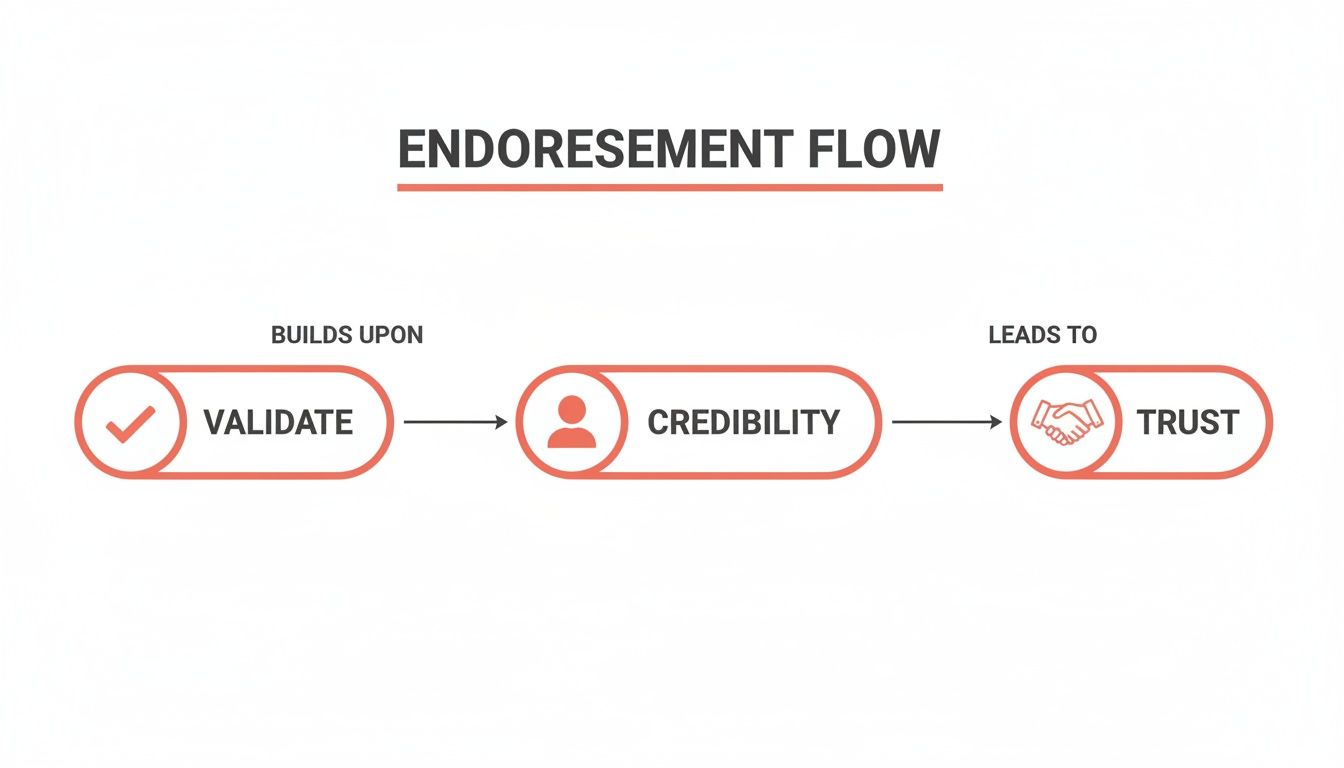
It all starts with validation. That validation builds credibility. Credibility creates the trust that makes hiring managers and clients feel confident in choosing you.
Comparing Types of Professional Endorsements
Let's put these side-by-side to make it clearer. This table breaks down the most common types of endorsements. It shows where they are used and their main benefit.
| Endorsement Type | Where It Is Used | Primary Benefit | Best For |
|---|---|---|---|
| Skill Endorsements | LinkedIn, Professional Profiles | Quick validation of specific abilities | Professionals wanting to highlight technical skills |
| Written Recommendations | LinkedIn, Personal Websites | Detailed, personal accounts of your work | Job seekers and career climbers |
| Client Testimonials | Freelance Platforms, Business Websites | Proof of delivering value to customers | Freelancers, consultants, and entrepreneurs |
| Peer Reviews | Internal Company Systems, Project Platforms | Shows collaborative strength and teamwork | Team members and corporate professionals |
The best approach is to not stick to one type. A healthy mix of quick skill checks and deeper, personal testimonials creates a full picture of you. This is how you build a profile that is impressive and trustworthy.
How To Ask For Endorsements Without Being Awkward
Asking someone to vouch for you can feel uncomfortable. It does not have to be. A simple, thoughtful approach can make the process easy. The secret is to be clear and respectful of their time. Be specific about what you are hoping for.

This guide explains who to ask, when to ask, and how to frame your request. With the right strategy, you can collect powerful endorsements that build your professional credibility.
Who Are The Right People To Ask
Choosing the right person is the most important step. You want endorsements from people who can speak directly to your skills. A generic "they were great" message is less valuable than a detailed one from a credible source.
Think about people who have seen you in action:
- Former Managers or Supervisors: They can talk about your performance, contributions, and professional growth.
- Key Clients or Customers: Their testimonials are strong proof of your ability to deliver results.
- Senior Colleagues or Mentors: They can vouch for your skills, collaboration, and industry knowledge.
- Project Collaborators: People you worked closely with on a successful project can highlight your specific contributions.
Avoid asking people who do not know your work well. The power of an endorsement comes from its authenticity. The relationship you have with the person giving it matters.
When Is The Best Time To Reach Out
Timing your request makes a big difference. People are more likely to write a thoughtful endorsement when your wins are fresh in their minds. You want to make it easy for them to remember specific examples of your great work.
Consider these perfect moments:
- Right After a Successful Project: When you have just delivered great results, your value is clear.
- During a Performance Review: If you get positive feedback, it is a natural time to ask your manager to share those thoughts as an endorsement.
- When Leaving a Job on Good Terms: Ask your manager and key colleagues for an endorsement as part of your exit.
- After a Client Praises Your Work: If a client emails to say thanks, reply and ask if they would mind turning that feedback into a testimonial.
Asking at these times makes the request feel natural. For a broader look at securing professional support, check out strategies on how to ask to be sponsored.
Simple Templates You Can Use
Make your request easy to fulfill. Give them context. State what you are asking for clearly. You can even offer a few starting points. This removes the guesswork for them.
Pro Tip: Always personalize your message. Mention a specific project you worked on together. Mention a skill you would love for them to highlight. This helps them write a more detailed and impactful endorsement.
Here is a simple template you can adapt for an email:
Subject: A quick favor
Hi [Name],
I hope you are doing well. I am updating my professional profiles. I was hoping you might write a brief endorsement about our time working on [Specific Project]. I really valued your insights on [Specific Skill].
There is no pressure at all, but any thoughts you could share would be greatly appreciated.
Thanks,
[Your Name]
Platforms built for career growth can help you manage and showcase your praise. You can build a powerful reputation by using tools designed to collect and display professional endorsements with GainRep.
Showcasing Your Endorsements For Maximum Impact
Getting a great endorsement is a huge win. But it will not help your career if nobody sees it. How you showcase that professional praise is as important as earning it. Your goal is to get your endorsements in front of the right people. These include hiring managers, potential clients, or future collaborators.
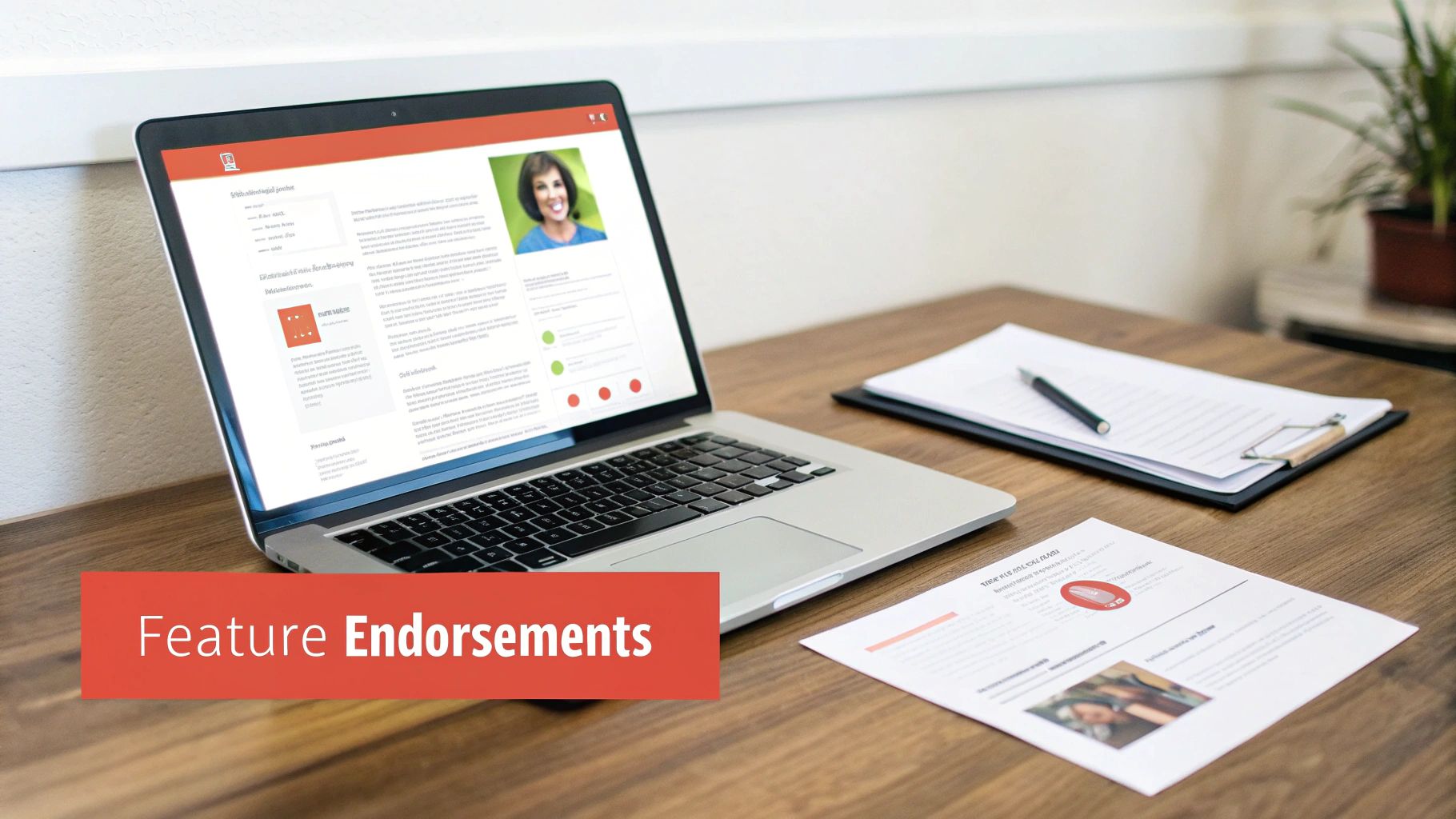
Think of your endorsements as your best marketing material. You would not hide your best work. Do not hide your best praise either. Let's look at the key places where your endorsements can shine.
Integrate Endorsements On Your LinkedIn Profile
LinkedIn is often the first place a professional contact will look you up. This makes it the perfect platform to display social proof. You can feature full written recommendations on your profile. This lets visitors read detailed accounts of your work directly from the source.
You do not have to stop there. Add quotes from your endorsements throughout your profile to build credibility:
- In your summary: Start your "About" section with a powerful quote from a former manager.
- In your experience descriptions: Put a short testimonial from a client under the relevant project description.
- In your featured section: Create a simple graphic with a compelling quote.
This approach adds validation into every part of your professional story. It makes it much more convincing.
Create A Dedicated Testimonials Page
If you have a personal website or online portfolio, you must have a testimonials page. This creates one place where anyone can see all your positive feedback. To make it more effective, group your endorsements by project or skill. This makes them easy to navigate.
Context is everything. An endorsement about your project management skills is most powerful next to a portfolio piece from that project. This direct link between praise and proof makes your claims undeniable.
For anyone looking for a job, this tactic is a game-changer. A simple website with your resume and a page of strong recommendations can set you apart.
Leverage Endorsements In Your Resume And Cover Letter
A full testimonial probably will not fit on your resume. But you can use short, impactful quotes to make a big impression. A one-sentence quote from a manager under a job description adds a powerful punch. For example, adding “'The most detail-oriented analyst I’ve ever worked with' – Jane Doe, Director of Analytics” provides instant proof of your skills.
You can also add a compelling quote into your cover letter. This will grab the reader's attention from the start. Your resume is a critical part of your job search. Adding real-world praise can make it more effective. If you need help creating a document that stands out, you might be interested in our guide to building professional resumes.
The market for professional development is growing fast. This includes the skill-building that leads to great endorsements. It was valued at USD 56.89 billion in 2025. It is expected to hit USD 72.89 billion by 2030. You can read the full research about professional development market trends.
Using Endorsements To Build Your Professional Brand
Endorsements are more than just a list of your skills. They are a powerful tool for building your professional brand. They shape how people in your industry see you. Think of your brand as the story people tell about you when you are not there.
Every endorsement you get adds a new chapter to that story. When different people all point to the same skill, it creates a theme. This repetition solidifies that part of your professional identity. It turns a skill you claim to have into a strength everyone recognizes.
Analyze Endorsements for Growth
You can also use endorsements as a mirror. Look at the ones you have received. What do they tell you? Analyzing them gives you a clear picture of which skills stand out to others. That feedback is very valuable.
This analysis shows you what your network sees as your biggest strengths. It can also reveal areas for growth. If you notice a skill you value is not getting much attention, it may be time to find projects where you can use that skill.
Your professional brand is not what you say it is. It is what your network confirms it to be. Endorsements are the proof that turns your claimed skills into validated strengths.
Connecting Endorsements to Career Management
This all ties directly into smart, long-term career management. You can be intentional about it. If you want a leadership role, start seeking endorsements that highlight your ability to mentor, manage, and inspire a team.
The market for professional services, which includes reputation management, was valued at USD 1,080,002 million in 2024. It is projected to more than double to USD 2,435,597 million by 2032. That huge growth shows how much professional credibility matters. You can read the full research on the professional services market.
Endorsements are not just a static collection of praise. They are a dynamic tool for building your brand. To make them work for you, you have to understand how to build your professional identity. This article on personal branding for consultants is a great place to start.
Your Guide To Common Endorsement Questions
Diving into professional endorsements can bring up a few questions. That is normal. Getting straight answers helps you build your reputation with more confidence. Let's answer some of the most common questions people have.
How Many Endorsements Do I Really Need?
Think quality, not quantity. The ideal number is around 3-5 powerful, detailed recommendations. They should come from people who matter, like a former boss or a key client.
For skill endorsements, it is better if they come from people known for that same skill. A few glowing endorsements that back up your career goals will always beat a long list of generic approvals.
Can I Ask Someone I Barely Know For An Endorsement?
I would not recommend it. The most powerful endorsements come from people who can truly speak to your skills.
A request from a near-stranger usually feels fake. At best, it gets ignored. At worst, you get a weak endorsement that does not help you. Stick to people who know your work. This includes colleagues, managers, clients, or anyone you have worked with closely.
You are in complete control of your professional story. On platforms like LinkedIn, you choose which written recommendations appear on your profile. If you get one you do not like, you can simply choose not to display it.
What If I Get An Endorsement I Don’t Like?
You are in charge of your professional brand. For skill endorsements that do not fit, you can easily manage your skills list to hide or reorder them. This is a great way to make sure your profile is an accurate reflection of where you are now and where you are going.
How Should I Thank Someone For An Endorsement?
A quick, personal thank you note is important. Send a message that shows you appreciate them taking the time to support you.
You can also offer to endorse them back. It is a simple gesture that strengthens your professional relationship. It shows you are a thoughtful and respectful professional.
Ready to start building a professional reputation that opens doors? With GainRep, you can easily request, manage, and showcase endorsements to create a powerful career brand. Start gathering the social proof you deserve at https://www.gainrep.com/.
