Let's get straight to the point: do you need a cover letter? The short answer is not always.
It was once a required part of any job application. The game has changed. Many recruiters now use software for the first review of candidates. A sharp resume and solid professional endorsements are more important. They help you get your foot in the door.
The Real Answer to the Cover Letter Question
Think of a cover letter as a special tool, not a required task. You use it in specific situations to get an advantage. You do not need one for every application you send. For many jobs, your time is better spent perfecting your resume. A good resume will pass the initial software scan.
Why has this changed? It is because of the high number of applications. A single remote job posting can get over 500 applications in 48 hours. Recruiters do not have time to read every word.
The numbers support this. One study showed that 47% of recruiters never read cover letters. Another 26% only look at one if they are unsure about a candidate. Just 17% see it as a required document. You can find more of these cover letter statistics on Skillhub.com.
Navigating the Modern Application Process
This data shows that Applicant Tracking Systems (ATS) are the new gatekeepers. These programs scan your resume for keywords and skills. A human sees your resume only after it passes this scan. If your resume does not match what the system seeks, your cover letter will not be seen.
Because of this, the decision to write one comes down to one question. Will it add real value, or will it be ignored? A strong resume, with strong professional recommendations, often says more in less time. Applying to jobs is a key part of the process, and using tools to automate it, like Gainrep's AI Auto-Apply, can make your search more effective.
This flowchart breaks down the decision-making process into a few simple steps.
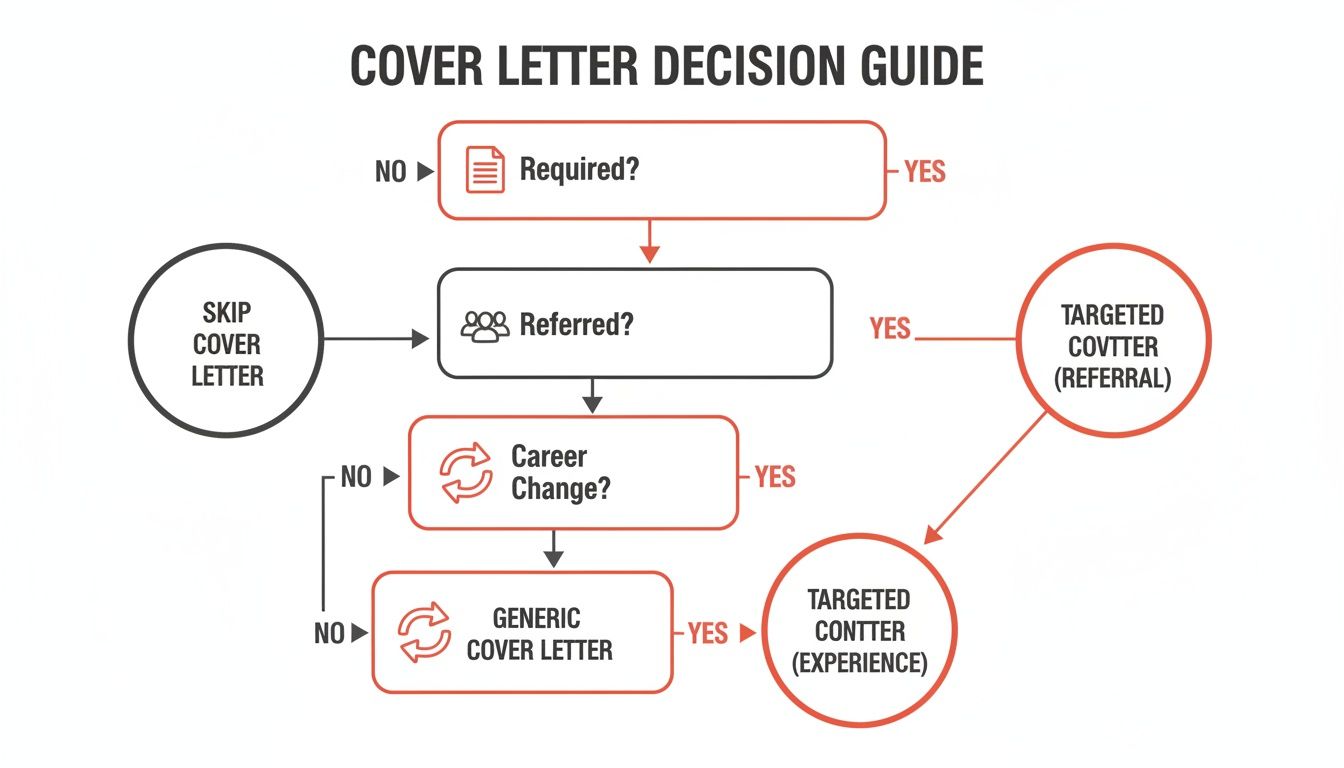
As you can see, the main factors are clear. Does the job require one? Do you have a referral? Are you making a big career change?
Here is a simple decision matrix. It can help you decide quickly.
Cover Letter Decision Matrix
Use this quick guide to decide whether to write a cover letter based on common job application scenarios.
| Scenario | Should You Write a Cover Letter? | Reasoning |
|---|---|---|
| The job posting says it's "required". | Yes, absolutely. | Your application will be incomplete without it. It will likely be rejected right away. |
| You have a referral or inside connection. | Yes, a brief one. | It is a great way to mention your connection. It also reinforces why they recommended you. |
| You're changing careers or industries. | Yes, it's highly recommended. | This is your chance to connect the dots. You can explain how your past experience is relevant. |
| The job posting says it's "optional". | Yes, if you have something compelling to add. | A well-written, short letter can make you stand out. A generic one is a waste of time. |
| You're applying through an "Easy Apply" button. | No, skip it. | These applications are for speed and volume. Focus on your resume and profile. |
| It's a high-volume role (e.g., retail, entry-level). | Probably not. | Recruiters are moving quickly. A strong resume is your best bet for getting noticed. |
It is about making a smart choice each time you apply.
Making a Strategic Choice
Your job search strategy should be about efficiency and impact. Spending hours on a cover letter that no one will read is a poor use of your energy. Instead, focus on the elements that recruiters and automated systems look at first.
A smarter approach is to build a great, all-purpose resume. Then, automate the most boring parts of the job hunt. Using a platform that helps you apply to multiple jobs can save you many hours. The Gainrep AI Auto-Apply feature does just that. It finds jobs that are a perfect match for you. It can also generate tailored application materials. This boosts your chances of getting an interview without all the manual work. This frees you up to focus on networking and preparing for interviews.
When a Cover Letter Is a Game Changer
For many online applications, the cover letter can feel old-fashioned. In some situations, it becomes your most powerful tool. Think of it as your secret weapon.
Imagine you are competing with another candidate. You both have nearly identical resumes. You have the same skills and experience. A strong cover letter can be the tie-breaker. It can get you the interview, not them. It is a big strategic advantage. This is true when qualifications seem equal on paper.
Of course, if your resume does not meet the basic job needs, no cover letter can save it. But when two candidates look equally good, the one with a good letter almost always wins. This is especially true if you are changing careers. It also applies when you apply to smaller companies. They tend to give cover letters more attention. You can read more about why cover letters are still worth writing at Staffing by Starboard.

Connecting the Dots for Career Changers
Your resume shows what you have done. Your cover letter explains why it matters for this new role. It is that simple.
Let's say you are moving from marketing to project management. Your resume alone might not make that connection clear to a busy recruiter. You need to connect the dots for them.
A cover letter is where you build that bridge. You can directly explain how managing campaign timelines and budgets is like overseeing project milestones. You get to tell a story that your resume, with its bullet points, cannot.
A cover letter is your chance to tell your career story. It helps a hiring manager understand your reason for applying. It shows how your skills are a perfect fit for their team.
Making an Impact at Small Companies
When you apply to a small or medium-sized business, your application is more likely to be read by a real person. This could be the hiring manager or even the owner. These people care about company culture. They want to find the right fit, not just a list of qualifications.
A cover letter shows them you are a real person. You can show genuine interest and a personality that fits their team.
These are the moments where a cover letter really helps:
- When you have a referral: Mentioning the person who referred you gives your application instant credibility. It explains the connection and supports the recommendation.
- To explain resume gaps: Life happens. A cover letter gives you a space to briefly and professionally address a period of unemployment. This turns a possible red flag into a non-issue.
- To show specific enthusiasm: You can mention a recent company achievement you admired. You can talk about a product you love. You can show how your personal values align with the company's mission. This proves you have done your research.
In these high-impact situations, writing a targeted letter is a smart move. It changes you from just another applicant into a memorable candidate they want to meet.
Knowing when to write a cover letter is a skill. But knowing when not to write one is a job search superpower. It saves you time and energy. You can use that energy on the parts of your application that really matter.
A cover letter can be your secret weapon in the right situation. Sometimes, it is just digital noise. The goal is to put your effort where it will make the biggest impact.
The clearest sign comes from the application form itself. If there is no specific field to upload a cover letter, do not try to force one in. This means the company does not want it and probably will not read it. Following their process shows you can follow directions. That is a good first impression.

High-Volume and Automated Applications
Big companies and major job boards use automated systems. These systems sort through thousands of applications. When you see an "Easy Apply" button, the goal is speed and efficiency. These systems are built to scan your resume for keywords. They are not designed to appreciate a well-written letter.
In these cases, your time is better spent polishing your resume.
Imagine you are a recruiter. You have 1,500 applications for one internship. Reading every cover letter is impossible. Your only job here is to make sure your resume stands out.
When you apply through a high-volume channel, your resume is your only marketing tool. A cover letter is an afterthought, if it is thought of at all. Focus on what gets seen first.
Specific Roles Where Skills Speak Louder
Not every job needs a detailed story about your professional journey. For certain roles, employers care more about your skills and availability than your long-term plan.
You can usually skip the cover letter for these types of jobs:
- Temporary or Contract Roles: These jobs fill a specific, short-term need. The hiring manager needs to know if you have the technical skills to start immediately.
- Most Tech and Engineering Jobs: Many tech recruiters care more about your project portfolio, your GitHub profile, and your coding challenge scores than a formal letter.
- Internal Promotions: If you are applying for a new role in your current company, your reputation already speaks for you. A formal letter is often unnecessary.
For these situations, a sharp resume is what gets you the interview. It should clearly list your skills and accomplishments. You can build a professional one quickly with online tools. The Gainrep resume builder is a great place to start. It offers templates designed to grab a recruiter's attention.
How to Write an Impactful Cover Letter Fast
When you decide a cover letter is the right move, it should not feel like writing a novel. A great cover letter is short, sharp, and to the point. The goal is to make a powerful impression in seconds. Do not just repeat everything from your resume.
You can write an impactful letter by using a simple three-paragraph structure. This approach shows you respect the hiring manager's time. It also makes it clear why you are the right person for the job. It is all about quality, not quantity.
The Three-Paragraph Power Structure
Think of your cover letter as a targeted sales pitch. You have about three paragraphs to convince the reader you are worth a closer look. Each part has a specific job.
The Hook (Opening Paragraph): Grab their attention immediately. Name the exact role you are applying for. Give one key reason you are a perfect fit. If you were referred by someone, mention it here.
The Proof (Body Paragraph): This is the core of your letter. Connect one or two of your biggest accomplishments to a problem the company is trying to solve. Use real numbers to show the impact you made.
The Close (Final Paragraph): End with confidence. Restate your excitement about the role. Give a clear call to action. Let them know you want to discuss how your skills will help their team.
This structure keeps your message focused and easy to scan. It also centers the conversation on their needs, not just your work history.
A Template for Quick Success
To make this even easier, here is a simple structure you can use. Just fill in the blanks with your own achievements. You can have a custom letter ready in minutes.
Quick Cover Letter Template
| Paragraph | Purpose | Example Snippet |
|---|---|---|
| 1. The Hook | Grab attention, state the role, and show immediate value. | "I am writing to express my keen interest in the [Job Title] position I found on [Platform]. My experience in [Your #1 Skill], which led to a 15% increase in sales at my last role, makes me confident I can help your team achieve its goals." |
| 2. The Proof | Connect your top achievement to the company's needs with data. | "At [Previous Company], I led the [Relevant Project], which ultimately cut project costs by 20%. I'm excited to bring my skills in [Skill from Job Description] to help [Company Name] tackle similar challenges." |
| 3. The Close | Reiterate interest and provide a clear call to action. | "Thank you for your time and consideration. I am eager to discuss how my background in [Your Field] can contribute to your company's success and am available for an interview at your earliest convenience." |
This direct approach works because it is tailored and focuses on results. For anyone applying to dozens of roles, automating this kind of personalization is a huge advantage. Services like Gainrep’s AI Auto-Apply can generate these kinds of personalized cover letters for each application. This frees you up to focus on the interview instead of writing.
Once you've crafted that impactful cover letter, if you're targeting international roles, knowing how to translate a document efficiently might be your next important step.
Powerful Alternatives to the Cover Letter
Making a great first impression does not always require a traditional cover letter. The modern job hunt has smarter, more effective ways to get a hiring manager’s attention. Instead of just telling them you are a great collaborator, you can show them with real proof from people you have worked with.
These alternatives are all about showing, not telling. They communicate your value directly. They often feel more genuine than a formal letter. A cover letter describes your skills. These methods put your skills on display, which is more convincing to a busy recruiter.
Showcase Your Skills with Endorsements
Think about it this way: a cover letter is your opinion of yourself. An endorsement is social proof. It is a credible, third-party testimonial. It validates the claims on your resume. When a former manager or colleague vouches for you, it speaks volumes.
This is where building a strong professional reputation online is valuable.
A strong endorsement from a respected colleague can be more convincing than three paragraphs you wrote about yourself. It provides concrete evidence of your collaborative skills, work ethic, and ability to deliver results.
Getting endorsements on platforms for professional reputation helps you build a portfolio of trust. For example, using a service like Gainrep lets you collect and feature recommendations. These act as powerful proof of your skills. This kind of verified feedback makes your application stand out. It is based on real-world performance, not just self-promotion.
Other High-Impact Alternatives
Beyond endorsements, there are other direct ways to connect without a full letter. These methods are quick, personal, and respect the recruiter's schedule.
Here are a few that work well:
- A Personalized Connection Note: When applying or reaching out to a recruiter, a short, personalized message is valuable. A couple of sentences explaining why you are excited about the role and highlighting a key achievement is often enough to get noticed.
- An Achievement-Focused Resume Summary: The professional summary at the top of your resume is very important. Avoid a generic objective. Use this space for a punchy, 2-3 sentence summary. Spotlight your biggest career wins with specific numbers. It is like a mini-cover letter that gets read every time.
These modern strategies shift the focus from what you say you can do to what you have proven you can do. This makes them powerful tools in your job search.
Building Your Career Strategy Beyond a Single Document
It is easy to get stuck on the cover letter debate. But that often misses the bigger picture. A successful job application is not about one magic document. It is a package deal. It includes a polished resume, a strong network, and a solid reputation. Focusing on just one piece can weaken your whole approach.
Think of your resume as the main event. It is the foundation of your career toolkit. It is the first thing recruiters and automated systems see. A poorly formatted or generic resume can get you rejected immediately. Nailing this document is your number one priority.
Your Resume Is the Star of the Show
Your resume needs to be clean, tailored, and full of your achievements. It should tell a powerful story about your value in just a few seconds. To achieve this, it helps to use professional designs that are proven to work. You can find fantastic templates and build a polished document with a tool like the Gainrep resume builder.
While your cover letter acts as your introduction, it's also smart to understand the different terms and powerful alternatives for your resume. Thinking outside of standard formats can help you tell your professional story in a more compelling way. The goal is to make your primary career document as strong as possible.
Automate and Focus Your Efforts
Building a complete career toolkit also means working smarter, not harder. Manually searching for jobs and tailoring every application takes a lot of time. Modern tools can handle that heavy lifting. This frees you up to focus on networking and preparing for interviews.
A great career strategy is built on efficiency. By automating the repetitive parts of your job search, you free up mental energy for high-impact activities like building connections and preparing for interviews.
For example, automated platforms can find and apply to roles that match your skills. The Gainrep AI Auto-Apply feature does exactly this. It finds ideal jobs and submits tailored applications for you.
When you build a complete strategy, the cover letter question becomes less critical. Your strategy should include a great resume, verified endorsements, and smart automation. Your qualifications and professional reputation will start to speak for themselves. This creates a much stronger impression than any single document ever could. This complete approach is what truly opens doors.
Got Questions About Cover Letters? We've Got Answers.
Even when you know the rules, some questions always come up. Let's clear up some of the most common ones. You can then apply with confidence.
How Long Should a Cover Letter Be Anyway?
Keep it short and punchy. A cover letter should never be more than one page.
The ideal length is between 250 and 400 words. That is typically three or four solid paragraphs. A hiring manager is more likely to read a brief, compelling letter than a long one. Do not just rehash your resume. It is all about quality over quantity here.
Seriously, Should I Write One if It Says "Optional"?
Yes—but only if you have something meaningful to say. Think of an optional cover letter as your secret weapon. It is a great chance to stand out from other candidates who skipped it.
Use this space to your advantage:
- Connecting the dots on a career change. Your resume shows what you did. A cover letter explains why it makes you perfect for this new role.
- Explaining a gap in your work history. Briefly and professionally, give context to that time off. It shows honesty and self-awareness.
- Showing you’re genuinely excited. Mention something specific you love about the company—a project, a value, a recent achievement. It proves you have done your research.
But if you are just planning to write a generic letter, do not bother. Your time is better spent polishing your resume.
Who on Earth Do I Address This Thing To?
Always try to find the hiring manager's name. A little research shows you are resourceful and interested. Check the company’s website. Or do a quick search on professional networking sites for the head of the department.
If you have searched and found nothing, do not worry. Just avoid old phrases like "To Whom It May Concern" or "Dear Sir or Madam."
Instead, use a modern, professional greeting:
- Dear Hiring Manager
- Dear [Department Name] Team
- Dear [Job Title] Search Committee
This keeps your letter feeling direct and professional, even without a specific name.
Building a great career story means using all the right tools. With Gainrep, you can build a resume that gets noticed and even put your job search on autopilot with our AI Auto-Apply feature, which finds and applies to your perfect-match jobs for you.
