


You should probably skip your full street address on your resume. It is an old practice from a different time. Sticking to a simple "City, State" is the new standard. This is often the smartest move for privacy and to avoid bias.
Why Your Resume Address Still Matters
Your address seems like a small detail. But it can shape a recruiter's first impression. The way companies hire has changed. No one mails you an interview invitation anymore. A full street address is just extra clutter.
This is not just about being paperless. It is about safety and fairness. Putting your exact location online can create privacy risks. It can also lead hiring managers to make assumptions based on your neighborhood or commute. They do not need this information.
Understanding Your Options
You have three main ways to handle your address. Each one has its place.
- Full Street Address: This is the old, traditional method. It is almost entirely outdated now.
- City, State, and ZIP Code: This is a good middle option. It shows you're local without giving away your exact block.
- City and State Only: This is the most common and recommended format. It gives recruiters what they need (your general location) and nothing more.
The modern approach is to be less specific. But old habits die hard. A 2025 analysis of over 12,000 resumes found that 86% of applicants still listed an address. You can discover more resume insights from the study. This shows how many job seekers have not caught up to the new norms.
To help you decide what is right for you, here is a quick comparison.
Resume Address Options at a Glance
This table breaks down the three main approaches. You can see the pros, cons, and best uses for each.
| Formatting Option | Best For | Pros | Cons |
|---|---|---|---|
| Full Address | Very specific local government or federal jobs that may require it. | Shows you meet strict location requirements. | Outdated; creates privacy risks and potential for bias. |
| City, State | Most local, in-office job applications. | Signals you are a local candidate; protects your privacy. | Might not be specific enough for hyper-local roles. |
| Omit Entirely | Fully remote jobs where location is irrelevant. | Maximizes privacy; useful for digital nomad roles. | Can confuse ATS or recruiters if a location is expected. |
The goal is to give the recruiter just enough information. You want them to see you as a good candidate without oversharing. For most jobs, "City, State" works perfectly.
Why a Full Address Is Becoming a Thing of the Past
Not long ago, your full street address was a required part of your resume. Companies used mail for everything, from interview invitations to job offers. But that world is gone. Today, communication is done through email, phone calls, and video interviews. This makes a full address an unnecessary and outdated piece of information.
Listing your full address can also create risks. Sharing your exact location can hurt your personal privacy. It also opens the door to potential bias. A recruiter might make quick judgments about you based on your neighborhood or commute time.
The Shift to Privacy and Relevance
A modern resume is all about making an impact. Every inch of the document is valuable space. Wasting it on an outdated address means less room for things that get you an interview.
Think about what you could use that space for instead:
- A direct link to your professional portfolio or GitHub.
- A short branding statement that summarizes your expertise.
- A link to a profile that shows your endorsements and verified skills.
Dropping your address lets you focus the reader's attention on what really matters. This includes your qualifications, your skills, and the value you offer. This is about updating your job application to match how companies hire today. A tool like GainRep's professional resume builder helps you create a clean, effective resume that highlights what is important.
The Remote Work Effect
The big shift to remote and hybrid work has sped up this change. The growing popularity of remote-first jobs is a huge reason the full address is disappearing from resumes. Your physical location is becoming less relevant for many roles.
When your physical location does not matter for the job, including a full street address only distracts from your qualifications. It is data without a purpose for remote roles.
The remote work trend changed the rules. Over 60% of US job postings in 2025 are expected to offer remote or hybrid options. This makes full home addresses on resumes almost obsolete. This trend grew after 2020, when the pandemic pushed 85% of office workers into remote setups. You can read more about these resume trends to see how much the job market has changed.
The bottom line is simple. If the job can be done from anywhere, your street address is not important.
How to Format Your Location for Any Job Type
Deciding what to put instead of your full address can be tricky. The best option depends on the job you want. The goal is to give just enough information to show you are a good geographic fit. You do this without sharing personal details.
This quick decision guide should make things clear.
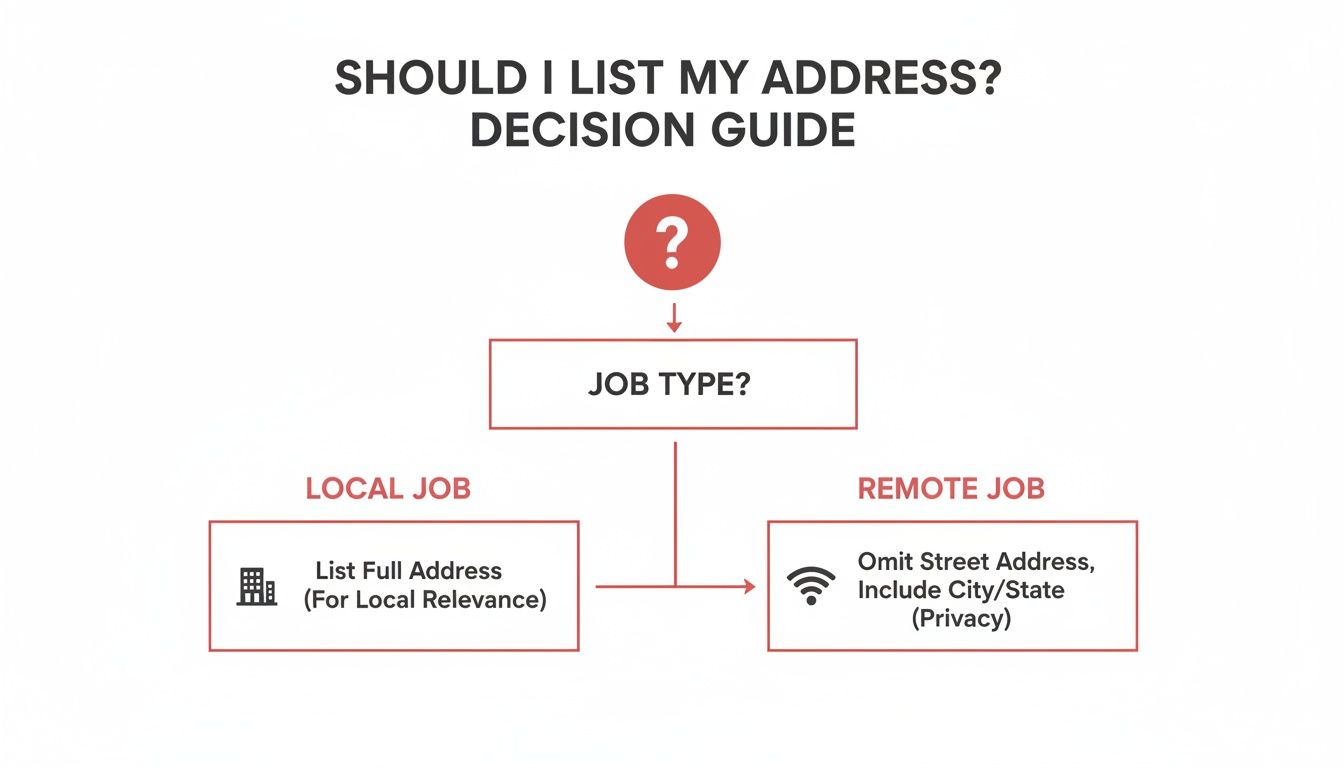
The main thing to consider is whether the job is tied to an office. Let's look at the best formats for each situation.
For Local, In-Office Jobs
When you apply for an on-site role, the employer has one main question: can you commute? Your full street address is not needed. You just need a simple format to confirm you are local.
This approach is the industry standard. It respects your privacy. It also gives the hiring manager exactly what they need to know.
Best Format: City, State
- Example 1: Atlanta, GA
- Example 2: San Francisco, CA
- Example 3: Miami, FL
This format is clean and professional. It tells the recruiter you are in the area without revealing your exact location.
For Fully Remote Jobs
If a job is 100% remote, your specific city often does not matter. However, state or country restrictions might matter for tax and legal reasons. In this case, you have a few options to show you are eligible.
For a remote role, your location's main purpose is to confirm your time zone and work eligibility. Anything more is usually clutter.
Best Formats:
- Option 1: State & Time Zone: This is a great choice for roles needing collaboration across different regions. (e.g., Colorado (Mountain Time Zone))
- Option 2: "Remote": If the job is open to applicants anywhere in the country, just listing "Remote" is a simple and effective choice.
- Option 3: City, State: This is also fine. It shows where you are based, which can be useful information for the employer.
For Candidates Planning to Relocate
What happens when the perfect job is in another state? You must be clear that you plan to move. If you are not, a recruiter will see your out-of-state location. They will likely reject your application, thinking you applied by mistake.
Be direct about it in your resume header.
Best Format: Relocating to [City, State]
- Example 1: Relocating to Denver, CO
- Example 2: Open to Relocation to the Pacific Northwest
- Example 3: Willing to Relocate to Austin, TX
This simple phrase removes any doubt about your plans. It helps keep your resume in the "yes" pile.
For International Applicants
If you are applying for a job in a different country, you must state your work status. Recruiters need to know immediately if you can legally work there. They also need to know if you will need sponsorship.
Best Format: City, State (Authorized to work in the [Country])
- Example 1: New York, NY (Authorized to work in the U.S. for any employer)
- Example 2: London, UK (Requires Tier 2 visa sponsorship)
Being clear saves everyone time.
You can easily use any of these formats with a professional template. Modern tools like the GainRep resume builder ensure your contact info is clear and professional for any job you apply for.
Getting Your Resume Past the Robots (ATS)
Many job seekers worry about one question. Will leaving my address off my resume cause it to be rejected by an Applicant Tracking System (ATS)? This is a common fear, but it is mostly a myth.
An ATS is like a bouncer for a club. It is not there to read your mail. It is there to check your name against the guest list. In this case, it scans for keywords and key qualifications.
Why City and State Are All You Need for ATS
Modern ATS software is smart. It knows how to find your phone number and email. When it looks for your location, it almost never needs your full street address.
Listing just your city and state is perfect. It gives the system the geographic info it needs. It can see if you are a local candidate. You do this without giving away private details. A simple "Boston, MA" actually makes the ATS's job easier.
If a company is hiring in Boston, the system looks for resumes that say "Boston, MA." Your full street address adds extra clutter. It does not help the software make a better match. A simple location tag is a much stronger signal.
An ATS is built to check for skills and keywords, not to map your commute. As long as you provide a general location, the system can confirm you are in the right geographic area.
Leaving your street address off is very unlikely to cause a problem. It is what most modern resume experts recommend. It keeps your resume focused on what really matters. For more on getting your resume seen, read this strategic guide on how to beat ATS systems.
Helping AI Job Tools Work for You
This simple approach is even more important if you use an AI-powered tool to apply for jobs. These systems need clear, standard info to find the best matches for you.
When you use a service like GainRep’s AI Auto-Apply, a clean location format helps the AI find the right local, hybrid, or remote jobs. It scans for roles in "Austin, TX," not a long street address. This lets the system quickly and accurately show your resume to hiring managers in your target city.
This kind of precision gets you more interviews with less work. You can learn more about GainRep's AI Auto-Apply tool.
Optimizing Your Header for Maximum Impact
Your resume header is prime real estate. It is the very first thing a recruiter sees. Wasting that space on an outdated street address is a big missed opportunity.
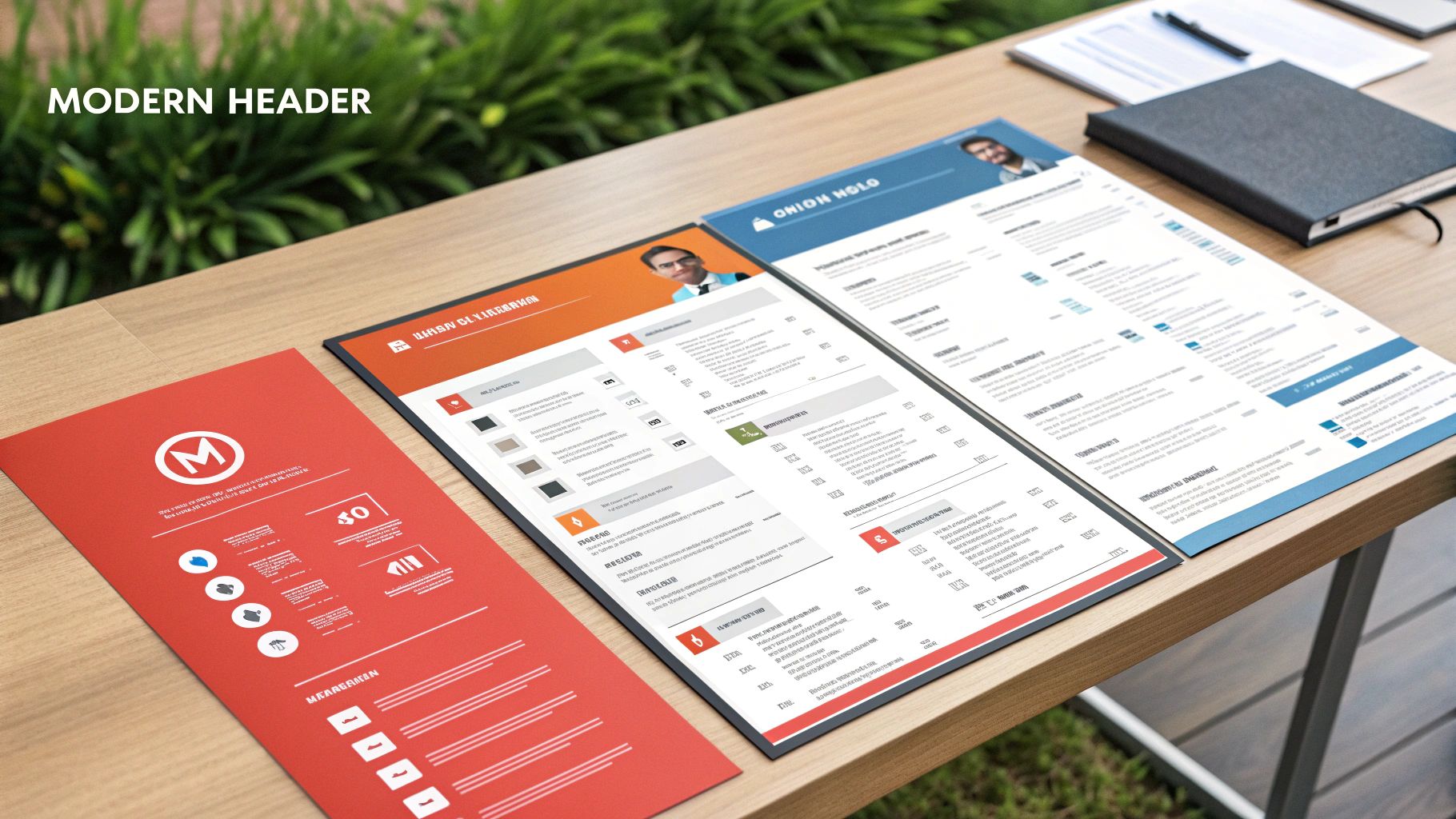
If you remove the address, what should you put there instead? A modern header is clean, professional, and full of value. It gives recruiters essential contact info. It also points them to places where they can see your capabilities.
Creating a Modern Resume Header
Your header needs to be easy to scan. It should contain only the most important information. Treat it like your professional business card at the top of your resume.
Your header should always include:
- Your Full Name: Make it the biggest, boldest text.
- Phone Number: Use a reliable number you will answer.
- Professional Email Address: Something like
firstname.lastname@email.comis best. - LinkedIn Profile URL: A polished LinkedIn profile is necessary in most industries today.
To make your resume stand out, go beyond the basics. Add elements that offer proof of your skills. This is where you can make a real impact.
A great resume header does not just say who you are; it shows what you can do. Linking to professional profiles invites recruiters to see proof of your abilities. This builds trust before they even read your experience.
Consider adding these powerful extras:
- A Portfolio or Personal Website Link: This is essential for creatives, developers, writers, and anyone with work to show.
- Your GainRep Profile Link: This is a great way to show your professional reputation with endorsements from colleagues. It offers instant social proof of your skills.
By swapping your physical address for a link to your endorsements, you change the focus. You shift it from where you live to what you have achieved. This simple change makes your resume much stronger. You can easily build a modern header using the professional templates in the GainRep resume builder.
Your resume header is your first chance to make an impression. Below is a checklist to ensure you include the right information to get a recruiter's attention.
Modern Resume Header Checklist
| Element | Status (Essential/Optional) | Purpose |
|---|---|---|
| Full Name | Essential | Clearly identifies you as the candidate. |
| Phone Number | Essential | Provides a direct line for recruiters to contact you. |
| Professional Email | Essential | Serves as the primary method for written communication. |
| LinkedIn Profile URL | Essential | Offers a detailed look at your professional network and history. |
| City, State | Optional | Shows your general location for local or hybrid roles. |
| Portfolio/Website | Optional | Provides direct proof of your skills and past work (crucial for some roles). |
| GainRep Profile | Optional | Offers social proof and verified endorsements of your abilities. |
A strong header sets the stage for the rest of your resume. Make sure it is working for you.
Common Questions About Your Address on a Resume
You may still have questions about your address on a resume. Let's clear up some common concerns with quick, simple answers.
Will I Get Rejected for Leaving My Address Off?
It is highly unlikely. Most modern companies and their Applicant Tracking Systems (ATS) do not require a full street address.
Recruiters are focused on your skills and experience, not your street name. Providing your city and state is enough to show them you are in the right area.
What if an Application Form Requires a Full Address?
If an online application has a mandatory field for your full address, fill it out. The company is requesting it for their internal records. In that specific case, it is safe and necessary to provide it.
Is It Okay to Use a P.O. Box?
I would advise against it. Using a P.O. Box can seem strange. It might look like you are trying to hide your real location. This could be a small red flag for a recruiter. It is better to stick with your city and state, or your physical address when an application asks for it.
Should My Cover Letter Include My Address?
The advice here is the same as for your resume. You do not need to include your full street address.
A simple, professional header with your name, phone, email, and city/state gives them everything they need. This keeps all your application documents looking consistent and modern.
Ready to create a resume that stands out? The GainRep resume builder offers professional templates. They help you optimize your header and focus on what truly matters—your skills and achievements.
