


Putting your accomplishments on your resume is the best way to show an employer your value. It proves your impact with real results. This changes your resume from a simple work history into a success story.
Why Accomplishments Are Better Than Responsibilities
Recruiters spend about seven seconds scanning a resume. They do not want a long list of your daily tasks. They want to see what you achieved.
Listing responsibilities only shows what you were supposed to do. Showing your accomplishments proves how well you did your job.
Think about this difference:
- Responsibility: "Managed social media accounts."
- Accomplishment: "Grew social media engagement by 45% in six months with a new content strategy."
The first example is vague. Anyone can write that. The second is specific and shows real value. It makes you look like a problem-solver who gets results.

From Task-Doer to Problem-Solver
Every job has a description. The best candidates show how they did more than the minimum. When you focus on accomplishments, you change your professional story. The focus shifts from your duties to your impact.
A resume with accomplishments sends a clear message. It says, "I deliver results that help the business." This shift separates a good resume from a great one.
This approach is more important than ever. Resumes that highlight achievements get more interview callbacks. Many companies use AI to screen applications. Numbers and clear results help you pass both AI filters and human reviewers.
Making Your Impact Visible
Building a resume that highlights your wins is essential. You should also focus on optimizing your LinkedIn profile. It acts as your online resume. A strong digital presence supports what you show on paper.
When you are ready to create your resume, the right tool helps. A good format makes your key successes stand out. A dedicated tool like Gainrep's professional resume builder can help you organize and highlight these achievements.
How to Find Your Accomplishments
Remembering your key accomplishments can be hard. Most people just see past work as a job. The daily routine does not always feel like a series of big achievements.
The secret is to focus on the impact you made. Look at your old roles with fresh eyes. Search for moments when you solved a problem or improved a process. This is not about bragging. It is about finding the real value you provided.
Brainstorming Your Biggest Wins
First, write down your ideas. Do not worry about perfect wording yet. This part is just for you. Get a notebook or open a document. Ask yourself questions about your old jobs.
Think about any time you made a real difference. Look at old performance reviews or project reports. Emails from managers praising your work are also great sources. These can remind you of your biggest contributions.
Use this simple checklist to start:
- What specific problem did I solve?
- How did I make something faster or cheaper?
- Did I save the company time or money? How?
- What was the scale of my work? (Number of customers, budget size, etc.)
- Did I train or mentor anyone? How did that help them?
- What were my biggest challenges, and how did I fix them?
An accomplishment does not need to be a huge project. Saving your team two hours every week by improving a report is a valuable achievement. It belongs on your resume.
Looking in the Right Places
Your memory is a good start. Hard evidence makes an accomplishment stronger. It is time to do some research.
Look for patterns in your work. Were you the expert for a certain type of problem? Did you often get praise for a specific skill? These are clues to your unique value. Finding these hidden successes gives you the proof you need for a resume that gets noticed.
Once you have your wins, a professional tool can help you format them. A resume builder helps structure them for maximum impact.
Using Numbers to Show Your Achievements
Words tell a hiring manager what you did. Numbers prove your impact. Quantifying your accomplishments makes your claims real and impressive.
Numbers are the language of business success. A vague statement like "Improved team efficiency" is not very strong. Compare it to "Slashed project completion time by 20% by launching a new workflow." The second one is memorable. It shows what you did and the scale of your success.
Finding these achievements is a simple process. You review your work, brainstorm your impact, and identify key results.
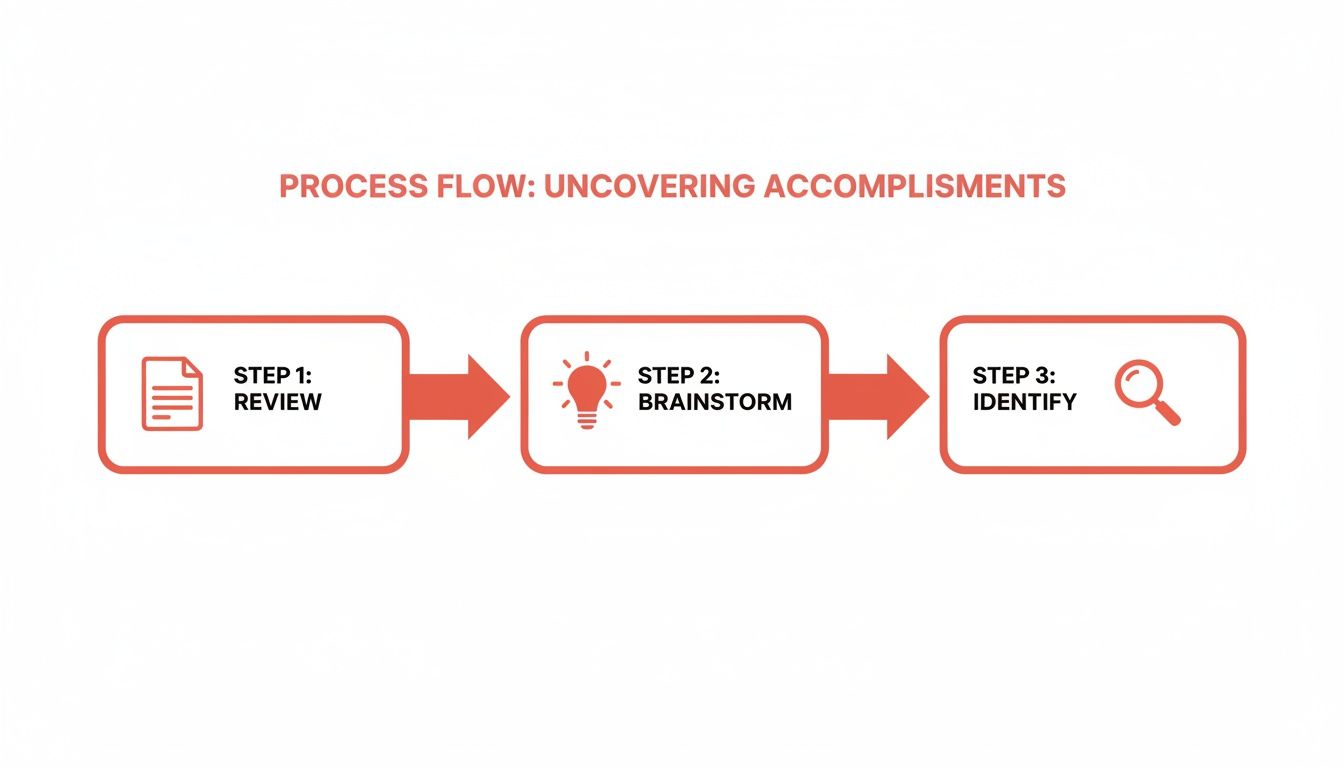
This simple flow turns daily tasks into a story of success.
Finding the Numbers in Your Work
You have numbers to share even if you were not in sales or finance. You just need to know where to look. Data can be about time saved, percentages improved, or the amount of work you handled.
Here are a few places to find metrics:
- Time: How much time did you save? Measure it in hours per week, days per project, or as a percentage.
- Money: Did you cut costs, increase revenue, or manage a budget? Use specific amounts or percentages.
- Scale: How many people did you train? How many customers did you help? How many projects did you manage? This shows your responsibility.
- Efficiency: Did you increase output or reduce errors? Percentages work well here.
These details are very important now. The resume writing service market report shows how critical these details have become. Employers want to see resumes that tell a powerful story with data. Metrics like "boosted team efficiency by 25%" help you get noticed.
See how a basic responsibility can become a strong, quantified accomplishment.
| Transforming Responsibilities into Quantified Accomplishments | |
|---|---|
| Generic Responsibility | Quantified Accomplishment |
| Managed the company's social media accounts. | Grew organic social media engagement by 45% across three platforms in six months. |
| Responsible for customer support emails. | Maintained a 98% customer satisfaction rating and reduced average response time by 30%. |
| Trained new employees on company software. | Onboarded 25+ new hires over one year, decreasing their ramp-up time by 15%. |
| Organized team files and documents. | Reorganized a 1,000+ file digital library, saving an estimated 5 hours per week for the team. |
The "after" column proves a result, not just a task. That is the goal.
What If You Do Not Have Exact Figures?
This is a common problem. Do not let it stop you. You do not need perfect data to quantify your work. Honest estimates are fine and still powerful.
Pro Tip: If you are stuck, look at old team goals or department reports. If your team was tasked with increasing customer retention by 10% and you were part of that, you can reference that metric.
For example, maybe you automated a weekly report. How long did it take before and after your change? If you cut the time from five hours to three, you saved two hours a week. That is a 40% reduction. You now have a powerful, quantified achievement.
After you gather your accomplishments, put them in a clean format. A tool like Gainrep's professional resume builder can help structure your achievements to grab a recruiter's attention.
How to Write Compelling Accomplishment Statements
You have identified your key achievements. Now you must write them in a way that gets a hiring manager's attention. A strong accomplishment statement tells a story of your impact.
The best statements use a simple formula. They combine a strong action with a measurable result. This structure makes your contributions clear.

The Action Plus Result Formula
Think of your accomplishments as Action + Quantifiable Result + Context. This is the key. It turns a simple duty into a small success story.
Let's break it down:
- Action Verb: Start every bullet point with a powerful verb. Words like "Orchestrated" or "Launched" are better than "was responsible for."
- Quantifiable Result: This is where you add numbers. Use percentages, dollar amounts, or time saved.
- Specific Context: Briefly explain the project or situation. This gives the hiring manager a clear picture.
This structure changes a vague task into a powerful accomplishment. You show how well you did your job and the positive result.
Choosing Powerful Action Verbs
The verb you choose sets the tone. Weak language can make an impressive achievement seem boring. Use verbs that show leadership, initiative, and results.
Here are some strong action verbs, grouped by skill.
Leadership and Management
- Orchestrated
- Directed
- Mentored
- Supervised
- Spearheaded
- Coordinated
Problem Solving and Efficiency
- Resolved
- Streamlined
- Optimized
- Redesigned
- Automated
- Standardized
These words make your resume more dynamic. They help readers and applicant tracking systems (ATS) quickly see your skills.
Putting It All Together With Examples
Let's see this formula in action. We will change a generic responsibility into a compelling statement.
Before:
"Responsible for handling customer emails."
After:
"Resolved (Action) 50+ customer inquiries daily (Context), maintaining a 98% customer satisfaction rating (Quantifiable Result)."
This type of data-driven content is key for job hunting. Automated tools that apply for jobs rely on strong content from your resume. For example, platforms like Gainrep's AI Auto-Apply feature can find and apply to jobs for you. Their success improves when your resume is full of well-crafted accomplishment statements.
Here is another example:
Before:
"Managed the department budget."
After:
"Reduced (Action) departmental operating expenses by 15% (Quantifiable Result) through strategic vendor negotiations and process improvements (Context)."
Once you master this formula, every bullet point on your resume will prove your worth.
Accomplishment Examples by Industry
Seeing real-world examples helps. You can use these as inspiration to build your own resume bullets.
Each example leads with a strong action verb and uses a hard number. They give enough context to show real impact. They showcase results, not just duties.
For Sales Professionals
Sales is a numbers game. Your resume must show that you can close deals and drive growth.
- Exceeded quarterly sales targets by an average of 18% through strategic client outreach.
- Expanded the client base in a new territory by 60% in three months by finding new leads.
- Recognized as the top sales representative for four straight quarters in a team of 25.
For Marketing Professionals
Marketing is about engagement, traffic, and conversions. Your resume should show how you grew an audience and helped the business.
- Grew organic website traffic by 45% in six months by executing a new SEO content strategy.
- Managed a monthly digital ad budget of $20,000, resulting in a 150% return on ad spend (ROAS).
- Increased the email subscriber list from 500 to 3,000 in one year, boosting lead generation by 25%.
Your goal is to provide clear evidence of your value. An accomplishment with a solid metric shows a hiring manager you get results.
For Software Development and IT Professionals
In tech, your value is in creating efficiency and solving problems. Your accomplishments should show how your skills improved a system or process.
- Refactored legacy code in the main application, decreasing server response time by 30%.
- Led the successful migration of the company’s database to a cloud platform, improving data retrieval speeds by 40%.
- Automated a manual reporting process, saving the data analytics team about 10 hours per week.
The resume building tool market is growing. Discover more insights about this growing market and how it is changing the job hunt. Job seekers need better ways to show their impact. A resume full of tailored, metric-driven accomplishments is what gets you noticed.
For Customer Service Professionals
Great customer service is about satisfaction and efficiency. Use metrics that prove you can handle issues and keep customers happy.
- Maintained a 97% customer satisfaction rating over a 24-month period.
- Managed 50+ customer inquiries daily, resolving issues 15% faster than the team average.
- Reduced customer churn by 10% by implementing a proactive follow-up system.
No matter your job, the secret is to turn your daily work into measurable outcomes. A resume filled with strong accomplishments on resume is your most powerful tool.
If you need help organizing your achievements, a tool like Gainrep's resume builder can make sure your best work stands out.
Common Questions About Resume Accomplishments
Writing about accomplishments can be tricky. Let's walk through some common problems so you can finish your resume.
What If I Do Not Have Exact Numbers?
This is a very common question. It should not stop you from showing your impact. You do not need a perfect spreadsheet to write a powerful accomplishment.
Honest, reasonable estimates are completely fine. Think it through. If you improved a process, how long did it take before versus after? That is a good starting point for an estimate.
The bottom line: The goal is to give a realistic sense of scale. A hiring manager will be more impressed by "Reduced weekly report generation time by approximately 40%" than "Made reporting more efficient."
How Do I Talk About Team Achievements?
Very few big wins happen alone. It is okay to include team wins on your resume. You just need to be clear about your role in that success.
Focus on action verbs that describe what you did. Did you coordinate the project? Analyze the data? Contribute a key piece of code? Frame the team's win through your specific actions.
For example, instead of a general "Our team increased sales by 20%," be more specific:
- Contributed to a 20% increase in team sales by developing new lead generation spreadsheets.
- Coordinated a team project that boosted quarterly sales by 20%, managing timelines and communication.
Are My Small Wins Worth Including?
Yes, absolutely. Do not think every bullet point has to be a groundbreaking achievement. Your smaller wins tell a powerful story about your work ethic.
Did you create a checklist that cut down on errors? Did you automate a task that saved your team a few hours each week? These might feel small, but they show an employer that you look for ways to make things better. That is very valuable.
Some jobs might require professional resume translation services to ensure your accomplishments have the same impact in any language.
Crafting a resume that reflects your value is the first step. At Gainrep, we help with what comes next. Our AI Auto-Apply feature takes your resume, finds matching jobs, and applies for you automatically. Start your job search with Gainrep today.
