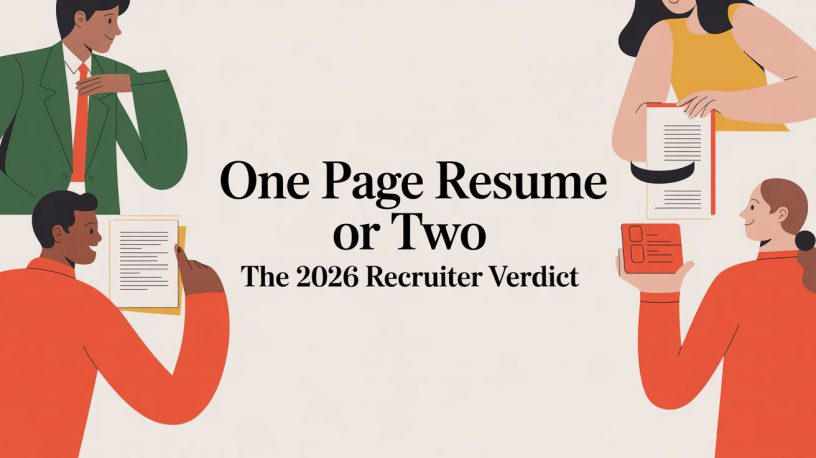

The "one-page resume" was once a firm rule. Job seekers were told to trim and cut every detail onto a single page. Does that rule still make sense for everyone? No.
The best resume length is not about an old rule. It is about matching your experience to the story you need to tell.
The Resume Length Debate One Page or Two
So, how do you choose? A good rule is to let your years of experience be your guide. If you have less than 10 years of experience, one page is usually enough. It can show your most important work. For those with longer careers, a two-page resume is becoming the new standard.
This is not a strict law. It is a great starting point. It helps you be brief while showing your true value.
This decision tree shows the basic idea.

It really depends on where you are in your career. The more you have done, the more space you have earned to talk about it.
Why Recruiter Preferences Have Shifted
Here is something that might surprise you. Recruiters are moving on from the one-page rule. A 2026 survey found that 68.6% of recruiters now prefer two-page resumes. Only 21.6% still think the one-page format is ideal.
This means a two-page resume is often what hiring managers expect from seasoned professionals. It gives you room to build a strong career story. You can show your progress and detail your biggest wins without sacrificing readability.
Use this quick guide to see which length fits your professional profile.
Resume Length at a Glance Which Is Right for You
Use this table to quickly find the ideal resume length for you.
| Experience Level | Recommended Length | Primary Focus |
|---|---|---|
| 0-10 Years of Experience | One Page | Highlighting key skills, education, and top achievements. |
| 10+ Years of Experience | Two Pages | Showcasing career progression, leadership, and expertise. |
| Academic or Federal Roles | Two+ Pages | Providing a detailed history of publications and projects. |
Deciding on the right length is the first step. The next is filling the page with content that gets attention. To get started, you can craft a perfectly formatted resume for any length. Learn more about how to create your ideal resume with our builder.
When a One Page Resume Is Your Strongest Asset
A one-page resume is a smart move. It tells a hiring manager you are focused. It shows you know what is important and you do not waste time. This approach is your best choice when you need to make a quick, strong impact.

The simple rule is this: if you have less than ten years of professional experience, stick to one page. It stops you from adding filler just to take up space. It forces you to focus on what really matters—your biggest accomplishments.
For some job seekers, a single page is the best way to get noticed.
Who Should Use a One Page Resume
The compact nature of a one-page resume is perfect for professionals starting their careers. It helps you stand out by showing you can communicate clearly.
You should use one page if you are in one of these groups:
- Students and Recent Graduates: Your value is in your internships, key projects, and relevant classes. A single page presents this information neatly.
- Professionals with Under 10 Years of Experience: This is the largest group. You have solid experience but not enough to need a second page. Keep it concise.
- Career Changers: When changing fields, you want the recruiter to focus on your transferable skills. A one-page resume keeps them from getting distracted by older, unrelated jobs.
A great one-page resume does more than list jobs. It proves you can distill information and present it with clarity. That is a skill every company wants.
To make this work, every word must be important. This means dropping generic job duties and replacing them with results.
Maximizing Your Impact on a Single Page
Getting your career onto one page is about being strategic. The goal is a document that a recruiter can scan in seconds but is still packed with value.
Here are some actionable tips to make that single page powerful:
- Lead with Achievements: Do not just list what you did. Focus on what you accomplished. Use numbers to prove your impact. For example, "Boosted team efficiency by 15%" or "Oversaw a $50,000 project budget."
- Use Strong Action Verbs: Start every bullet point with a verb that shows ownership. Words like "Orchestrated," "Engineered," or "Spearheaded" are stronger than "Responsible for."
- Optimize Your Formatting: Keep margins between 0.5" and 1.0". Use a clean, readable font at 10-12 points. A good layout with clear sections makes your resume easy to scan.
Putting this all together can be a challenge. To ensure perfect formatting and highlight your best achievements, you can build a concise and effective resume with GainRep’s resume builder and get it right the first time.
Showcasing Your Career with a Two Page Resume
For someone with a lot of experience, squeezing a career onto one page is limiting. It is also counterproductive.
When you have a long history of leadership and major projects, cutting it down can reduce your value. A two-page resume is a strategic move to tell your complete story.

If you have 10 or more years of experience, two pages are often the right choice. This also applies to complex fields like IT, science, or academia where depth is expected. This extra space lets you show your growth and expertise clearly.
Senior-level hiring managers are looking for a proven history of success. Data supports this. Recent polls show that up to 54% of hiring managers prefer a two-page resume for candidates with over a decade of experience. Some surveys put that number as high as 90%. You can read the full research about these resume trends to see why depth often beats brevity.
Strategic Blueprint for Two Pages
A two-page resume needs a smart layout. Page one should grab attention. Page two should provide the details. Your goal is to make page one so good that the recruiter wants to read the next page.
Here is a simple blueprint to make that happen:
Page One: The Hook
- Powerful Summary: Start with a strong professional summary. It should state your expertise and biggest wins.
- Recent High-Impact Roles: Detail your last one or two jobs. Focus on numbers, results, and leadership.
- Key Skills: List your most important technical and professional skills on the first page.
Page Two: The Foundation
- Earlier Experience: Your older roles go here. Keep the descriptions short. The goal is to show a clear career path.
- Education and Certifications: List your degrees, licenses, and important professional development.
- Projects or Publications: This is your space for detailed project work or published research.
Think of it this way: page one makes your opening argument. Page two delivers the supporting evidence that proves you are the right person for the job.
Building Credibility on Page Two
Your second page is the perfect place to reinforce your expertise with social proof. You can add a strong layer of credibility with verified endorsements from people who know your work.
A tool like GainRep can be a secret weapon. Instead of just listing skills, you can showcase endorsements from colleagues and managers. Placing these on your second page gives concrete proof of your abilities.
Why not get endorsements from your peers on GainRep and build a resume that truly backs up its claims?
How Recruiters and ATS View Resume Length
When you apply, your resume goes on a two-part journey. First, it is screened by an Applicant Tracking System (ATS). This software does the initial filtering. If it passes, it then goes to a human recruiter for a quick scan.
You have to win over both. Understanding how they judge your resume’s length is key to your decision.
The ATS: More Keywords, Better Chance
Let's bust a myth: modern ATS software does not have trouble with two-page resumes. Today’s systems parse multiple pages easily.
A longer resume can even be an advantage. It offers more space to naturally include keywords from the job description. More relevant content often means a higher match score for the ATS.
The Recruiter's Perspective
After the ATS, your resume must grab a human’s attention quickly. A cramped, overstuffed one-page resume is hard to scan. A well-organized two-page document with white space is much easier to read. The goal is to make your biggest wins impossible to miss. For a seasoned professional, a two-page resume often does this much better.
The old one-page rule is fading. A well-structured two-page resume proves you have substantial experience and know how to present it clearly.
The 2026 State of the Resumes Report from Monster found that 49% of job seekers now submit resumes longer than one page. As this trend grows, it is clear the old thinking is changing. You can read more Monster insights about the state of the resume.
Optimizing for Both Robots and Humans
Your resume needs to appeal to both the software and the person reading it. After the ATS pass, recruiters begin shortlisting candidates from a large pool. A clean layout is your best friend here.
Here are a few actionable tips for both:
- Use Clear Headings: Stick with simple titles like "Professional Experience" and "Education." Both software and people understand them.
- Put Critical Info on Page One: Your professional summary, top skills, and most recent job belong on the first page. This ensures recruiters see what matters most.
- Weave in Keywords Naturally: Work keywords from the job description into your bullet points. This satisfies the ATS without sounding robotic.
Both the ATS and the recruiter reward clarity. Whether you choose one page or two, your main goal is to create a document that is easy to read and proves your value. This is the same principle that powers GainRep's AI Auto-Apply tool, which helps create optimized applications designed to impress both software and hiring managers.
Actionable Tips to Adjust Your Resume Length
Deciding on a resume length is just the start. The real work is making your story fit that page count without losing its impact.
Whether you need to trim down or build up, every word needs to earn its spot.
How to Condense Your Resume to One Page
If your resume is spilling onto a second page, it is time to edit. Be concise. Every line must have a purpose.
Here are proven ways to get everything onto one powerful page:
- Cut Experience Older Than 10-15 Years: Let go of old roles unless they are directly relevant to the job you want now.
- Consolidate Similar Roles: Group similar jobs at the same company under one heading with a combined date range. This shows progression without using too much space.
- Swap Paragraphs for Bullets: Replace dense text with sharp, action-oriented bullet points that focus on what you achieved.
- Edit Every Bullet for Brevity: Go through each bullet point. Ask: can I say this with fewer words? For example, "I was responsible for managing the team" becomes "Managed the team."
A common mistake is filling your resume with generic job descriptions. Transform them into achievement-focused statements. This saves space and adds power.
A small change can make a big difference.
- Before: "Managed a team."
- After: "Led a cross-functional team of 8 engineers, cutting project timelines by 15%."
The "after" version is shorter and much more impressive.
How to Expand Your Resume to Two Pages
For seasoned professionals, filling two pages is an opportunity. It is a chance to build a compelling narrative about your expertise. But it must be filled with substance, not fluff.
Here is how to strategically use that extra space:
- Add a Detailed Projects Section: Go deep on specific projects you led. Talk about the scope, your role, the tech you used, and the successful outcomes.
- Include a Professional Summary: At the top of your resume, write a punchy 3-4 line summary. It should highlight your experience, expertise, and biggest wins.
- List All Relevant Certifications: Create a dedicated section for your certifications, professional development courses, and any licenses you hold.
- Showcase Verified Endorsements: This adds undeniable proof to your claims. Instead of just listing "Project Management," you can point to strong, peer-verified endorsements.
Building a resume that fits your career story is a critical step. With the right approach, you can create a document optimized for impact. Find out how to craft the perfect resume with GainRep's builder and get started.
Frequently Asked Questions About Resume Length
A few common questions always come up about resume length. Let's clear them up so you can build your resume with confidence.
Is It Ever Okay for a Resume to Be Longer Than Two Pages?
Yes, but it is rare. For most corporate jobs, going over two pages is a mistake. Recruiters do not have the time.
However, a longer document is expected in a few specific fields.
- Federal Government Jobs: These applications require a lot of detail. They often run past two pages.
- Academic and Scientific Roles: A Curriculum Vitae (CV) is standard. You are expected to list every publication, project, and presentation. This can create a document that is many pages long.
- Executive-Level Positions: For top leadership roles, a third page might be needed. It can fully capture a long history of major accomplishments and projects.
How Do I Decide What to Cut From My Resume?
Shortening your resume is about being strategic. Your goal is to make your best achievements impossible to ignore.
Start by getting rid of the extra weight. Here is what to cut first:
- Old or Irrelevant Jobs: Remove anything from 10-15 years ago unless it is critical for the role you want now.
- Vague Duties: Replace lines about your responsibilities with bullet points showing what you achieved. Use numbers.
- An Objective Statement: These are outdated. Use a sharp, powerful professional summary instead.
- Filler Language: Hunt down phrases like "responsible for managing" and replace them with a single, strong verb like "Managed."
Will a Two Page Resume Make Me Look Too Old?
This is a common fear, but it is misplaced. A well-written two-page resume does not suggest age. It showcases deep expertise.
A longer resume reframes your career not as age, but as a deep well of expertise and success. It is a sign of value.
The key is to keep your most recent and relevant accomplishments on the first page. When a recruiter sees your current impact right away, they see someone who is valuable today.
Ready to apply for jobs without the hassle? Gainrep finds positions that perfectly match your resume and automatically applies for you, tailoring each cover letter with AI. Stop searching and start interviewing with our AI Auto-Apply tool.
