



To get great testimonials, you need a simple game plan. Figure out who your happiest clients are. Ask them for feedback at just the right moment. Make the whole process very easy for them. The best approach is sending a personal request right after a successful project. You can even offer a few guiding questions or a draft they can approve.
Why Client Testimonials Are Your Secret Career Weapon
Think of testimonials as a professional superpower. They are a strong form of social proof. They build immediate trust with potential clients, recruiters, and hiring managers. Genuine feedback makes your profile stand out. It validates your skills in a way that listing them yourself never could.
Picture two freelance designer profiles. One is just a list of skills and software. The other has a glowing recommendation from a past client. It details how the designer's work directly boosted their sales. The difference is huge. The second profile tells a story of real-world success.
This guide will show you how to get this powerful feedback. We will walk through how to turn positive client experiences into endorsements that open doors for you.
The Power of Social Proof
Authentic endorsements are a must-have for a strong professional brand. They provide clear evidence of your skills and your work ethic. They show your ability to deliver results. This is what convinces someone to choose you over a competitor. It is like a trusted friend's recommendation.
For example, a recruiter sees a detailed testimonial on your profile. It removes much of the guesswork from hiring. They see that someone else had a great experience working with you. This makes their decision to reach out much easier. You can use platforms like GainRep to gather and showcase endorsements. This helps you build a trustworthy professional reputation in one place.
"When you say it, it’s marketing. When your customers say it, it’s evidence. Video testimonials in particular are an effective way to build trust with buyers." – Sam Shepler, CEO at Testimonial Hero
Data backs this up. The impact of authentic feedback on building trust is massive. Research from Northwestern University's Spiegel Research Center found that displaying reviews can increase conversion rates. This can be 190% for lower-priced offerings. It can be an incredible 380% for higher-priced items. For freelancers and job seekers, showing genuine testimonials creates social proof that connects with decision-makers. You can dive into the full study on spiegel.medill.northwestern.edu.
If you need a quick overview of how this works, this table breaks down the essentials.
Quick Guide to Getting Great Testimonials
| Phase | Key Action | Why It Matters |
|---|---|---|
| Identification | Pinpoint your happiest, most successful clients. | They are most likely to provide enthusiastic, detailed feedback. |
| Timing | Ask for a testimonial right after a project win or milestone. | The positive experience is fresh in their mind, making them more willing to share. |
| Request | Make your ask personal, specific, and incredibly easy to fulfill. | A simple process dramatically increases your chances of getting a "yes." |
| Collection | Offer multiple formats (quote, video, star rating) to suit their comfort level. | Flexibility leads to more and better-quality testimonials. |
| Showcase | Display testimonials prominently on your website, resume, and profiles. | This is where the social proof works its magic to attract new opportunities. |
Following these key steps will help you build a system for gathering powerful social proof.
This simple infographic shows the core process. It is about finding your advocates, asking for their feedback, and putting those results to work.
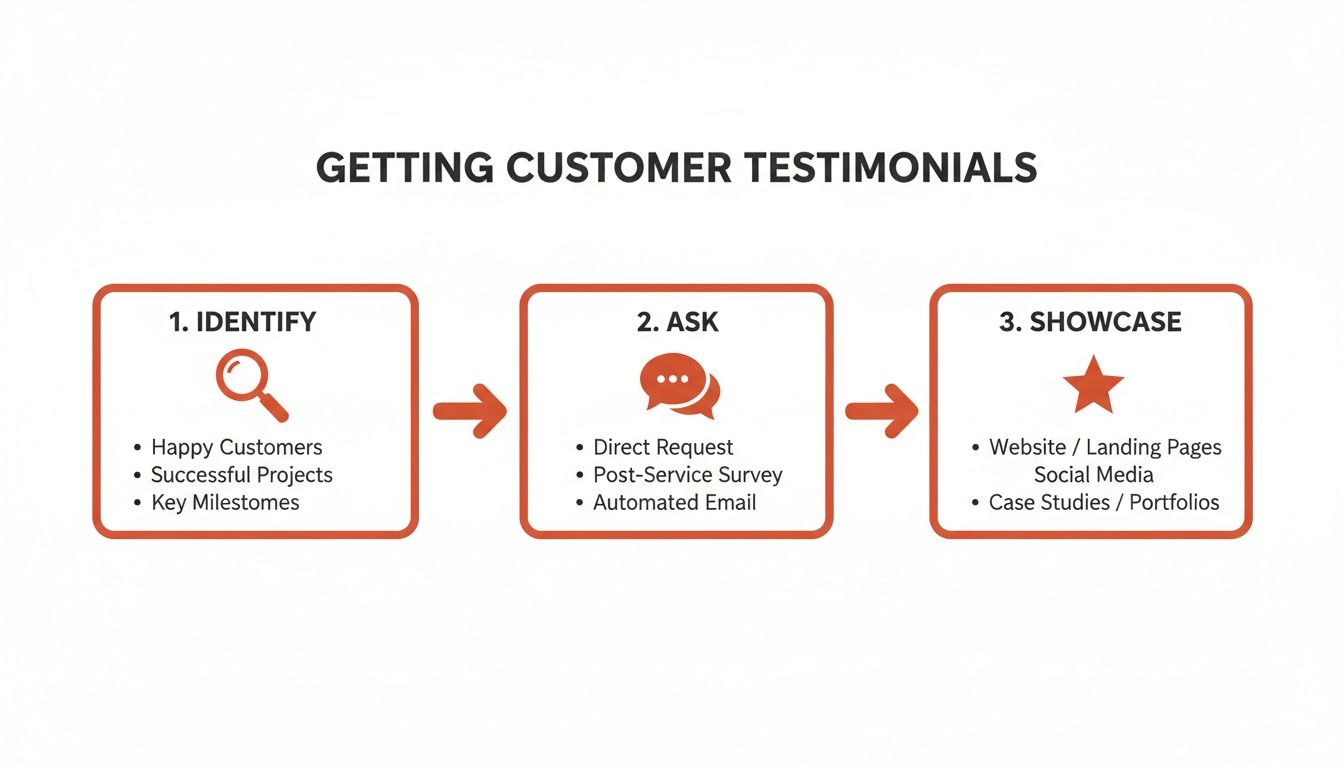
As the visual shows, a successful strategy is a simple, repeatable three-step flow.
Finding the Right Clients and the Perfect Time to Ask
Getting a great testimonial starts with two simple things. You need to know who to ask and when to ask them. Not every client is the right person. You want to focus on the ones who have seen real results from your work. They should be genuinely happy with the outcome.
Think of it this way: your most satisfied clients are your biggest fans. They have probably already told you they are happy. These are the people who will give you a specific, glowing review. This review will build immediate trust with anyone thinking about hiring you.
Identifying Your Biggest Advocates
The best candidates for a testimonial usually send clear signals. You just have to know what to look for. These are the people who have already shown they appreciate what you do. This makes asking for a testimonial feel like a natural next step.
Here is a quick checklist to help you spot your prime candidates:
- They sent you a "thank you" email. An email praising your work is a golden opportunity.
- They have already referred new business to you. A referral is one of the strongest signs of a happy client.
- They have praised you verbally. Did they compliment your work on a call? That is your green light.
- You just wrapped up a successful project. The client is thrilled with the result. The value you delivered is fresh in their mind.
- They tag your business in a positive way on social media. Public praise is a huge sign they would be willing to make it official.
Watching for these signs helps you avoid asking clients who might be lukewarm. You can put your energy into relationships that are already strong. This hugely increases your chances of getting an enthusiastic "yes."
Pinpointing the Perfect Moment to Ask
Once you have someone in mind, timing is everything. Asking at the right moment makes the request feel natural. If you get it wrong, you can seem pushy. The trick is to ask when the value you have delivered is top of mind.
These moments are often called "peaks of happiness" in the client journey.
The goal is to capture your client's positive feelings when they are at their strongest. Waiting too long lets that excitement fade. A testimonial then feels like a chore, not a chance to share a great experience.
Here are the most effective times to make your move:
- Right after hitting a project milestone. You deliver a key part of a project and get great feedback. That is your moment. For example, "I'm so glad you love the new website design! Would you be open to sharing a few words about your experience?"
- During the final project wrap-up call. You are recapping successful outcomes. You can smoothly transition into the ask. The client is already thinking about the positive results.
- Immediately after they give you praise. A client emails you to say, "This is amazing work!" Your reply should be a thank you. Then, add a gentle request for a testimonial.
- A few weeks after the project is done. Sometimes, clients need time to see the full impact of your work. Checking in to see their results is a perfect lead-in to a testimonial request.
To get better at gathering these insights, explore strategies on how to collect customer feedback that actually drives growth. Knowing these methods can help you build a more structured approach.
By timing your request perfectly, you make it easy for your client to say yes. They can provide the authentic, enthusiastic feedback that builds your professional reputation. Strong endorsements are a key part of your career toolkit. A well-managed collection on a platform like GainRep can make a real difference.
Crafting a Request They Can't Refuse

How you ask for a testimonial makes all the difference. A vague or demanding request is easy to ignore. A personal, clear, and simple one makes it easy for your client to say yes.
Your goal is to remove all friction from the process. Make it so easy they can send a response in a few minutes. This shows you respect their time. It also increases the odds of getting the social proof you need.
The Anatomy of a Perfect Request
Every great testimonial request has a few key ingredients. It is a simple formula you can use for any situation. It shows professionalism and makes your client feel valued.
A strong request should always:
- Get Personal: Use their name. Refer to a specific project or a win you shared. Generic emails are easy to delete.
- Explain the "Why": Briefly tell them why you are asking. Something simple like, "Your feedback helps others understand the impact of my work," works perfectly.
- Make It Easy: This is the most important part. Offer to draft something for them. Provide a few guiding questions. You can even offer a quick call.
- Be Gracious: Thank them for their time and partnership. Do this whether they agree to the testimonial or not.
Building your message around these four points turns a simple ask into a professional interaction. It can even strengthen your client relationship.
Email Templates You Can Adapt and Use
Having a couple of proven templates ready saves time. It makes the whole process less intimidating. Think of these as a starting point. The magic is in filling the blanks with specific details to make it feel real.
Template 1: For a Recently Completed Project
This one is perfect for when the good feelings from your project are still fresh.
Subject: A quick question about our recent project
Hi [Client Name],
I really enjoyed working with you on [Project Name]. I'm thrilled with the results, especially [mention a specific positive outcome].
I'm gathering some feedback to help potential clients understand what it's like to work with me. Would you be open to writing a short testimonial about your experience?
To make it easy, I've drafted a few guiding questions below. Or, if it's easier, feel free to just write a sentence or two.
- What was the biggest challenge you faced before we started working together?
- How did my work help you solve that challenge?
- What was the most significant result you saw from our project?
Thanks so much for your time and for being a great partner.
Best,
[Your Name]
Template 2: For a Long-Term Client
With a long-term client, you can be more direct. Lean on your established relationship.
Subject: A small favor
Hi [Client Name],
It's been great working with you over the past [duration, e.g., six months]. I've especially valued our collaboration on [mention a specific initiative].
Positive endorsements are very helpful for freelancers. Would you be willing to share a few sentences about your experience working with me? It would mean a lot.
No pressure at all. If you're open to it, a brief comment on my reliability or work quality would be fantastic. I'm also happy to draft something for you to approve if that saves you time.
Thanks for everything,
[Your Name]
Remember to adjust the tone and details. Match them to your relationship with the client. The more personal it feels, the better your response rate will be.
Guiding Them to Give Great Feedback
Vague praise like "He was great to work with" is nice. But it does not really move the needle. You need testimonials that highlight specific results and prove your value. The secret is to ask the right questions.
Instead of just asking, "Can you write me a testimonial?" guide them with prompts. This encourages specific details.
- Before: "What was the main problem you were trying to solve before you hired me?"
- During: "What did you like most about the process of working together?"
- After: "What's the single biggest result you've seen since we completed the project?"
These questions guide your client toward telling a story. It's a story with a problem, a solution, and a successful outcome. That story is far more powerful than simple praise. By making it easy and guiding them toward impactful answers, you get endorsements that drive your career forward.
Showcasing Testimonials for Maximum Career Impact
Collecting powerful testimonials is just the first step. How you showcase them turns that social proof into real career opportunities. Strategic placement gets your endorsements in front of the right people. This includes recruiters, hiring managers, and potential clients when they are making a decision.
Think of your professional brand like a storefront. You want your best reviews in the window, not hidden in a back room. Feature them on your professional profiles, your personal website, and your resume. The goal is to make your credibility impossible to miss.
Quality Over Quantity Always Wins
It is tempting to think more is always better. That is not the case with testimonials. A few detailed, results-focused endorsements are more persuasive than a dozen generic ones. One client story that breaks down a specific problem, your solution, and the impact is worth ten quotes that just say, "They were great to work with."
You should curate a collection that tells a story about your skills and value.
- Highlight Specific Skills: Choose testimonials that mention key skills you want to be known for, like project management or client communication.
- Showcase Tangible Results: Prioritize feedback with numbers or outcomes, like “increased lead generation by 30%” or “helped us launch two weeks ahead of schedule.”
- Represent Different Angles: If you can, get endorsements from different collaborators. A direct manager, a peer, and a client can give a well-rounded view of your abilities.
This curated approach builds a powerful story that generic praise cannot match. It is the difference between telling someone you are good at your job and showing them proof.
Strategic Placement for High Visibility
Where you put your testimonials is as important as what they say. You need to place them where they will have the most influence. Weave them naturally into the platforms where you build your professional presence.
The placement of testimonials plays a huge role in their effectiveness. Research shows that detailed customer success stories generate a 62% increase in conversion rates compared to generic praise. These stories describe specific problems and how they were solved. Also, placing testimonials near calls-to-action can create a 34% uplift in engagement. For professionals, this means putting endorsements where recruiters will see them first. You can read the full research about these conversion rate findings on fastercapital.com.
A testimonial's power is multiplied when it appears right next to the skill it validates. A recruiter reads "Expert in Python" on your resume. They then see a quote below it from a manager praising your Python skills. The connection is immediate and powerful.
Centralize Your Endorsements for Easy Access
Managing testimonials across multiple platforms can become a headache. A scattered collection of quotes is hard to maintain and less impactful. The solution is to use a central hub to manage all your professional endorsements in one place.
A dedicated platform makes it simple for recruiters and clients to find all your social proof. This is where a tool like GainRep becomes essential. It lets you gather, organize, and display all your recommendations in a single, professional profile you can easily share. This creates a unified and compelling picture of your professional reputation. To maximize the impact of your testimonials, exploring dedicated testimonial features can also help you display them effectively.
By centralizing your endorsements, you ensure that anyone evaluating you gets a complete view of your skills. They see your accomplishments, backed by the authentic voices of those who have worked with you. This professional presentation makes a lasting impression. It can give your career a significant boost.
Go Beyond Quotes: How to Use Video and Case Studies to Tell a Bigger Story

Standard text quotes are great, but they are just the beginning. To really make an impact, you need to explore formats that tell a more compelling story. Moving beyond basic written feedback helps you build a much stronger emotional connection. It helps you establish trust almost instantly.
Video testimonials, in-depth case studies, and even simple star ratings each reveal a different side of your professional value. The trick is to give people different ways to share their positive experiences. Someone who does not have time to write a paragraph might be happy to record a quick 30-second video on their phone.
The Unmatched Power of Video Testimonials
Nothing builds credibility like video. It puts a real face and a genuine voice to the praise. It feels more authentic than text ever could. A potential client or employer can see and hear someone talking about their success with you. This creates an immediate sense of trust.
The numbers back this up. A staggering 77% of viewers say they have been convinced to buy something based on a company's video. For professionals, an endorsement from a client is dynamic proof of our skills. Data even shows that adding video to a landing page can boost conversions by up to 80%. That is how powerful the emotional connection is. You can dig into more of these powerful video statistics on teraleap.io.
A great video testimonial is a short story. It captures the client's challenge, the journey of working with you, and the successful outcome, all in their own words. It's social proof at its most powerful.
Getting a video does not have to be a big production. The goal is to make it as simple and low-pressure as possible for your client.
How to Easily Ask for (and Get) a Video
The secret to getting great video testimonials is to make the process ridiculously easy. Most people are happy to help. But they get nervous about a formal recording. Your job is to reassure them that a simple, informal clip from their smartphone is perfect.
Here is a simple way to approach it:
- Frame the Ask Simply: When you reach out, downplay the technical side. Try something like, "Would you be open to recording a quick 30-second video on your phone sharing your thoughts? It doesn't have to be perfect—authentic is what matters!"
- Give Them Guiding Questions: Just like with written requests, provide a few prompts. This takes the pressure off them. Good questions include: "What was the main reason you chose to work with me?" or "What's the one thing you'd tell someone else considering my services?"
- Suggest Easy-to-Use Tools: Recommend tools they already have, like their phone's camera. If they are comfortable with it, free tools like Loom or Vidyard are fantastic for recording their screen and webcam.
- Keep It Short: Stress that you only need a very short clip, usually 30 to 60 seconds. This makes the request feel manageable and shows you respect their time.
Going Deeper with Other Formats
While video is a heavy hitter, other formats are crucial. They build a well-rounded professional reputation. They provide different kinds of social proof that appeal to different people.
- Short Case Studies: Think of a case study as a mini-story. It walks through a client's problem, your solution, and the results. This is perfect for showing off your strategic thinking. It proves you can deliver measurable outcomes. You can write most of it yourself. Then just ask the client to approve it and provide a quote.
- Star Ratings: Simple star ratings are a quick, visual gut check for potential clients. They are effortless for your contacts to provide. They are even easier for prospects to understand. A high average rating is an at-a-glance signal of quality.
By offering these different formats, you can build a robust collection of endorsements. A platform like GainRep can help you create a complete picture of your professional value.
Answering Your Toughest Questions About Testimonials
Even with a perfect plan, asking for testimonials can feel a little awkward. You will run into tricky situations and common hurdles. Knowing how to handle them ahead of time helps you navigate these conversations like a pro.
Let’s walk through the most common questions that pop up. Think of this as your playbook for managing the process without a hitch. It covers everything from dealing with busy clients to figuring out how many testimonials you need.
What Should I Do If a Client Is Too Busy to Write a Testimonial?
A client tells you they are swamped. The goal is simple: make it very easy for them. Your job is to reduce the effort required from them to almost nothing. Do not just give up. Offer a simple, helpful alternative that respects their time.
One of the best things you can do is offer to write a draft for them. You can pull this together based on positive feedback they have already given you.
A simple "I completely understand. To make it easier, would you be open to me drafting a few sentences based on our project? You could then quickly approve or edit it" works wonders.
Another great option is to suggest a quick call. A five-minute chat where you ask a couple of guiding questions can be recorded. You must get their permission, of course. You can transcribe it later. This often feels less like a chore and more like a natural conversation.
How Many Testimonials Do I Actually Need?
Here is the deal: focus on quality over quantity. Three to five powerful, detailed testimonials are worth far more than ten generic compliments. They should highlight specific, measurable results. Your goal is a curated collection that showcases your skills.
A handful of strong endorsements from respected clients or managers can change the game. Instead of chasing a big number, focus on getting testimonials that tell a story. This story should be about the value you deliver.
Start with your happiest clients. These are the ones who were thrilled with your work. From there, you can slowly build a collection that paints a clear picture of what you can do. Remember, one great story beats a dozen vague compliments every time.
How Often Should I Ask for New Testimonials?
You should get into the habit of asking for feedback as a natural part of your workflow. A good rule of thumb is to request a testimonial at the end of every major project. This keeps your endorsements fresh, current, and relevant. It helps you find the kind of work you want to do next.
If you are in a long-term role, a great time to ask is after a big milestone. A positive performance review is another good time. Fresh endorsements show potential employers and clients that your skills are sharp. They show that you consistently deliver great work.
Do not be afraid to circle back with past clients. A quick check-in to see how things are going can be the perfect opening. You can ask for an updated review. This is especially true if the impact of your work has become clearer over time.
Should I Offer an Incentive for a Testimonial?
It is best to avoid offering direct payment for testimonials. This can make the feedback feel inauthentic. It can seriously damage the trust you are trying to build. The most powerful endorsements are the ones that come from genuine satisfaction.
Instead of cash, think about a non-monetary gesture of appreciation. A simple act of reciprocity often works best.
- Offer to write a glowing endorsement for them in return.
- Share their business or their work with your professional network.
- Send a thoughtful, personalized thank-you note.
A sincere expression of gratitude goes a long way. The best testimonials are given freely. They come from clients who are genuinely happy with your work. They want to see you succeed.
At GainRep, we believe your professional reputation is your most valuable asset. That's why we've built a platform to help you easily collect, manage, and showcase powerful endorsements from your peers and clients. Build trust and stand out in your field by centralizing your social proof in one place. Start building your professional reputation on GainRep today.
