


Applying for jobs can feel like a full-time job. You search for hours. You fill out the same forms over and over. It is a grind. But you can put the most boring parts on autopilot. The right move is to automate job applications with smart tools. These tools do the hard work for you. This lets you focus on what really matters: acing interviews and making connections.
Why Put Your Job Search on Autopilot?
The old way of job hunting is broken. You spend hours looking for roles. You tweak your resume again and again. You write cover letters from scratch for every opening. All that effort often leads to nothing. It does not just waste time; it is exhausting.
Automating your search changes the game. This is not about sending out hundreds of generic applications. It is about using technology to get a real advantage.
Manual vs Automated Job Applications: A Quick Comparison
The difference between the old way and the new way is big. Let's break it down.
| Feature | Manual Application Process | Automated Application Process |
|---|---|---|
| Time Spent | Hours per day searching, filling forms, and tailoring documents. It's a massive time drain. | Minutes per day to review matches and tweak settings. The system handles the heavy lifting. |
| Application Volume | Low. You can realistically only apply to a handful of jobs each day. | High. The system can apply to dozens or even hundreds of perfectly matched jobs for you. |
| Personalization | High effort for each application. Tailoring every resume and cover letter is slow. | Smart and scalable. You create rules and templates, and the AI personalizes them for you. |
| Consistency | Inconsistent. It's easy to get burned out and let applications slide for a few days. | Consistent 24/7. Your job search never sleeps, applying to new roles as they're posted. |
| Tracking | Manual and messy. Relies on spreadsheets or memory, which can lead to missed follow-ups. | Built-in and automatic. Most tools have a dashboard to track every application and response. |
Automation is not just faster—it's smarter. It frees you from boring tasks. You can focus your energy on high-value activities that land you the job.
The Power of Working Smarter, Not Harder
Modern tools can scan thousands of job boards. They find roles that are a perfect match for your skills. Once a fit is found, they can automatically submit a personalized application. This means you could apply to dozens of relevant jobs every day. This greatly boosts your chances of getting noticed.
By automating the repetitive parts of the job search, you reclaim your most valuable asset: time. You can reinvest that energy into things that truly matter, like networking, acing interviews, and learning new skills.
The numbers back this up. Job seekers using manual methods often get a response rate below 5%. Automation tools can significantly increase your callback rate. This is true in competitive fields where you face hundreds of other applicants.
Taking Control of Your Applications
Automation gives you incredible control. You set the rules. This ensures you only apply to positions that fit your career path. You can refine your search with criteria like:
- Job Titles and Keywords: Target the exact roles you want.
- Industry and Company Size: Focus your energy on specific sectors.
- Location and Work Type: Filter for remote, hybrid, or in-office jobs.
- Salary Expectations: Only see roles that meet your financial needs.
To do this well, it helps to understand how an automated job application system works for employers. Knowing what they see helps you build a strong application. It will stand out to both the algorithm and the human recruiter. With a tool like Gainrep AI Auto-Apply, you set your preferences once. The system does the rest. It finds and applies to the best opportunities while you sleep. To get started, check out our AI application tool at https://www.gainrep.com/ai-auto-apply.
Build Your Master Resume and Profile

Before you use any automation, you need a strong foundation. This means building a ‘master resume’ and polishing your professional profile. Think of these as your core plan. Everything your automated job search does will pull from here.
A master resume is not something you send out. It is your private, complete record of your professional history. Every job, project, skill, and achievement goes in here. There are no page limits. This document is the database your tools will use. It will create tailored resumes for each application.
Crafting Your Master Resume
Start by listing every role you have held. For each one, do not just list your duties. Frame your accomplishments with strong action verbs. "Managed social media" is weak. You need to show results.
The real magic is in the numbers. Quantifying your achievements gives recruiters proof of your value. It makes your impact feel real. It is also what AI tools look for when they scan your resume.
Here’s what that looks like:
- Before: "Responsible for email marketing campaigns."
- After: "Spearheaded a new email marketing strategy that lifted open rates by 25% and drove over $50,000 in new sales in six months."
A well-built master resume is your secret weapon. It ensures that every automated application pulls from your most impressive, relevant achievements, aligning them perfectly with what the employer wants to see.
This detailed approach makes sure every application starts from a place of strength. If you want to get the structure right from the start, using a professional tool can help. You can find resume tips and tools at https://www.gainrep.com/resumes.
Building a Powerful Professional Profile
Your resume tells one side of the story. Your professional reputation tells the other. A strong profile with real endorsements builds trust. A recruiter will see this before they even call you. These testimonials validate your skills and work ethic.
They offer social proof that you are who you say you are. A recommendation that speaks to your problem-solving skills can make a difference. It might be the one thing that pushes a hiring manager to choose you. It adds a human touch that a list of skills cannot.
Gathering Effective Endorsements
The way to get great endorsements is to ask for them thoughtfully. A generic request often gets a generic response. Instead, reach out to former managers or senior colleagues. Ask people who saw your best work.
When you ask, make it very easy for them. Remind them about a specific project you worked on together. Mention the great outcome. You might say something like, "I'm updating my profile and was hoping you could write a quick recommendation about my work on the Q3 product launch. I really valued your feedback on my project management during that time."
This simple prompt helps them remember specifics. They can write a much more detailed and powerful endorsement.
Here are a few more tips:
- Be Specific: Guide them by mentioning the skills or projects you want them to highlight. This keeps the recommendation relevant.
- Choose the Right People: Ask colleagues who can speak with authority about your abilities.
- Offer to Reciprocate: A great way to build goodwill is to offer to write one for them in return. It turns a favor into a professional courtesy.
- Say Thank You: Always express your gratitude. A thoughtful recommendation is a valuable gift.
Building a solid professional reputation is an ongoing process. For more tools and ideas on how to showcase your skills and gather powerful testimonials, you can explore the resources at Gainrep. This groundwork is crucial. It ensures that when you automate your job applications, you’re putting your absolute best self forward.
Choosing the Right Job Application Automation Tools
Once your master resume is ready, you need to pick an automation tool. The market has many options, but they are not all the same. A good tool is more than a form-filler. It is a smart agent. It hunts down and applies to roles that match your career goals.
The best platforms use AI. They dig into job descriptions to see how they match your skills. This way, you apply to the right jobs. It is about quality over quantity. The right tool will increase your odds of getting noticed by a recruiter.
What to Look for in an AI Auto Apply Tool
When you look at your options, a few critical features matter. These features separate a helpful tool from a noisy one.
- Job Matching Accuracy: You need an AI that understands job titles and responsibilities. It must go beyond simple keyword matching. It should understand the context of a role to see if it’s a true fit.
- Resume and Cover Letter Tailoring: A top tool will automatically tweak your resume and cover letter for each application. It should pull the most relevant experience from your master resume. It will then craft a new document that speaks to that specific job post.
- Customization and Control: You must be in control. Look for a tool that lets you set your preferences. This includes job titles, industries, salary, and location. You should never feel like you’ve lost control of your job search.
For instance, a platform like Gainrep is built on these ideas. You can explore our effective AI auto-apply tool and see how it works. It uses your profile to find and apply for jobs that are a perfect match, all while keeping you in complete control.
Evaluating Different Platforms
As you compare tools, think about what you need for your industry. Some platforms are general. Others are specialists for fields like tech or creative work. If you're a freelancer, you might look into solutions for Upwork proposal automation.
The goal is to find a system that feels like a true partner in your job search. It should save you time on repetitive tasks so you can invest that energy into interview preparation, networking, and skill development.
Do not forget to consider the user experience. A confusing interface can create more work. The setup should be simple. Upload your resume, enter your preferences, and let the system do its thing.
Understanding the Impact of AI on Hiring
The way we work is changing fast. AI continues to reshape industries. Job seekers can feel buried by online job postings. Some estimates suggest that 27% of current work hours could be automated by 2030. Using smart tools is not just nice to have; it is how you stay competitive.
Automation tools help you cut through the noise. They find the best-fit roles. They apply with perfectly tailored documents. This is becoming more critical. Research shows that as many as 40% of global jobs are exposed to AI. This changes how we find and land work. Embracing technology to automate your job search is a smart career move.
Configuring Your Automated Application Workflow
You have your master resume and your automation tool. Now it is time to set up the engine for your job search. Configuring your workflow means teaching the AI what you want. You turn your career goals into clear instructions. This step ensures the system works for you.
Getting this initial setup right is key. A sloppy configuration will have you applying for jobs that do not make sense. This wastes everyone’s time. But a thoughtful setup will turn the tool into a precise and effective assistant.
This is not just about uploading a document. You are defining the rules. You tell the AI exactly what you are looking for. It's your chance to automate job applications with real intelligence.
Think of it as a simple, three-part philosophy: Match, Tailor, and Control.
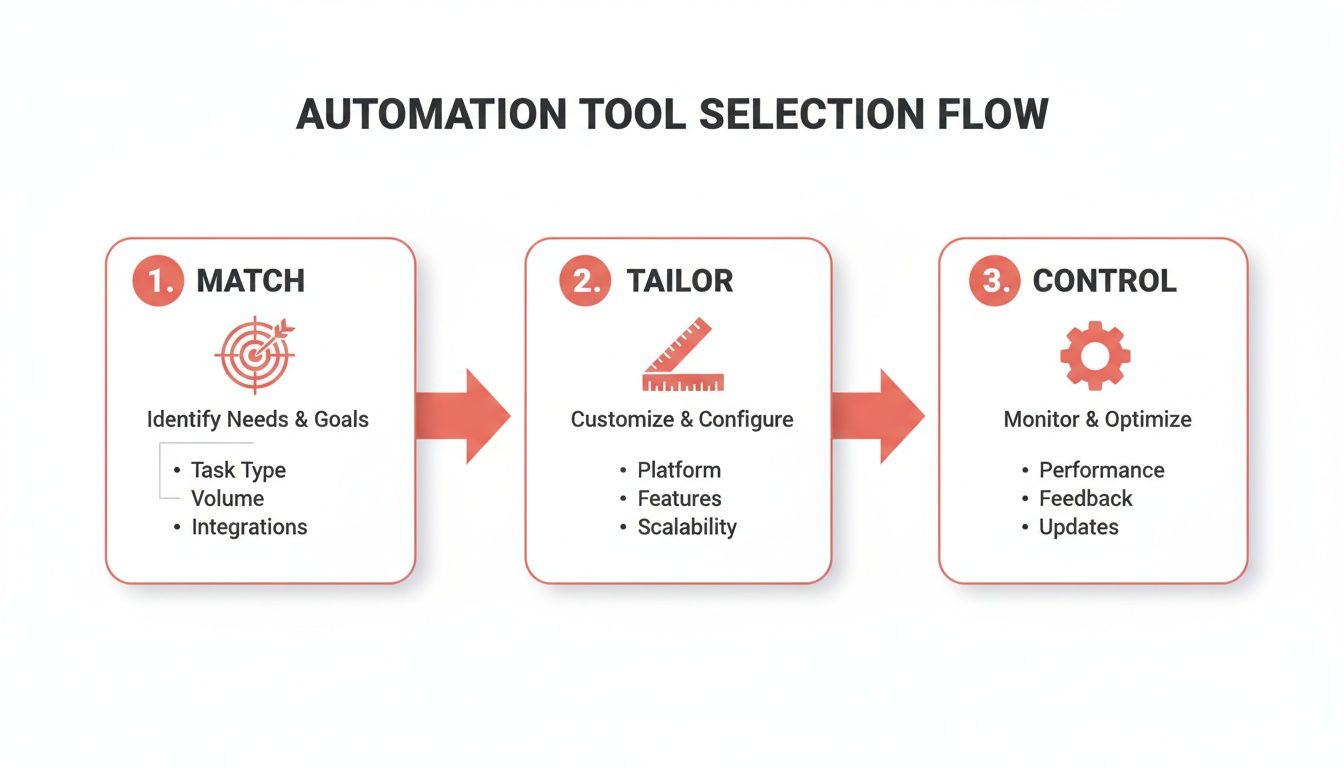
This flow means a good automated search starts by finding the right jobs. Then, it intelligently tailors your pitch for each one. You stay in control the whole time.
Defining Your Job Search Parameters
First, you must input your core job preferences. This is where you draw the map for your search. Think of it as giving your AI assistant a detailed shopping list. The more specific you are, the better the results.
Here's what to lock in:
- Target Job Titles and Keywords: Do not just stop at "Project Manager." Add variations like "Senior Project Manager," "Agile Project Lead," and "Scrum Master" if they fit what you do.
- Salary Expectations: Put in a realistic range. Having a minimum and a target number gives the tool some helpful room.
- Location and Work Arrangements: Be crystal clear. Are you looking for jobs in specific cities? Do you want remote, hybrid, or on-site roles?
- Company Size and Industry: This matters. If you work best in startups or prefer large corporations, add that filter. The same goes for industries like "fintech" or "healthcare tech."
A big mistake is being too broad. If you are a software development manager and just put "Manager," you might get applications for retail jobs. That clogs up your tracker.
Uploading Your Master Resume and Profile
Next, you will upload that master resume. The automation tool uses this document as its source of truth about you. It will pull information from this file to build resumes for each job.
Make sure the resume you upload is clean and well-formatted. It should have no typos. Some systems get confused by fancy layouts with columns or graphics. A simple, chronological format usually works best for AI.
Your configuration is only as good as the information you provide. A detailed, well-structured master resume and specific job preferences are the foundation for a successful automated job application workflow.
If you need a hand with that document, platforms like Gainrep offer tools to build professional resumes. You can learn more about crafting the perfect one on the Gainrep resume builder page.
Creating Smart Personalization Templates
The final piece is personalization. To avoid sounding like a spambot, you need to set up rules and templates. These guide the AI when it crafts cover letters and summaries. This step separates a dumb bot from a smart job-seeking ally.
For example, you can create a rule like: "If the job description mentions 'leadership,' use the paragraph from my master profile that highlights my experience leading a team."
Here are a few other ideas for personalization rules:
- For Different Job Functions: Have separate cover letter introductions ready. A marketing role could get a creative opening. A project management role gets one about efficiency.
- For Company Values: You can set up a template that uses phrases related to a company's values. If their careers page is about "innovation," your rule can tell the AI to mention one of your innovative projects.
- For Required Skills: Create a rule to ensure your cover letter mentions the top three skills listed in the job description. Include a quick example of how you've used them.
This level of detail makes the output feel personal. It speaks directly to what the employer wants. A well-configured AI auto-apply tool, like the one offered by Gainrep, uses these inputs to create applications that get noticed. With these settings, your workflow is ready to start hunting for your next opportunity.
How to Track Your Success and Sidestep the Usual Blunders
Turning on an automation tool is a big step. But it is not a "set it and forget it" deal. You have to watch what works and what does not. Think of it like a marketing campaign. You launch, check the data, and then tweak things for better results.
This is what separates a successful automated search from one that goes nowhere. By watching a few key numbers, you can turn your system into an interview-generating machine.
The Key Numbers to Watch in Your Job Search
Do you want to know if your strategy is working? You have to track the right data. Numbers show you where your approach needs a tune-up.
Here are the most important metrics to watch:
- Application Volume: This is the total number of applications your tool sends. It's a simple check to see if your system is running.
- Response Rate: This is the percentage of applications that get a human response. A low response rate is a red flag that your resume is not hitting the mark.
- Interview Request Rate: This is the ultimate goal. This number measures how many applications turn into an interview. It tells you if you're hitting the right targets.
- Time-to-Response: How long does it take to hear back? If you notice that startups respond faster than large corporations, you know where to focus your energy.
Tracking these numbers helps you find trends. For example, you might notice that applications sent on Tuesday mornings get a 10% higher response rate. Or you might find that one resume version lands you more interviews.
The data you gather is your roadmap. It takes your job search from a game of luck to a strategic, data-backed process where you're constantly getting smarter.
Dodging the Common Automation Mistakes
When you automate job applications, it is easy to fall into a few common traps. Knowing them ahead of time will help you stay on track.
The biggest mistake is a lack of personalization. Some tools blast the same generic resume to hundreds of jobs. Recruiters can spot these easily. They almost always go into the trash. Your automation has to be smarter.
Another classic error is applying to irrelevant jobs. This happens when your search filters are too broad. Applying for a senior marketing director role when you are a junior developer wastes everyone’s time. It can even get you blacklisted.
Fine-Tuning Your Strategy for Better Results
What do you do when the numbers are not good? You adjust. A low response rate signals that something in your core documents needs work.
Here’s how to start refining your approach:
- Fix Your Keywords: Go back to your master resume. Are you using the same language you see in job descriptions for roles you want? If not, update your skills and experience sections.
- Narrow Your Filters: If you're getting irrelevant job matches, your search criteria are too loose. Get more specific with job titles, skills, and industries. It is better to apply to 20 relevant jobs than 100 random ones.
- Tweak Your Personalization Rules: Your automation tool should let you set rules for customization. For instance, you could create a rule that inserts a specific project example when a job description mentions "data analysis." This small touch can make a big difference.
The key to success is to continuously monitor and refine your system. An effective automated job search is an active process. With a platform like Gainrep's AI Auto-Apply, you have the controls to make these adjustments, making sure your applications are always sharp and compelling.
Job Application Automation: Your Questions Answered
Jumping into job application automation can feel new. It is normal to have questions. It is a different way to job hunt. We've rounded up the most common questions to give you straight answers.
Will My Automated Applications Look Like Spam?
This is a big worry, but the answer is no—if you do it correctly. Modern AI tools are not spam bots. They are smart. Instead of sending a generic resume, they pull keywords and requirements from a job description. Then, they weave them into your application.
The magic is in the prep work. You create a detailed "master resume." Then, you set up personalization rules. This ensures every application is customized for that specific role. It feels targeted, not like it came from an assembly line.
Is It Okay to Automate Job Applications? Is It Ethical?
Yes, if you are responsible about it. Think of automation as a personal assistant. It helps you with the repetitive nature of the modern job market. The process is ethical when you apply for jobs you are interested in and qualified for.
The goal is not to spam employers. It is to be more efficient. A responsible approach means setting up your job filters carefully. This respects everyone's time—yours and the recruiters'. It also keeps your professional reputation safe.
The ethical line is all about intent. If you're using automation to find and apply for relevant jobs more efficiently, you're just working smarter. If you're using it to shotgun your resume at every opening in sight, you're just adding to the noise.
How Can I Tell if My Automated Job Search Is Working?
You measure success by watching a few key numbers. This data will show you what's working and what needs a tweak.
Focus on these metrics:
- Application Volume: The total number of applications sent. This confirms your system is running.
- Response Rate: What percentage of your applications get a reply? A low number here is a red flag. Your resume might need work.
- Interview Requests: How many applications turn into an interview? This is the most important metric. It's the ultimate sign of success.
If you see a low response rate, do not panic. It is a signal to refine your strategy. Maybe you need to add more keywords to your master resume. Or you might need to narrow your job filters. The point is to see a steady rise in real conversations with employers.
Ready to break free from the endless cycle of manual applications? Gainrep has the tools to make it happen. Our AI Auto-Apply feature finds jobs that are a perfect match for your skills and handles the application process for you, making sure every submission is professional and personalized. Start automating your job search and focus on what really matters—nailing the interview.
