


Negotiating your salary is a key step for your financial future. You are not being difficult by negotiating. You are making sure your professional value matches market pay. A little research helps. Good timing and clear communication are also important. This guide will help you feel ready and in control during your interview.
Why You Should Always Negotiate Your Salary
Many people leave money on the table. This does not have to be your story. Many professionals feel nervous talking about pay. They worry it will make them seem greedy. They also fear the company might take back the offer. The reality is different. Most companies expect you to negotiate. They build it into their hiring process.
Not negotiating can affect you for years. Your starting salary sets the base for all future raises and bonuses. It even affects your next job offer. A small increase now can grow into thousands of dollars over your career. Understanding this helps you accelerate your salary over time.
The Modern Job Market Expects Negotiation
The job market has changed. Employers are more prepared for salary talks today. Showing up with a well-researched number is a good thing. It shows you are a confident professional. You know your worth in the industry.
Data supports this. In 2023, 96% of companies worldwide increased their salary budgets. This was due to a competitive market and a new focus on total pay. This signals that employers are ready to talk. Your mindset should change. You are not just a hopeful candidate. You are a powerful negotiator.
Think of the salary talk in a new way. It is not a fight. It is a discussion to find a number that works for both of you. It should reflect your skills and the company’s budget.
Core Pillars of a Winning Negotiation
You need a strategy for a successful negotiation. It should be built on three main ideas:
- Solid Research: Know what you are worth. Use hard data, not just feelings.
- Perfect Timing: Know the right time to talk about salary. This has a big impact.
- Clear Communication: Use precise, confident words. Explain your value and what you want.
Mastering these is a skill. Like any skill, it improves with practice. The more interviews you get, the more you can sharpen your approach.
Build Your Case with Solid Salary Research
Going into a salary negotiation without data is a mistake. It is like taking a test without studying. You are just guessing. Your biggest advantage is not charm. It is solid data.
Before you think of a number, do your homework. Become an expert on what the market pays. Look for someone with your exact skills, experience, and location. This is not about what you feel you are worth. It is about what market data proves.
When you have research, the situation changes. The talk stops being personal. It becomes a business discussion based on facts. You are not just asking for more money. You are presenting a case for fair market value.
Finding Your Market Value
First, you need to find information from several good places. Using only one website can give you a wrong idea. The best way is to pull data from multiple sources. This helps you find a consistent, realistic range.
Here are some good places to start your search:
- Online Salary Calculators: Websites like Glassdoor, Payscale, and Salary.com are very helpful. They offer free tools. These tools give you salary ranges based on job title, industry, and location.
- Industry-Specific Reports: Look for annual salary surveys from groups in your field. These reports have very detailed and useful information.
- Job Postings: Do not just apply to jobs. Analyze them. Look for similar jobs in your area that list salary ranges. This tells you what companies are offering right now.
For example, global surveys show big pay differences between countries. The IMA 2023 Global Salary Survey found that US accounting professionals had an average base salary of $133,033. The same job in the Middle East/Africa/India region averaged just $32,878.
This is a huge difference. It shows why location-specific data is so important. It helps you get an accurate benchmark. It is worth a read to understand the full picture of global salary trends.
To keep your information organized, use a worksheet. A simple sheet can help you see patterns and find a believable target.
Sample Salary Benchmarking Worksheet
| Data Source (e.g., Glassdoor, Payscale) | Role Title | Location | Low Range | Average Range | High Range | Your Target Salary |
|---|---|---|---|---|---|---|
Filling this out helps you build a data-driven plan for your negotiation.
Define Your Salary Boundaries
With your research complete, you need to set your limits. This means deciding on three key numbers. These numbers will guide you during the negotiation. Knowing them beforehand keeps you from getting nervous and accepting a low offer.
Your research is your map. But you still need to decide your destination. These numbers are your personal negotiation GPS.
You need to define these three figures:
- Your Target Salary: This is the realistic number you want. It should be at the high end of your researched market range. It must be justifiable with your data.
- Your "Walk-Away" Number: This is your bottom line. It is the lowest amount you can accept. It is based on your financial needs and professional value. If an offer is below this, you must be ready to say no and walk away.
Look Beyond the Base Salary
An offer is more than just a paycheck. A great compensation package has many parts. Each part has real value. A slightly lower base salary might be a good deal if it comes with great benefits.
When you look at an offer, consider every part:
- Performance bonuses
- Stock options or equity
- Health insurance coverage
- Retirement savings plans (like a 401(k) match)
- Paid time off and vacation days
- Professional development funds
Understanding the full value of the package gives you more options. If a company cannot increase the base pay, you can pivot. You could ask for a signing bonus. Or you could request an extra week of vacation. This is how you can turn a "no" into a win.
What to Say When It's Time to Talk Money
The moment has arrived. The talk shifts from your experience to your expectations. It can feel stressful. You might worry about losing the opportunity.
It does not have to be this way.
Knowing what to say removes the anxiety. The right words can show your confidence. They can also reinforce your professional value. Think of it as a business discussion, not a fight. Everyone wants a good outcome.
This visual chart shows the whole process. It goes from research to making your case.
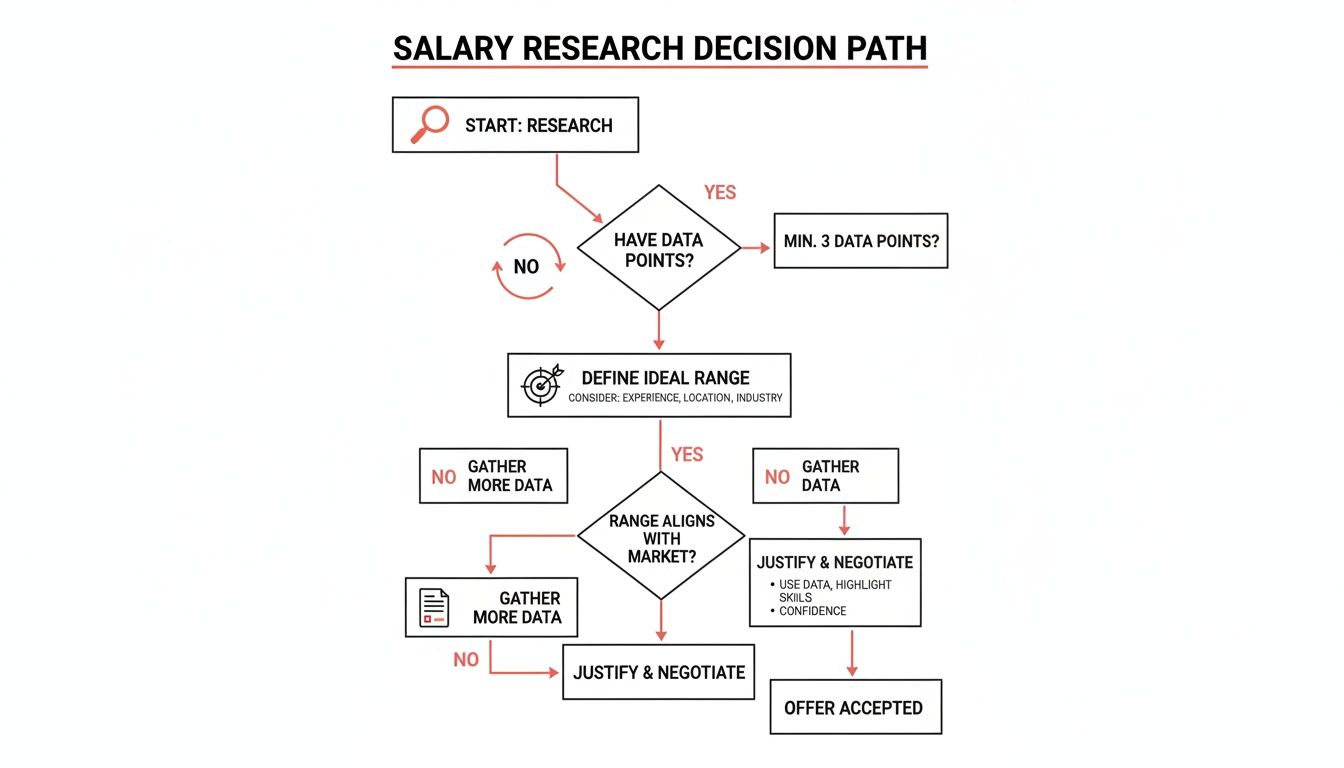
Following these steps helps you walk into the conversation with a solid number and data to support it.
Responding to "What Are Your Salary Expectations?"
This question is tricky. It often comes up early in the interview process. You have not yet learned the full scope of the role. The goal is to avoid giving a single number. Pivot back to the role itself.
Here is a script you can use:
"I'm focused on learning more about this opportunity to see if it's a great mutual fit. From my research, similar roles in this area seem to fall in the [Your Researched Range] range. I'm sure we can agree on a fair number once we both decide I'm the right person for the team."
This approach works well. It shows you did your homework. It gives them a broad but informed range. It also delays the hard-number talk until you have more leverage.
How to React When They Make an Offer
The offer is here. It might sound great. You might want to say "Yes!" right away. But do not. Never accept an offer on the spot. Your first move should be to show appreciation. Then ask for time to review it.
Try this simple, powerful phrase:
- "Thank you so much for the offer! I'm really excited about the possibility of joining the team. Could you send the full details in writing so I can review the complete package? I can get back to you within 48 hours."
This response is professional and positive. It also buys you important time. It lets you look at the entire compensation package. You can analyze benefits, bonuses, and perks. This helps you prepare a thoughtful counteroffer if needed.
Presenting a Confident Counteroffer
After reviewing the offer, it is time to make your counteroffer. This talk is best done over the phone or video. A personal connection can help. Always start by saying you are excited about the role and company.
Then, build your case. This is where your research and value shine. It is also where a strong resume helps you. A good resume quantifies your achievements. You can find helpful tips to build a powerful one at https://www.gainrep.com/resumes.
Here is how to frame your counteroffer:
- "Thank you again for this offer. After looking over the package and comparing it with market data, I was hoping we could get closer to [Your Target Number]. Based on my experience in [mention a key skill or accomplishment], I am confident I can start delivering results right away. Would a salary of [Your Target Number] be possible?"
This script is direct but not demanding. It is respectful and based on data. Non-verbal cues matter, even on video. Some insights from face analysis for job interviews show how reading reactions can help you adjust your approach.
Handling Objections and Closing the Deal
You have made your case and a confident counteroffer. What happens if the hiring manager says "no"? This is a common moment in negotiation. It is not the end of the conversation.
Hearing "no" can be disappointing. But skilled negotiators know this is the next phase. The trick is to stay calm and professional. Be ready to pivot. Your job is to understand their limits and find creative ways to agree.
Common Objections and How to Respond
When a company pushes back, it is usually for a few common reasons. Knowing how to handle them keeps the conversation going. Be ready for phrases like, "That's over our budget," or "This is the top of the range."
Here is a real-world example and how to handle it:
- If they say: "That’s more than we have budgeted for this position."
- You can respond: "I understand you have a set budget. Could you share the approved salary range for this role? Maybe we can look at other parts of the compensation package, like a performance bonus or professional development funds, to make it work for both of us."
This response shows you are a collaborator. It opens the door to negotiating other perks. This is a smart move when a company has a fixed salary number.
Pivot Back to Your Value
If you sense resistance, guide the conversation back to your value. This is not just repeating your resume. It is about connecting your skills to the company's goals.
Remind them why you are a good investment.
"I appreciate you sharing that. Based on our talks about the team's goal to increase market share by 15%, my experience leading a project that resulted in 20% growth makes me confident I can deliver. I believe that justifies an investment at the higher end of the market."
This approach focuses the talk on performance and results. It helps them see you as a solution, not a cost. This is a much stronger position for negotiation.
Turn a Roadblock into an Opportunity
When a company will not move on base salary, get creative. A great offer is about more than a paycheck. This is your chance to negotiate non-salary benefits. These can add real value to your total compensation.
Think about asking for things like:
- An extra week of paid vacation
- A signing bonus
- A guaranteed performance and salary review after six months
- A stipend for your home office
- A bigger budget for professional courses
These perks are often easier for a manager to get approved. They might come from a different budget. By being flexible, you show you are a problem-solver.
Always Get It in Writing
Once you agree on the final offer, there is one last step. Ask for an updated, official offer letter. It should list every detail you agreed on. This includes base salary, bonus structure, and vacation time.
Do not resign from your current job until you have this signed document. A written offer makes everything official. It protects you and the employer from future confusion. It is the final step to close the deal with confidence.
Negotiating Perks Beyond Your Paycheck

A great job offer is more than just a paycheck. You must look at the entire compensation package to see its true value. Companies often have flexibility in other areas, even if the base salary is firm. These other areas can add serious financial worth.
When you discuss total compensation, you create more options. It shows the employer you are a strategic thinker. This shift can turn a salary stalemate into a win-win situation.
Identify Key Negotiable Benefits
Before you respond to an offer, look at all non-salary parts. Many of these perks have a cash value. They can also improve your work-life balance. Learning to talk about them is a key step in a smart negotiation.
Here are a few high-impact areas to explore:
- Signing Bonus: A one-time payment when you start. It can close the gap if the base salary is slightly below your target.
- Performance Bonus: Look at the details. Is it guaranteed? What metrics is it tied to? A well-defined bonus can greatly increase your annual earnings.
- Stock Options or Equity: Common in tech and startups. Equity can offer large long-term rewards if the company succeeds.
- Enhanced Health Insurance: A premium plan can save you thousands of dollars a year in medical costs.
- Remote Work Stipend: A budget for your home office can cover a good chair, internet, or other equipment.
- Professional Development: A budget for courses shows you are committed to growth. The company gets a more skilled employee.
The rise of pay transparency makes these talks easier. As more companies publish their pay data, negotiations become more direct. You can learn more about how to use public data in salary negotiations to build a stronger case.
Use Your Reputation as Leverage
What if the company cannot move on salary? This is where your professional reputation becomes a powerful tool. When you can prove your value with past performance, you gain leverage. This helps you ask for non-salary perks.
A collection of strong recommendations from former managers and colleagues proves your skills. It is one thing to say you are a great team player. It is another to have five people confirm it.
By building a strong professional reputation through endorsements at sites like https://www.gainrep.com/, you create leverage for future negotiations. You can use this social proof to justify a request for a bigger signing bonus or more flexible hours. It shows that your exceptional value deserves an exceptional overall package. This strategy turns your past successes into future benefits.
Salary Negotiation Q&A: Your Most Common Questions Answered
Even a good negotiation plan can face unexpected questions. Knowing how to handle these situations ahead of time helps you stay confident.
Let’s review some of the most common questions in salary talks. This is your playbook for tricky moments.
When Is the Best Time to Bring Up Salary?
The golden rule is simple: let them bring it up first. This usually happens after they decide you are a serious candidate. This puts you in a stronger negotiating position.
What if they ask about your salary expectations early? Your best move is to politely avoid the question.
You can say this:
"I’m focused on understanding the role and making sure it's a great fit. Once we know I’m the right candidate, I’m confident we can agree on a salary that’s fair for the value I'll bring."
This script keeps the focus on your value, not a number. It pushes the money talk to a better time.
What if the Offer Is “Non-Negotiable”?
You get an offer with the line, "this is our best and final." Do not panic. Even if the base salary is fixed, the talk is not over. This is your cue to think about the entire compensation package.
Acknowledge their position, then pivot. For example:
- "I understand the limits on the base salary. Could we explore a one-time signing bonus or an additional week of vacation to make the overall package a better fit?"
This keeps the talk collaborative. It shows you are flexible while still asking for other valuable perks.
How Do I Negotiate Without a Competing Offer?
You do not need another job offer to negotiate well. Your leverage is not another company. It is the unique value you bring to this company. Finding great opportunities is key; platforms that help you auto-apply for jobs can increase your chances of landing more interviews to practice these skills.
Anchor your talk in your qualifications. Use your market research to show your request is in line with industry standards. Remind them of the problems you can solve and the results you will bring.
Should I Negotiate Over Email or Phone?
A phone or video call is almost always better. It is a real-time conversation. You can read their tone and react personally. An email negotiation can feel cold and demanding.
Once you have a verbal agreement, lock it in. Send a polite follow-up email that summarizes the details. Ask for the final, updated offer in writing before you officially accept. This simple step prevents confusion and protects everyone.
At Gainrep, we're committed to giving you the tools you need to build a standout career. From perfecting your application materials to showcasing your professional value, we've got you covered. Strengthen your professional reputation by gathering powerful recommendations on our platform.
