You have just graduated. This is a huge achievement. But you may have one big question: what now?
The best thing to do is make a clear plan. This plan should cover your first few weeks. Take a break to recharge. Then, you can start building the foundation for your job search.
Your First Month After Graduation
You just finished years of hard work. Take a moment to breathe before you enter the job market. This is not about being lazy. It is about preventing burnout before you start.
Celebrate with your friends and family. A short break helps you switch from a student to a professional mindset. This time is for setting yourself up for success. Think of it like gathering tools before building a house. You are not rushing to apply for jobs.
Set Up Your Professional Identity
It is time to trade your student identity for a professional one. This involves a few simple but important tasks. These tasks will shape an employer's first impression of you.
- Create a Professional Email Address: Stop using your old, casual email address. A clean and simple email like
FirstName.LastName@email.comis perfect. Use this new address for all job applications and networking emails. - Clean Up Your Social Media: Recruiters will look at your social media. Go through your profiles. Make them private or remove anything you would not want a future boss to see. Your public profiles, especially LinkedIn, should show a professional image.
Build Your Master Resume
You need to create a "master resume" before you apply for jobs. This is a big document. It lists everything you have ever done. This includes every job, internship, volunteer position, class project, and skill.
A master resume is your personal career database. You do not send it out directly. Instead, you will use it to create a custom resume for each job application.
Having this document ready makes the application process much faster. You will not have to remember details from a project you did two years ago. You will just copy, paste, and customize the best points for the job.
It is also smart to prepare for what happens after you get a role. Learning about what you should do in the first 30 days of a new job will help you make a strong start.
This timeline shows the key steps for your first month. First, recharge. Second, build your foundation. Third, start networking and applying.
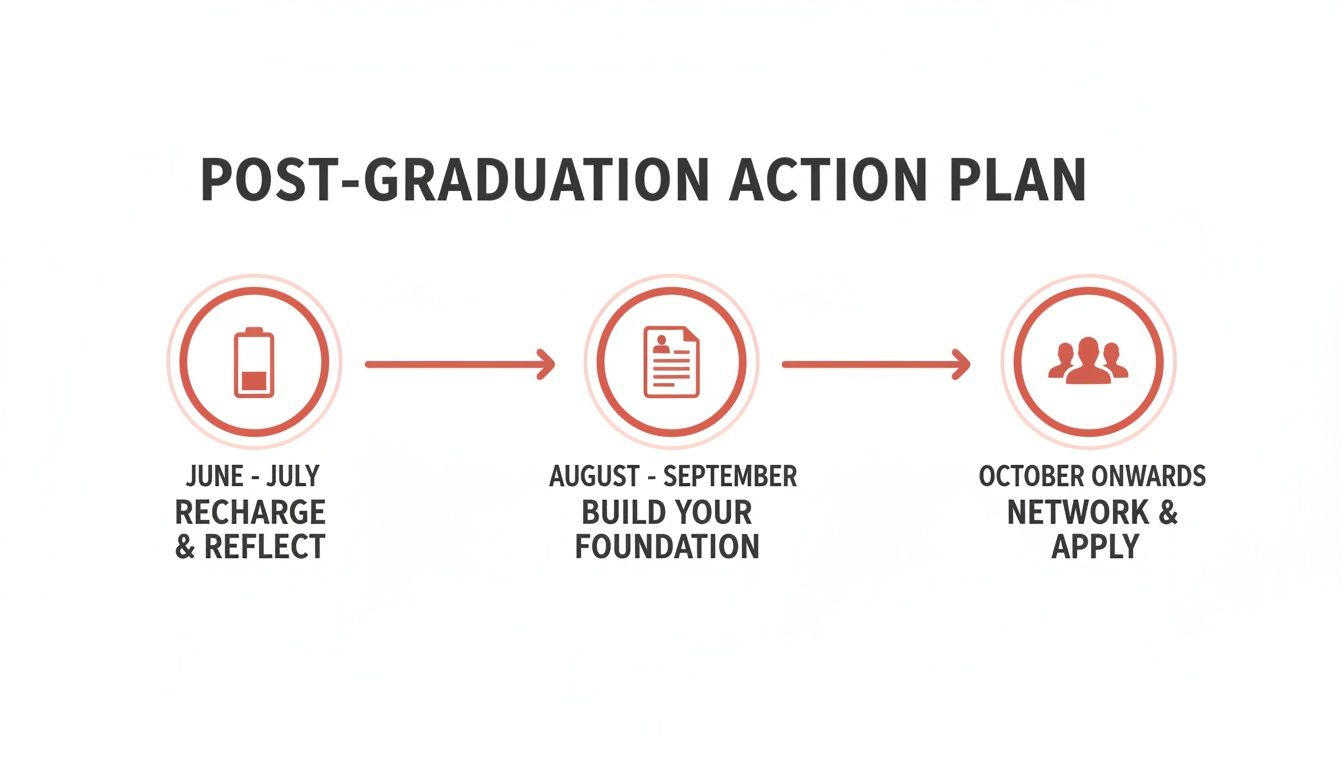
A successful job search does not start with sending many applications. It starts with smart personal and professional preparation.
Craft A Resume That Stands Out
Your resume is your first handshake with an employer. As a recent grad, you might feel like you have nothing to put on it. The good news is you have more valuable experience than you think. You just need to learn how to present it.

Framing your experience correctly is very important now. The job market for new graduates is tough. A recent 2025 employability report shows that only 30% of recent graduates find full-time jobs in their field right away. This means your resume needs to work hard for you.
Translate Academic Work Into Professional Achievements
Hiring managers know you just graduated. They do not expect a long work history. They are looking for potential, motivation, and useful skills.
Your class projects and internships are very valuable. You need to present them as professional accomplishments, not just schoolwork.
Do not just list a project by its course name. Describe what you did and the result. Use numbers to show your impact when you can.
Here’s how to reframe it:
- Before: "Completed a semester-long marketing class project."
- After: "Developed a comprehensive marketing strategy for a local business as part of a university project, resulting in a 15% increase in their social media engagement over three months."
The second version is specific. It uses a strong action verb ("Developed"). It also measures the outcome. This is the language of results, and it gets a recruiter’s attention.
Master Action Verbs And Keywords
Your resume will likely be scanned by an Applicant Tracking System (ATS) first. This software looks for specific keywords from the job description. If your resume misses these keywords, a person may never see it.
The job description is like a cheat sheet. It tells you exactly what skills the employer wants. Your resume should use the same language.
Here's a simple process to get past the ATS:
- Analyze the Job Post: Copy the job description into a word cloud tool. The biggest words are your target keywords.
- Weave in the Keywords: Add these words and phrases naturally into your experience descriptions. If the job asks for "project management," you should have a bullet point explaining how you "managed a project."
- Lead with Action Verbs: Start every bullet point with a powerful verb. Words like "managed," "created," "analyzed," "implemented," and "improved" are stronger than passive phrases like "was responsible for."
Tailor Every Single Application
A big mistake new grads make is sending the same resume everywhere. This approach does not work. You must change your resume for every role you apply for.
This does not mean you start over each time. You just need to be strategic. Read the job description carefully. Then, adjust the bullet points on your resume. Highlight the experiences that are most important for that specific job.
- Applying for a data analyst role? Move projects with spreadsheets and data analysis to the top.
- Going for a social media coordinator position? Make sure your experience with managing accounts and creating content is easy to see.
This shows the employer that you read their posting. It shows you care about the role.
Choose The Right Format And Template
The look of your resume is important. It needs to be clean, professional, and easy to read quickly. A messy layout can get your application rejected.
Avoid creative designs with strange fonts unless you are a designer. A classic, reverse-chronological format is best. It puts your most recent experience at the top.
A dedicated tool can make this easier. The GainRep Resume Builder offers professional templates made for recent graduates. Using one helps you present your skills clearly and professionally. This gives you a better chance of passing the first screening.
Build Your Professional Network And Reputation
A great resume helps you get noticed. A strong professional network can open new doors. For new grads, "networking" can sound scary. But it is really just about building real relationships.

Starting this early makes a big difference. Data from a survey on graduate employability shows that 57% of graduates found a job before graduation. This is not luck. It shows that building connections early works.
Start With Your Existing Connections
Your professional network is bigger than you think. You do not need to start by messaging CEOs on LinkedIn. Begin with people who already know and trust you.
Your immediate network includes:
- Professors and faculty who know your work ethic.
- Alumni from your university, especially those in your target field.
- Supervisors and colleagues from internships or jobs.
- Family, friends, and their professional contacts.
Your goal is not to ask for a job right away. It is to learn and build relationships that might lead to opportunities later.
Conduct Informational Interviews
Informational interviews are a great way to network. This is just a short, casual chat with someone in a job you are curious about. You are not asking for a job. You are asking for their story and advice.
Many professionals are happy to talk for 15-20 minutes about their career. Reach out to alumni on LinkedIn or ask your old professors for an introduction.
Pro Tip: When you reach out, say you are looking for advice, not a job. This removes pressure and makes them more likely to agree. Explain why you chose them, and always respect their time.
Here's a simple script you can use for a LinkedIn message:
Subject: Question from a Fellow [Your University Name] Alum
Hi [Name],
My name is [Your Name], and I just graduated from [Your University] with a degree in [Your Major]. I saw your profile and was impressed with your work as a [Their Job Title] at [Their Company].
I am exploring careers in [Their Industry] and would appreciate the chance to ask you a few questions. Would you be open to a brief 15-minute chat next week?
Thanks so much,
[Your Name]
Gather Social Proof With Endorsements
Your reputation is your most valuable career asset. As a new graduate, you need "social proof." This is evidence from others that you have the right skills and character. Professional recommendations and endorsements provide this proof.
Think like a hiring manager. Anyone can write "hard worker" on their resume. But a strong recommendation from a professor is real validation. It builds trust.
Do not wait for a recruiter to ask for references. Start collecting endorsements now.
Who to Ask for Recommendations:
- A professor from a class where you did well.
- Your academic advisor.
- A manager or supervisor from an internship or job.
- A leader from a volunteer group or club.
How To Ask For A Powerful Recommendation
When you ask for a recommendation, make it easy for the other person. They are busy. Give them everything they need to write something specific and helpful.
Here’s a template you can use:
Subject: Recommendation Request – [Your Name]
Dear Professor/Mr./Ms. [Last Name],
I hope this email finds you well. I am writing to request a professional recommendation. I valued my time in your [Course Name] class and learned a lot from [mention a specific project].
I am currently looking for roles in the [Your Target Industry] field. To help me stand out, I’m building a portfolio of endorsements. Would you be willing to write a brief recommendation about my skills in [mention 2-3 specific skills, e.g., research, data analysis, teamwork]?
To make it easier, I have attached my resume and a link to a job description I’m targeting. This will give you an idea of what recruiters want. Thank you for considering my request.
Best,
[Your Name]
Using a platform like GainRep simplifies this process. It lets you request endorsements and show them on your public profile. This creates a trustworthy portfolio that recruiters can see.
Master Your Job Application Strategy
Applying for jobs can feel like a full-time job. The cycle of searching, updating your resume, and applying is tiring. You need a smart strategy to survive. Focus on finding good fits, not just sending many applications.
This is not about the "spray and pray" method. That method involves sending hundreds of generic applications. It is better to be intentional. Find companies and roles that match your skills, values, and career goals.
You must be strategic in today's market. The job market is harder for new graduates now. In 2025, the unemployment rate for young college grads is around 4.59%. This is higher than the 3.25% in 2019. You can learn more about these recent labor market shifts to understand what they mean for you.
Quality Over Quantity: Finding The Right Fit
You need to know what you are looking for before you apply. A scattered approach wastes energy. It can lead to interviews for jobs you do not even want. A targeted search is more effective.
Start by making a list. What is important to you in a first job?
- Industry: What fields interest you? Where can you make a real impact?
- Company Culture: Do you prefer a fast-paced startup or a large corporation?
- Role Responsibilities: What kind of work do you enjoy? Are you analytical, creative, or a people person?
- Growth Opportunities: Does the company invest in its employees? Do they offer training and a clear career path?
Once you have this clarity, you can search job boards with a purpose. Every application you send will be for a role that excites you.
Embrace Technology To Accelerate Your Search
Manually searching for jobs and tailoring each application is exhausting. Technology can be your best friend in the job hunt. Tools can automate the repetitive parts of the process. This frees you up for what really matters: networking and preparing for interviews.
Your time is your most valuable asset during a job search. Do not waste it on tasks a machine can do faster. Focus your energy on the human parts of the process that will land you the job.
Tools like AI-powered applicators were made for this. They handle the boring work so you can focus on high-impact actions. For example, the GainRep AI Auto-Apply tool searches thousands of job postings for you. It finds roles that are a perfect match for your resume.
It does not just find the jobs. It automatically applies for you. It even generates a tailored cover letter with AI for each one. This technology can save you hundreds of hours. This lets you apply to more relevant jobs without losing quality. This means more chances for interviews while you prepare to do well in them.
Let's break down the difference.
Traditional Job Search vs AI-Powered Job Search
| Aspect | Traditional Method | AI-Powered Method (GainRep) |
|---|---|---|
| Time Spent per Week | 15-20 hours of manual searching and applying. | 1-2 hours to set up your profile and let the AI work. |
| Applications Sent | 10-20 high-quality applications per week. | Hundreds of targeted applications sent automatically. |
| Effort Level | High. Leads to burnout and frustration. | Low. Frees you to focus on networking and interview prep. |
| Typical Outcome | A slow trickle of responses. | A big increase in interview invitations and a faster path to offers. |
The difference is clear. Using a smart tool gives you a big advantage. It lets you apply to more jobs without the manual work.
Create A System For Tracking And Follow-Up
You must stay organized as you send applications. It is easy to lose track of which company you applied to and when. A simple tracking system gives you control. It makes sure no opportunity is missed.
You do not need anything fancy. A basic spreadsheet or a free tool like Trello works well. Make sure your tracker includes these columns:
- Company Name: The name of the organization.
- Job Title: The role you applied for.
- Date Applied: The day you sent your application.
- Application Link: A link to the job posting.
- Status: A dropdown with options like "Applied," "Interviewing," or "Rejected."
- Contact Person: The name of the recruiter, if you have it.
- Notes: Any important details about the role.
This system does more than keep you organized. It helps you see patterns. You might notice certain roles get you more interviews. This lets you adjust your strategy. It also helps you follow up professionally. This shows recruiters you are organized and interested.
Thinking Beyond The Traditional 9-to-5 Job
A corporate job is a great goal. But it is not the only path to a good career. Many recent graduates find that a different path builds unique skills and offers flexibility.
Figuring out what to do after graduation is not a multiple-choice test with one right answer. It is about finding the path that matches your goals. This could mean more school, starting your own business, or traveling.
Let's look at some of these other options.
Is Graduate School The Right Move For You?
Graduate school can feel like a safe choice when the job market is uncertain. It offers a clear path. But it is a big commitment of time and money. You have to ask yourself why you are considering it.
Do you need a master's or Ph.D. for your dream career, like a therapist or professor? Or are you just trying to delay the job search?
Be honest with yourself. If you are uncertain about finding a job, it might be better to get work experience first. A year or two in the workforce can provide clarity. It can also make a future grad school application stronger.
Think about these factors before you commit:
- Cost vs. Potential Salary Increase: Compare the average starting salary for someone with a bachelor's versus a master's degree in your field. Will the extra pay justify the student loan debt?
- Time Commitment: A master's program usually takes two years. A Ph.D. can take five or more. Is that time you are willing to trade for work experience?
- Career Goals: Talk to people in your target industry. Do they say a graduate degree is necessary, or is hands-on experience more valued?
Diving Into Freelancing And The Gig Economy
The world of work is changing. More people are choosing to be freelancers. Freelancing offers freedom and the chance to be your own boss. For a new grad, it is a great way to build a portfolio with real client work.
You can start small. Offer skills you already have, like writing, social media management, or graphic design. Platforms like Upwork and Fiverr can help you find your first clients. Your existing network is also a powerful resource.
Starting a freelance career means running a small business. If you want a more flexible career, check out this ultimate guide to freelancing in the Netherlands. It can help you understand what being an independent worker involves.
Making A Gap Year Count
A gap year is often seen as a long vacation. But if you do it right, it can be a strategic move. It can make your resume stand out.
The key is to use your time with a purpose. A year spent volunteering abroad or working on a passion project is more impressive to an employer than a year of drifting.
A well-planned gap year shows maturity and independence. For example, teaching English in another country proves you have communication skills. Volunteering for a non-profit shows dedication and project management experience.
When you return to the job search, you will have more than a degree. You will have a unique story and real-world experiences that put you ahead of other candidates.
Common Questions Every New Grad Asks
Entering the "real world" after graduation brings up many questions. It is normal to feel a bit lost. Let's answer some of the most common worries to give you clarity.
How Long Should My Job Search Take After Graduation?
There is no single answer. It depends on your industry, the job market, and your search strategy. A good rule is to expect the search for a full-time role to take three to six months. Do not panic if you do not have a job in the first few weeks.
Consistency is the most important thing. Keep your momentum going. This is where being smart with your time helps. Getting stuck in endless applications leads to burnout. Using a tool like GainRep's AI Auto-Apply can automate the hard work. It frees up your energy for networking and preparing for interviews.
The goal is not just to find any job. It is to find the right job. Patience and a steady strategy will lead to a better result than a frantic search.
What If My Degree Is Unrelated To The Job I Want?
Many successful people work in fields unrelated to their college major. The key is to focus on the transferable skills you learned.
What are transferable skills? They include:
- Critical thinking and problem-solving
- Communication (written and verbal)
- Project management and meeting deadlines
- Research and analyzing information
These skills are valuable in any industry. Your job is to show the hiring manager how you have used them. Highlight class projects or internships on your resume that demonstrate these skills. You can also take online courses or get certifications to fill any knowledge gaps. Also, network with people in your target industry. Ask them how they got started.
Should I Take The First Job Offer I Receive?
This is a tough question. The answer is: it depends. If the first offer is from a good company, gives you a chance to learn, and pays fairly, it could be a great start. A "good enough" first job lets you gain experience while you look for your dream role.
But, you should trust your gut. If you noticed red flags during the interview, it might be better to wait. Maybe the company culture seemed toxic or the role sounded different from the job description. You have to weigh the pros and cons based on your financial situation and your long-term career goals.
How Do I Handle Rejection During The Job Search?
Rejection is a normal part of the job search. It is not a reflection of your worth. A company might get hundreds of applications for one position. It is a numbers game, so do not take it personally.
Try to see every rejection as a chance to learn. You can politely ask the recruiter for feedback. Review your resume and cover letter again. Practice your interview answers with a friend. Every "no" gets you one step closer to the right "yes." Your resilience is your greatest asset.
Ready to stop worrying and start applying smarter? GainRep is your career co-pilot. Build a standout resume with professional templates from our Resume Builder, or let our AI find and apply to your perfect jobs automatically. Take control of your job search today with GainRep's AI Auto-Apply.
