


Negotiating a job offer is a key step in your career. It has three main parts. First, you research your market value. Second, you ask for what you want. Third, you finalize the deal. Most employers expect you to negotiate. This one conversation can greatly increase your long-term earnings.
Why You Should Always Negotiate Your Salary
Getting a job offer feels good. It means a company wants you on their team. But accepting the first number is often a mistake. Many companies add a buffer to their first offers. They assume top candidates will ask for more. If you do not ask, you leave money on the table.
Your starting salary sets the foundation for future earnings. All your raises and bonuses are based on this number. A small increase now can turn into thousands of dollars over a few years. Negotiating is a crucial part of the job application process. Tools that streamline your job search, like an AI job application filler, can get you more interviews and more offers to negotiate.
The Power of Asking
Fear often holds people back. They worry about seeming greedy. They fear the company might take back the offer. Data shows these fears are mostly unfounded. A polite, well-researched request is a standard part of hiring. Nearly eight out of ten people who ask for more money get a better offer.
Skipping this step can be costly. The typical raise for those who negotiate is about 18.83%. If you want to see the numbers for yourself, you can explore more salary negotiation statistics.
You have the most leverage right after you get a job offer. The company has already invested time and money to recruit you. They have decided you are the best person for the job.
The process can be broken down into three simple stages. First, do your research. Second, have the conversation. Third, finalize the agreement.
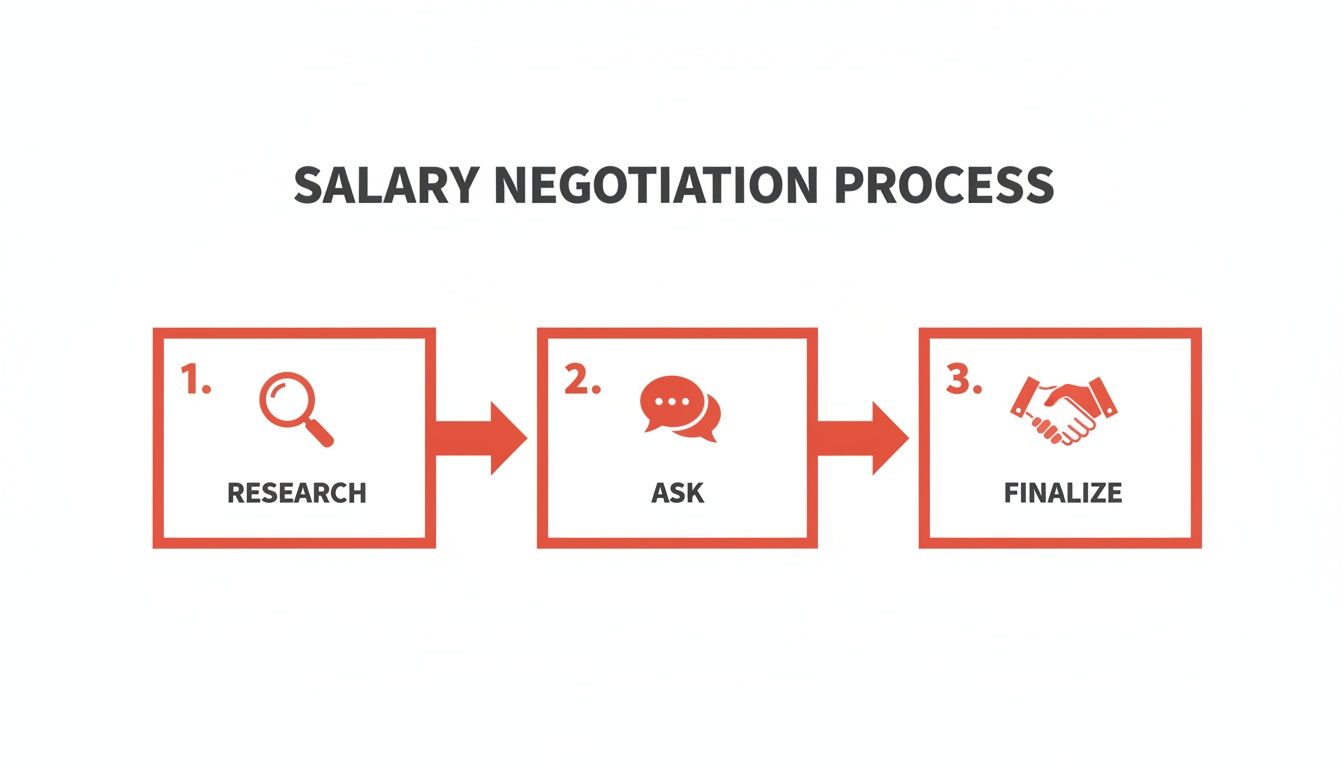
This visual guide keeps it simple. A good negotiation begins with solid preparation. It ends with a clear, agreed-upon result.
Your Negotiation Framework
A simple game plan helps you stay on track. Treat it like a firm but friendly business talk. You are advocating for your professional value. Before you think about numbers, remember these principles:
- Be Prepared: Know your worth. Use real market data for your role, experience, and location.
- Stay Positive: Keep the conversation upbeat. Show your excitement for the role and company.
- Communicate Clearly: State your request and reasons with confidence. Do not apologize.
- Remain Flexible: Be open to discussing other things if the salary cannot change. This can include benefits, vacation time, or a signing bonus.
Here is a quick guide on what to do and what to avoid.
Key Do's and Don'ts of Salary Negotiation
| Do | Don't |
|---|---|
| Research industry salary benchmarks thoroughly. | Accept the first offer without discussion. |
| Frame your request based on your value and market rates. | Make it personal or emotional. |
| Express enthusiasm for the role and the company. | Give an ultimatum unless you are ready to walk away. |
| Listen carefully to their response and concerns. | Apologize for negotiating your compensation. |
| Be prepared to discuss benefits and perks. | Lie about your current salary or other offers. |
| Follow up with a clear, written confirmation. | Rush the conversation or feel pressured to decide instantly. |
Following these simple guidelines will keep you in a strong, professional position.
Preparing for a Strong Negotiation
A successful salary negotiation is won before you talk to the hiring manager. This is when you do your homework and build your case. Most importantly, you build your confidence. Walking into the talk with real data changes your request. It becomes a logical proposal they cannot easily dismiss.
Your first move is to understand the market value for your role. This is not just about a job title. It includes your industry, years of experience, and location. A software developer in San Francisco has a different market value than a recent graduate in a smaller city.
Gather Your Salary Data
To learn how to negotiate a salary offer well, you need solid numbers. Use a few different sources to get a complete picture.
- Salary Databases: Sites like Payscale and Glassdoor are very helpful. They collect salary data based on title, location, and experience. This gives you a good starting point.
- Government Data: The U.S. Bureau of Labor Statistics offers detailed wage data. This official benchmark adds weight to your argument.
- Industry Reports: Look for annual salary guides from professional groups in your field. These reports are often very specific and show current pay trends.
As you research, you are looking for a range, not just one number. Write down the low, median, and high-end salaries for your position. This range is your area for negotiation.
Define Your Numbers
You have the market data. Now, it is time to set your personal numbers. These three key numbers will guide you through the negotiation.
First is your target salary. This is the number you will start with. It should be ambitious but realistic. It usually falls in the upper half of your researched range. It is based on data and reflects your unique skills.
A well-researched target salary is more than just a number. It tells the employer you understand your market worth and are serious about your career.
Next, you must set your walk-away number. This is your absolute lowest acceptable salary. You must decide this before the negotiation begins. It protects you from accepting a low offer under pressure. It is about respecting your financial needs and career standards.
Finally, think about your ideal number. This is your "pie-in-the-sky" salary. You will probably not start with this number. But having it in mind helps you aim high.
Build Your Value Proposition
Your request for more money must be about your specific value. It is not just about what the market pays. Look at the job description and your resume.
Your job is to connect your skills to their needs. List your key qualifications and achievements that match what they are looking for.
- Quantify Everything: Do not just say you "improved efficiency." Instead, say you "streamlined a process that saved 15 hours per week." Numbers are powerful and make your impact clear.
- Highlight Your Unique Skills: Mention any rare certifications or specialized experience you have. This justifies paying you at the top of the market range.
- Tie It to Their Goals: Show them how your past achievements will help them. For example, "My experience growing a social media audience by 300% will help you achieve your goal of expanding brand reach."
This preparation changes the conversation. You are no longer just asking for money. You are showing that your skills are a valuable investment.
Using the Right Words to Make Your Case
Knowing your number is one part of the process. Saying it out loud is another. Having key phrases ready can make a big difference. The goal is to start a conversation, not make a demand.

The basic flow is the same whether you are on the phone or writing an email. Start with gratitude. Build your case with research. Then, open the floor for discussion. This keeps the exchange positive and professional.
Kicking Off the Conversation
Your first response to the offer sets the tone. Always start with genuine excitement and appreciation. You want them to know you are thrilled about the role.
A great starting point sounds like this:
"Thank you so much for the offer! I am very excited about the opportunity to join the team and contribute to [Company Name]'s goals."
This positive opener makes the hiring manager more open to your request. It shows you are negotiating from a place of shared interest. After establishing this goodwill, you can move to the numbers.
Phrasing Your Counteroffer on the Phone
Phone calls can feel more intense. But direct contact can be an advantage. You get immediate feedback from their tone. You can adapt as you go. Write down your key points so you do not get nervous and forget them.
Here is a simple framework for the call:
- Start with Thanks: Give a warm, genuine thank you for the offer.
- Reiterate Excitement: Remind them you want to join the company.
- Make Your Case: Use your research here. Explain the basis for your number.
- State Your Number: Say your desired salary clearly and confidently.
- Keep the Door Open: End with a question that invites discussion, like "Is this something we can discuss?"
Example Phone Script:
"Thank you again for this offer. I am thrilled about the possibility of working together. Based on my research into the market rates for this role in [Your City] and my experience in [mention a key skill], I was targeting a salary closer to $85,000. I am confident my skills will bring great value to the team. Would it be possible to discuss this further?"
This script is polite, data-driven, and confident. It turns a potentially awkward ask into a straightforward business chat.
Crafting the Perfect Negotiation Email
Email can be a better option sometimes. It gives you time to perfect your words. It also creates a written record of the conversation. The structure is similar to a phone call, but you can be a bit more detailed.
A strong negotiation email is short and professional. It gets straight to the point.
Here is a template to use:
- Subject Line: Your Name – Question about the offer
- Opening: Start with gratitude and excitement.
- The Ask: State your counteroffer and briefly explain why. Mention market data and your unique skills.
- The Justification: Connect your value directly to their needs. Briefly mention one or two powerful achievements.
- Closing: Reiterate your enthusiasm and suggest the next step, like a quick call.
Example Email Snippet:
"Thank you again for offering me the [Job Title] position. I am very excited about this opportunity.
After reviewing the offer and researching salaries for similar roles in our area, I would like to discuss the compensation. Given my 7 years of experience in project management and my track record of increasing efficiency by over 20%, I was seeking a salary of $92,000.
I am confident that my background aligns perfectly with your goals for this position. I am eager to bring my skills to your team.
Would you be open to a brief call to discuss this?"
This email is direct but not demanding. It clearly states what you are asking for and why. It keeps the conversation open.
Dealing with Objections and Counteroffers
A hiring manager rarely says "yes" to your first counteroffer. You will often hear a common objection. Handling these moments well keeps the conversation going. It shows you are a calm, professional negotiator.
An objection is not a hard "no." It is an invitation to talk more. They are telling you about their limits. Your job is to listen and understand. Then, guide the conversation back to the value you bring. Stay cool and collaborative.
"This Is the Top of Our Budget"
This is a very common line. It is meant to sound final, but it often is not. Acknowledge their budget. Then, gently remind them of your high value.
When you hear this, do not give up. Try saying this:
"I understand you have a budget to work within. Looking at the role's responsibilities and the value I can bring—especially with my experience in [mention a key skill]—I feel my request reflects the market and my potential contribution. Is there any flexibility?"
This response is respectful but firm. It shifts the focus from their budget back to your qualifications and the market rate. It keeps the door open for a creative solution.
"We Need to Maintain Internal Pay Equity"
This objection is about fairness. Companies must pay people in similar roles a similar amount. Your goal is to show how your specific skills put you on a different level.
Here is how you can handle this:
- Highlight Your Unique Value: Gently point to skills or experiences you have that are not common on their team. For example: "I appreciate the importance of internal equity. Could we look at how my background in [specific advanced skill] or my [specific certification] might position my contribution differently? These qualifications will help me deliver results faster."
- Show You Are a Stronger Performer: Frame your experience as a direct benefit to them. Suggest that your advanced skills mean you will need less time to get up to speed. This saves the company money and resources.
This approach does not argue with their policy. It makes a case for why you might fit into a higher bracket within that policy.
Handling the Company's Counteroffer
The company will often come back with a number between their first offer and your request. This is a great sign. It means they want you and are willing to negotiate. Now, you have a choice to make.
First, take a moment. You do not have to decide right away. Thank them for the new offer and ask for a day to think about it. This gives you space to evaluate it without pressure.
Next, look closely at the new number.
- Does it meet your walk-away point? If it is below your minimum, you must be ready to politely decline.
- How close is it to your goal? If it is close, it might be smart to accept. This is especially true if you love the role.
- Is there room for one last push? If there is still a gap, you could make one final, smaller counteroffer. You might say, "Thank you for working with me on this. We are very close. Would it be possible to meet in the middle at [a number between their counter and your last ask]?"
Your decision depends on how much you want the job. It also depends on how firm their last offer seemed. Trust your gut. No matter what you choose, always stay professional and appreciative.
Looking Beyond Your Base Salary
Sometimes, a company cannot increase the base salary. They might be limited by pay bands or strict budgets. This is not the end of the conversation. It is a signal to change the subject.
A job offer is a complete package. The salary is just one part. Your total compensation includes health insurance, retirement plans, vacation days, and more. If the company is firm on base pay, you can often negotiate these other components. Pivoting the discussion shows you are flexible and focused on finding a solution.

Shifting the Conversation to Perks
A smooth transition is important when the salary talk stalls. You want to keep the tone positive. A simple phrase can shift the focus.
For example, you could say:
"I understand that the base salary is firm. Since we are close to an agreement, I would love to explore other parts of the compensation package to see if we can bridge the gap."
This shows you are still very interested in the role. It also opens the door to discuss other valuable benefits. Many companies have more flexibility with one-time bonuses or perks than with a recurring salary expense.
Common Benefits You Can Negotiate
Be ready with a few specific requests after you pivot the conversation. Think about what matters most to you. This could be your work-life balance, career growth, or financial needs.
Here are some common and valuable perks to consider:
- Signing Bonus: This is a one-time payment when you join. It is a great way for an employer to make the deal more attractive without increasing long-term salary costs.
- More Paid Time Off (PTO): An extra week of vacation is very valuable. Asking for a third week is a reasonable request, especially for senior roles.
- Flexible Work Schedule: The ability to work from home can save you time and money. This is often an easy "yes" for companies because it costs them nothing.
- Professional Development Budget: Ask for a budget for courses, certifications, or conferences. This shows you are committed to growing your skills, which benefits them.
Also, look into more creative options. There are many innovative employee benefits available.
How to Prioritize Your Asks
You probably will not get everything you ask for. It is important to prioritize. Before you have the conversation, decide what is most important to you.
Make a simple list of perks. Rank them from "must-have" to "nice-to-have." For example, a signing bonus might be your top priority if you are relocating. A hybrid work arrangement might be the most valuable thing if you have a long commute.
This clarity helps you be strategic. Start by asking for your number one item. If they cannot provide it, move to the next item on your list. This thoughtful approach shows you have carefully considered the offer. It also shows you are negotiating in good faith to find a solution that works for everyone.
Answering Your Top Salary Negotiation Questions
You might face some tricky questions during a negotiation, even with a good plan. Knowing how to handle these moments beforehand is key to staying confident.
Think of this as your personal FAQ for awkward spots. We will clear up the confusion so you can navigate the conversation with skill.
When Should I Bring Up Salary?
Timing is very important. It is almost always better to let the employer bring up money first. This usually happens once they have decided you are a serious candidate. At that point, you have more leverage.
If they ask about your salary expectations early, try to deflect. You can say you are flexible. Say your main focus is learning more about the role. Always prove your value before you talk about numbers.
The golden rule of negotiation is to never be the first to name a number. When the employer makes the first offer, you learn about their budget. You also avoid accidentally asking for too little.
What if They Ask for My Current Salary?
This is a classic tactic, but you do not have to answer. In many places, it is illegal for companies to ask. Sharing your current salary anchors the negotiation to what you used to make. It should be about what you are worth now.
Instead of giving a number, pivot the conversation back to market value.
A strong response sounds like this:
- "I would prefer to focus on the value I can bring to this role. Based on my research for similar positions in this city, roles with this level of responsibility typically pay between $80,000 and $95,000."
This changes the frame of the discussion. It moves from your past salary to the job's current market worth. This puts you in a much stronger position.
Can I Negotiate if a Recruiter Is Involved?
You absolutely should negotiate when a recruiter is involved. A good recruiter is your ally. Their commission is often a percentage of your starting salary. Getting you a better offer is in their best interest, too. Be transparent with them from the start.
Share your salary expectations and research with your recruiter. When an offer comes in, discuss your counteroffer strategy with them. They have inside knowledge about the company's flexibility. They can act as a professional buffer, making the process smoother.
Is It Possible to Lose an Offer by Negotiating?
This is the biggest fear for many people. But it is very rare for a company to withdraw an offer because you tried to negotiate. As long as your request is professional and backed by research, the worst that usually happens is they say "no" to your counteroffer.
Companies expect their top candidates to negotiate. It is a normal part of the hiring process. A polite, reasonable negotiation shows you know your worth. Any company that would take back an offer over something so standard is probably not a place you want to work.
At Gainrep, we are committed to helping you build the career you deserve. A weak resume should not hold you back from opportunities that pay what you are worth. Our professional resume builder provides expert templates and guidance. It makes sure your skills and accomplishments stand out. This gives you the confidence to negotiate for the salary you have earned.
