

The old one-page resume rule is outdated. It is time to forget it. For most professionals, sticking to that rule can hurt your chances. Recruiters often prefer a two-page resume. It paints a clearer picture of what you bring to the table. It gives you room to detail your value. You will not have to cram years of work into a tiny, unreadable box.
Your Guide to Ideal Resume Length
So, what is the magic number? The truth is, it depends on where you are in your career. A recent graduate’s one-page resume looks different from a senior executive's two-page career story. The goal is to be compelling, not overwhelming.
Resume standards have shifted in recent years. We have seen a trend toward longer resumes. The average word count grew from 312 words in 2018 to over 500 in 2023. This is a 61% increase. Two-page resumes are now more common than one-page resumes. This shows what hiring managers expect. You can learn more about how resumes are changing to see how much the game has evolved.
Resume Length at a Glance
Think of your resume length as a reflection of your career. Here is a quick guide to help you find the right length for your career stage.
| Experience Level | Recommended Page Count | Optimal Word Count |
|---|---|---|
| Students & Entry-Level | 1 Page | 300–500 words |
| Mid-Career Professionals | 1–2 Pages | 475–600 words |
| Senior & Executive-Level | 2 Pages | 600–800 words |
| Academic or Scientific | 2+ Pages | 800+ words |
This table gives you a solid starting point. Now, you must fill those pages with content that makes a hiring manager notice. Building a document that clearly shows your achievements is key. Using a professional tool like the GainRep resume builder can help you create a polished resume structured for today’s job market.
Is the One-Page Resume Rule Officially Dead?
The idea that every resume must fit on one page is old. It comes from a time when resumes were typed, printed, and mailed. Shortness was a practical need.
Things are different now. Roles are more specialized. Hiring managers need proof of what you have done. They want to see what you can do for them.
Forcing ten years of experience onto one page often fails. It leads to cutting important details. It makes you shrink the font size. It makes you squeeze the margins until the page looks cluttered. Instead of impressing, it can make your resume look rushed and incomplete. This can hide your biggest career wins.
Your Value Needs Room to Breathe
Look at any modern job description. They are packed with specific needs. Employers want to know how you did your job, not just that you had it. A single page is often not enough space to tell that story well. This is especially true if you have a lot of experience.
A well-crafted two-page resume gives you the space you need.
- Explain key projects. You can properly describe the challenge, your actions, and the measurable results.
- Show off your achievements with numbers. This is where you prove your impact. Think "grew sales by 15% in six months" or "cut project overhead by $20,000."
- List the right technical skills. You have enough room to list the software, languages, and certifications the job requires.
A one-page resume is like a movie trailer. A two-page resume is the full movie. It gives recruiters a complete picture of your journey. It shows the real value you can bring. Hiding your best work to follow an old rule is a missed opportunity.
How to Use Extra Space Correctly
Adding a second page does not mean you should include every job you have ever had. Every word on your resume must earn its place. The goal is to add depth, not just length. Cramming everything you have ever done can hide your most important qualifications.
Your resume’s job is to show the top 10% of your experience. This experience must be relevant to the role you want. Do not let an old page limit stop you from showing your best work.
Giving your achievements more space makes it easier for a hiring manager to see why you are a perfect fit. A clean, well-organized resume that shows your value will always win. To build a resume that presents your experience well, use professional templates. You can find great options at GainRep resumes to help you structure your accomplishments for the best effect.
Finding the Sweet Spot: It's All in the Word Count
We often focus on page count. The real secret to a resume that gets noticed is the word count. It is the sweet spot where your resume is detailed enough to impress but quick enough to scan.
Data shows that resumes with between 475 and 600 words get more interviews. This is not a random number. It is the perfect balance. It is long enough to show your best achievements with context. It is short enough for a busy recruiter to understand in under a minute.
Hitting this target means every word has a job.
Why This Word Count Works
Your resume should be a highlights reel, not the full movie. Sticking to the 475-600 word range forces you to focus only on what the employer cares about. A resume in this range avoids common mistakes that get other applications rejected.
Here is why it is so effective.
- It cuts out fluff. You do not have space for vague job duties. Every bullet point must have action verbs and measurable results.
- It respects the recruiter's time. Hiring managers review many resumes. They spend just seconds on the first look. A resume in this range is easy to read. Your best qualifications stand out.
- It proves you communicate clearly. Presenting complex information in a simple way is a skill. A tightly edited resume is your first chance to prove you have it.
Sticking to this length gives recruiters the detail they need without overwhelming them.
Research shows that resumes in the 475 to 600-word range were twice as likely to get an interview. This is compared to much shorter or longer resumes. A surprising 77% of resumes are outside this ideal range. You can see the full research on resume statistics to understand how powerful this one change can be.
How to Hit the Perfect Word Count
Getting your resume into this ideal range is about smart editing.
If you are over the limit, start cutting.
- Shorten descriptions for jobs from more than ten years ago.
- Remove generic phrases like "responsible for."
- Use powerful action verbs that show what you did.
If your resume is too short, you can add more impact.
- Go back through your experience. Add specific numbers and metrics.
- Instead of "Managed social media," try "Grew social media engagement by 45% across three platforms in six months."
- These details add weight and credibility. They help you hit that sweet spot.
How to Match Your Resume Length to Your Experience
One of the first questions people ask is, "How long should my resume be?" There is no single magic number. The right length reflects your career journey. A recent grad’s resume is about potential. A senior leader’s resume must show a history of impact. It is all about telling your professional story effectively.
This flowchart shows the word count sweet spot that gets the most attention.
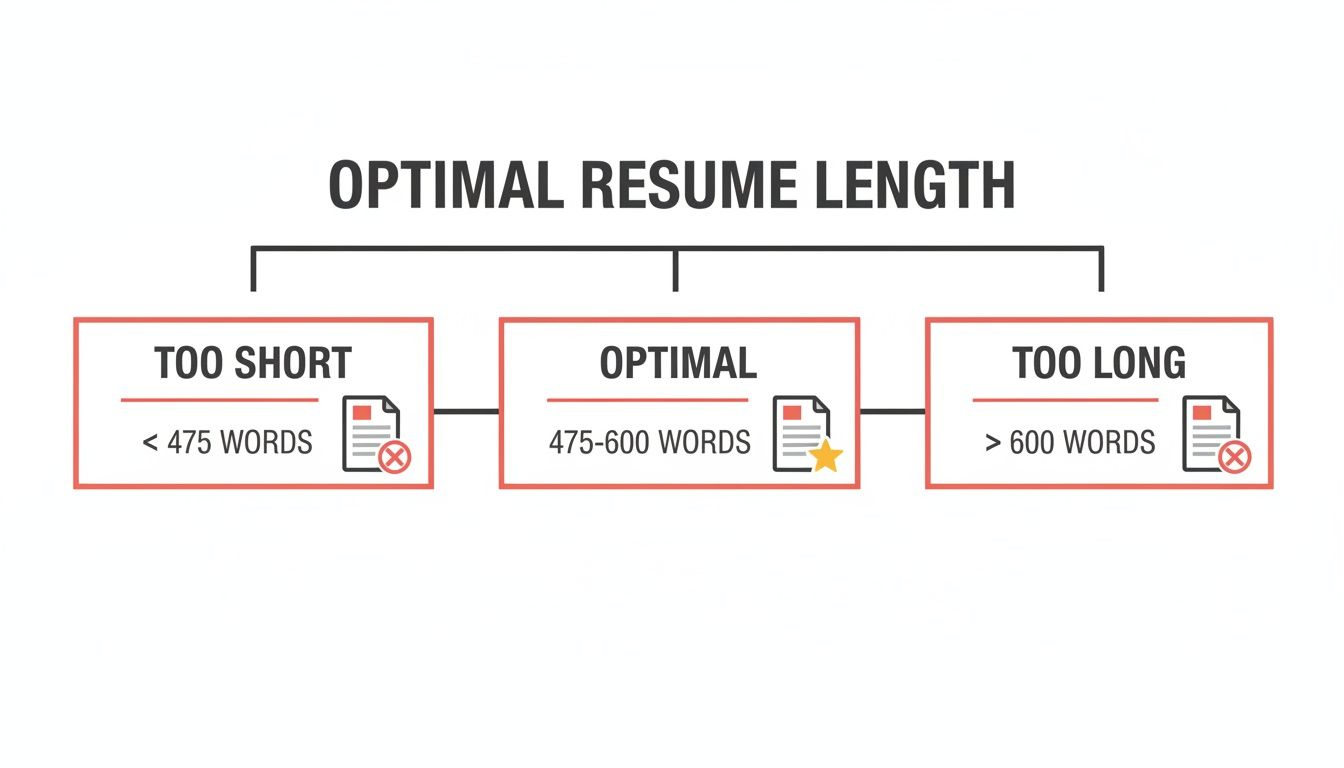
The key takeaway is that the 475-600 word count range maximizes your chances. A resume that is too short suggests you lack experience. A resume that is too long can hide your key achievements.
Students and Entry-Level Professionals (0-5 Years)
If you are just starting out, a one-page resume is your best friend. Recruiters for entry-level roles expect a short, high-impact summary. They need to see your skills and potential quickly.
Your goal is to pack that single page with relevant information. It should prove you are ready for the job.
- Focus on Education and Internships. Put your relevant coursework, projects, and internships first.
- Showcase Key Skills. Have a section for technical skills, software, or languages from the job description.
- Use Numbers When Possible. Even in early roles, numbers matter. Mention how many customers you helped or the size of a project team you joined.
A focused one-page resume shows you can prioritize information. It also shows you can communicate clearly. These are skills every new hire needs.
Mid-Career Professionals (5-15 Years)
Once you have over five years of solid experience, a two-page resume often becomes necessary. Trying to fit a decade of wins on one page does a disservice to your career. You risk cutting valuable accomplishments just to meet an old page limit.
A second page gives you the room to properly show your career growth.
A two-page resume allows you to provide context for your biggest wins. You can detail significant projects, highlight leadership experience, and show a clear pattern of professional development. A single page cannot capture this.
For mid-career roles, recruiters look for depth. They want to see how you have solved problems and delivered results over time. Do not be afraid to use the space to tell that story.
Senior Leaders and Technical Experts (15+ Years)
For executives and senior managers, a two-page resume is the standard. A three-page resume might be acceptable in specific cases, like for federal jobs or in academia. But that is rare.
Your focus should shift to strategic impact and leadership.
- Prioritize Recent Accomplishments. Give the most space to your last 10-15 years of experience. That is what is most relevant now.
- Highlight Leadership. Show your experience managing teams, overseeing budgets, and driving company-wide projects.
- Create a "Career Highlights" Section. An executive summary at the top is perfect for busy hiring managers who need the main points fast.
For these roles, a resume must prove a history of high-level success. Two pages ensure you can provide the evidence needed to land top-tier interviews. Building a document that reflects this level of experience can be a challenge. Using a professional resume builder can help you organize a long career history into a powerful format.
One Page vs Two Page Resumes
Still not sure? This table breaks down the decision. It will help you choose the right fit for your career stage.
| Consideration | One-Page Resume | Two-Page Resume |
|---|---|---|
| Best For | Students, recent grads, and professionals with under 5 years of experience. | Professionals with 5+ years of experience, managers, and senior leaders. |
| Primary Goal | To show potential and highlight relevant skills and education. | To show a detailed history of accomplishments, career growth, and impact. |
| Recruiter Expectation | A quick, scannable summary of qualifications. | In-depth evidence of skills and leadership demonstrated over time. |
| Key Content | Internships, academic projects, core skills, and early job duties. | Major projects, quantifiable achievements, leadership roles, and strategic contributions. |
| Mistake to Avoid | Using tiny fonts or margins to cram in too much information. | Filling the second page with irrelevant details from over 15 years ago. |
The goal is not just to fit on a certain number of pages. It is to tell the most compelling story possible. Choose the length that lets you do that without selling yourself short or overwhelming the reader.
What Recruiters and Hiring Managers Actually Want
To write a resume that gets you hired, you need to think like the person reading it. What do they really want to see? It is easy to think shorter is always better. But the game has changed. Hiring managers now look for depth and context, not just a brief summary.
Their process is fast. The first glance at your resume is quick. Studies show 57% of managers spend one to three minutes on a resume. But 22-24% make a decision in less than 60 seconds. This means your resume must be easy to scan and detailed enough to make them pause.
The Two-Page Preference Is Real
Let go of the old one-page rule. It no longer helps most job seekers. Modern hiring managers want more detail.
Recent data shows a clear shift. A majority now prefer two-page resumes. It gives them a fuller picture of who you are and what you can do.
Here is what the numbers say: 54% of hiring professionals now favor two-page resumes. Even more telling, 70% are more likely to consider a candidate with a two-page resume over a one-page version. The message is clear: they want more detail.
This confirms that giving your experience room to breathe is a smart move. A well-crafted two-page resume lets you build a compelling story about your career. That is what gets a recruiter’s attention.
Formatting Is Non-Negotiable
Even the best career history will be ignored if the resume is a mess. Poor formatting is a big red flag for recruiters. In fact, 73% of hiring managers say bad formatting is a top reason for rejecting a resume.
This is not about being picky. It is about readability. Your resume must be clean, professional, and easy to scan. Get these basics right.
- Clear Headings. Use simple, bold headings for sections like "Experience," "Skills," and "Education."
- Ample White Space. Do not cram everything together. Proper margins and line breaks make your resume inviting.
- Consistent Font. Stick to one professional font like Calibri or Arial. Keep the size readable, usually between 10-12pt.
- Actionable Bullet Points. Start your bullet points with a strong action verb to describe your accomplishments.
You can check out these 7 Reasons Employers Are Rejecting Your Resume to make sure you avoid common mistakes. Nailing the small details ensures your qualifications shine, not your formatting errors.
Every job is different, so tailoring your resume is crucial. Using a tool like GainRep's AI Auto-Apply can be a game-changer. It automatically customizes your resume for each application. This ensures you always put your most relevant experience first.
Simple Ways to Adjust Your Resume Length

Getting your resume to the right length is about smart editing. Whether it is too long or too short, a few changes can make a big difference. Your goal is to create a focused, powerful document. It should respect a recruiter’s time while showing your best self.
If your resume is too long, it is time to cut the extra information. A crowded document can overwhelm a hiring manager. Your most impressive achievements might get lost.
How to Shorten a Long Resume
Think of yourself as a sculptor. You must chip away anything that does not support your application for this specific role. Be tough. Every word needs to earn its spot.
- Remove Old Jobs. Jobs from over 15 years ago can usually be removed. They take up space and are rarely relevant today.
- Cut Filler Words. Get rid of phrases like "responsible for" or "duties included." Jump straight to the action. Start your bullet points with strong verbs.
- Group Your Skills. Instead of a long list of every software you have used, group them into categories. Use "Proficient In" for your core tools and "Familiar With" for others.
- Adjust the Format. Small changes can save a lot of space. Try narrowing the margins, but not below 0.5 inches. You can also tighten the line spacing.
A short, clear resume sends a powerful message. It shows you communicate well and know how to prioritize. A modern resume builder with professional templates can make this easier.
How to Expand a Short Resume
If your resume feels a little empty, do not worry. This is a great chance to add more value. A resume that is too short can suggest a lack of experience. Adding meaningful detail is key to making a stronger impression.
Your resume is a marketing document, not just a list of jobs. Adding specific, measurable achievements is the fastest way to show your impact. This expands your resume with high-value content.
Here is how to add more substance.
- Explain Your Projects. Do not just list the project name. Briefly explain its goal, your role, and the outcome.
- Add Measurable Results. Look for numbers in every role. How much did you increase sales? By what percentage did you boost efficiency? Numbers are powerful.
- Include a Professional Summary. A short summary at the top of your resume is a perfect way to frame your experience. It adds valuable content right away.
- Showcase More Skills. Consider adding a section for important soft skills like "Communication" or "Team Leadership." Include a brief example for each one to prove it.
Making these changes will help you find the perfect balance. It will answer the "how long should a resume be" question for your own career.
Still Have Questions About Resume Length?
You have done the hard work. Your resume is almost ready. But a few final questions can pop up. Let's clear up some common ones so you can apply with confidence.
Is a Three-Page Resume Ever a Good Idea?
Yes, but it is rare. A three-page resume is mainly for senior executives, academics with many publications, or technical experts. These roles may need that level of detail.
For almost everyone else, one or two pages is best. Before you add a third page, ask yourself if every word on it is essential for the job you want.
Should I Change My Resume's Length for Different Jobs?
Yes. You should tailor your resume for every application. Sometimes that means changing the length.
For example, imagine you are applying for a project management job. You will want to expand on your project descriptions. You might add more bullet points with specific outcomes. This could easily and correctly turn your one-page resume into a clean, two-page resume. The main goal is relevance, not just hitting a certain page count.
An old myth says that Applicant Tracking Systems (ATS) reject longer resumes. This is not true anymore. Modern ATS software can easily read two pages. Clean formatting and the right keywords are what really matter.
Crafting the perfect resume takes time, but it does not have to be a struggle. Gainrep makes it simple with professional templates and easy-to-use tools. Start building a resume that gets you noticed by visiting our resume builder.
