Are you asking, "why am I not getting hired?" You might be stuck using old job search advice. The problem is often not your skills. It is how you present them in a crowded market. To get hired, you need to change your strategy.
Why Your Job Search Might Be Stalling
Sending many applications can feel useless. You spend hours on your resume and cover letter. Then, you hear nothing back. This is a common feeling. It is a sign of a changed job market, not a reflection of your worth.

The market is very competitive. Employers see a high volume of applicants. A single corporate job posting can get hundreds of applications. It is impossible for a person to read every one. This is where the real challenge of the modern job search starts.
The New Rules of the Game
Companies use automated tools to handle this flood of candidates. These tools create new hurdles for you to clear. Understanding this new system is the first step to a smarter strategy.
Here are the key factors in today's job search:
- Automated Gatekeepers: Most companies use Applicant Tracking Systems (ATS). These systems scan and filter resumes. Think of them as robot bouncers. Your resume will be rejected if it is not formatted correctly. It will also be rejected if it is missing the right keywords.
- Intense Competition: The job market has shifted. Competition is fierce. For example, in November 2025, the U.S. unemployment rate was 4.6%. Hiring slowed down. When fewer jobs are available, more people apply for each role. You can read more about global economic trends and their impact on employment.
- The Need for Social Proof: Resumes are not enough anymore. Employers want proof that you can do what you claim. Your online presence, recommendations, and endorsements matter more than ever.
Think of the job market like a crowded audition. Being talented is not enough. You must also know how to get the casting director's attention among hundreds of others.
This guide will break down these challenges into simple steps. We will show you why old methods fail. We will give you real, actionable solutions to get noticed and hired.
Your Resume Is Getting Lost in Translation
Your resume must pass an Applicant Tracking System (ATS) first. A hiring manager will not see it otherwise. An ATS is software that scans and filters applications. It handles the hundreds of applications companies receive for one role. Your resume gets tossed aside if it cannot "speak" the ATS language. This often happens for simple formatting reasons.
An ATS is like a very literal robot. It does not appreciate creative fonts, layouts, or graphics. These things confuse the system. It cannot parse the information correctly, so it rejects the application. This process is tough. Some studies show that up to 98% of resumes are filtered out by these systems.
This means you could be the most qualified person for the job. But your application might never reach a human. The secret is a clean, simple resume that software can read easily. Building a perfect resume is a great first step. Visit https://www.gainrep.com/resumes to find tools that can help.
Why Your Resume Gets Rejected by Robots
An ATS is programmed to do two things. It looks for specific keywords from the job description. It also pulls your information into a database. The system needs a simple structure to grab your contact details, work history, and education. Creative formats create roadblocks for the software.
Here are common mistakes that get resumes rejected by bots:
- Unsupported File Types: You should stick to the basics: .docx or .pdf. A PDF keeps your formatting perfect for humans. However, some older ATS systems struggle to read them. A .docx file is often your safest choice.
- Complex Formatting: Columns, text boxes, and tables can confuse an ATS. Even fancy headers and footers can cause problems. A simple, single-column layout is always the best option.
- Graphics and Images: Logos, photos, and skill charts are invisible to an ATS. The software either skips them or reads them as an error. This can mess up the rest of your resume.
Your goal is not just to impress a hiring manager. You must first get past the machine. An ATS-friendly resume is your ticket through the initial screening. It ensures your qualifications get the attention they deserve.
Here is a quick breakdown of common mistakes and how to fix them.
Common Resume Mistakes vs ATS-Friendly Solutions
This table shows frequent errors that cause resume rejection by automated systems. It also provides simple, actionable fixes.
| Common Mistake | Why It Fails | How to Fix It |
|---|---|---|
| Using tables or columns for layout | The ATS reads from left to right, top to bottom. This jumbles your information. | Use a single-column layout with standard section breaks and margins. |
| Including images, logos, or charts | These elements are unreadable by the software. They can cause parsing errors. | Remove all graphics. Use standard bullet points to list skills and achievements. |
| Using creative or non-standard fonts | The ATS may not have the font installed. This leads to misreading or skipping text. | Stick to universal fonts like Arial, Calibri, Georgia, or Times New Roman. |
| Putting contact info in the header | Some systems are programmed to ignore headers and footers completely. | Place your contact information at the top of the main body of the document. |
| Saving as an uncommon file type (.jpg, .png) | The ATS can only parse text-based files like .docx and some .pdf versions. | Always save and submit your resume as a .docx or a text-based .pdf file. |
| Using "creative" section titles | The ATS looks for standard headings. Examples are "Work Experience," "Education," and "Skills." | Use clear, conventional headings so the system can categorize your information correctly. |
By keeping these fixes in mind, you build a resume that gets through the first digital door.
To make this process easy, you need a document built for success. Use a professional template designed for this purpose. A tool like Gainrep's resume builder helps you create a clean document. It will be readable by automated systems. It removes the guesswork from formatting. You can then focus on showcasing your skills and experience.
Applying for Everything Is Applying for Nothing
Sending hundreds of applications might feel productive. But this "spray and pray" approach leads to burnout. It also leads to many rejections. Recruiters can easily spot a generic, mass-produced application.
This method floods your job search with low-quality leads. It is like fishing with a giant net in the ocean. You might catch something, but probably not what you wanted. You get silence in return. This can lower your morale and make you doubt your qualifications.
Why Quality Beats Quantity
A targeted strategy is always better. It focuses your energy where it has an impact. When you tailor your application, you stand out. You become a thoughtful candidate who shows genuine care.
Here’s why a focused approach works:
- It shows genuine interest. A custom application proves you researched the company. It shows you understand what they need.
- It aligns with their needs. Tailoring your resume highlights the exact skills that solve their problems.
- It stands out from the crowd. Your carefully crafted application will grab their attention. Other candidates send the same generic document.
The number of applicants is a huge hurdle. The job market is tough. Global unemployment has affected over 230 million people recently. Every role is a battle. Tailored applications get more responses. Still, most job seekers send generic ones, hoping for the best. You can find more insights on the competitive labor market forecast to see how fierce it is.
Think of it like sending a personal letter versus a generic flyer. One feels special and gets a response. The other goes into the trash. Your job application is no different.
Shift Your Strategy with Smart Automation
Manually tailoring every application is a lot of work. But you can combine a targeted approach with the speed of automation. Technology can give you an edge. It can focus your efforts and handle repetitive tasks. For tools to help with applying to jobs, check out https://www.gainrep.com/ai-auto-apply.
This new way of thinking lets you prepare for interviews. You will not waste time filling out forms. It turns the job hunt into a strategy game. The Gainrep AI Auto-Apply tool does exactly this. It finds jobs that match your profile. It then automatically submits tailored applications for you. This tool ensures your effort is spent where it counts. It greatly increases your chances of getting an interview.
Your Online Reputation Is a Blank Slate
Your resume makes a claim. What backs it up? Employers look for proof to feel confident about hiring you. A hiring manager might search for you online. If they find nothing, you become a question mark. An empty online presence is a missed chance to build trust.
Endorsements and professional visibility are very powerful. Recruiters and hiring managers actively look online to verify your skills. A strong, visible reputation can turn a "maybe" into a definite "yes" for an interview.
Why Social Proof Matters to Employers
Think from the employer's perspective. Hiring is a big, expensive task. A bad hire can cost a company thousands. It can also damage a team's morale. To avoid this, they look for signs that you are a reliable professional. A blank online slate offers them nothing.
Here’s what a lack of online presence can signal to them:
- Lack of Engagement: It might suggest you are not involved in your professional community.
- Unverified Claims: Without others vouching for you, the skills on your resume are just words.
- Hidden Red Flags: An empty search result can make them wonder if you are hiding something.
A strong online reputation is like a digital handshake. It introduces you as a credible professional before you even enter the room. It turns you from a risky unknown into a trusted candidate.
Building a public record of your skills is essential. Every piece of positive feedback from a colleague or client acts as a testimonial. It builds a case for you.
Build Credibility That Gets You Noticed
You can start building that professional reputation today. You do not need to become a social media influencer. It just requires a focused effort to gather proof of your abilities. Ask the people who know your work best.
Collecting endorsements is one of the most effective ways. An endorsement is a specific recommendation from a colleague, manager, or client. It speaks to your skills. It is tangible proof that you get results.
Platforms like Gainrep are designed to help you showcase these endorsements. They create a central hub for your professional credibility. By asking your peers to endorse you, you build a powerful portfolio. Hiring managers can easily find this social proof. It validates your resume and makes you a much more attractive candidate.
You're Winning the Audition but Failing the Performance
Getting an interview is a great sign. It means your resume and online presence worked. You passed the first test. But if you often get to this stage without an offer, the problem is likely the interview itself. It is not your qualifications.
The interview is where you prove the claims on your resume. Many people who look great on paper stumble here. They treat it like a casual chat. It is really a high-stakes performance. You must connect your skills to the company's problems.
From Vague Answers to Powerful Stories
A common mistake is giving generic, forgettable answers. An interviewer might ask, "Tell me about a time you solved a problem." A weak response is, "I'm a good problem solver. I handle issues all the time." This tells them nothing.
You need to tell a story that proves it. The best way to frame these stories is with the STAR method. It is a simple but powerful way to turn your experiences into compelling stories. These stories stick in an interviewer's mind.
Here’s the breakdown:
- Situation: Briefly describe the challenge or situation.
- Task: Explain your specific role and responsibility.
- Action: Detail the exact steps you took. Be specific here.
- Result: Share the outcome. Use numbers if possible. Did you increase revenue, save time, or improve a process?
Using this method turns a vague claim into a memorable example. It shows you know how to use your skills to get real results.
An interview is your chance to direct the movie of your career. The STAR method gives you a script. It turns abstract skills into a compelling story with a clear beginning, middle, and end.
Do Your Homework and Ask Smart Questions
Walking into an interview without researching the company is a huge red flag. It signals you are not genuinely interested. Understand their mission, recent news, and the role's specific challenges. Also, look up your interviewers on professional networks to learn about their background.
This prep work lets you ask insightful questions. At the end of the interview, they will ask if you have questions. Asking something like, "What does success look like in this role in the first 90 days?" shows you are thinking like an employee.
This preparation is vital for specialized fields like nursing. You must be ready for industry-specific questions. It helps to review guides on top nursing interview questions and answers to be fully prepared.
A professional community can be a big help. Gainrep’s career discussions are a great place to connect with others. You can get feedback, share experiences, and sharpen your interview skills before the big day.
Your Action Plan to Get Hired
Knowing why you are not getting hired is the first step. Now, let's turn that knowledge into a clear plan.
Think of this as your personal project plan for landing a job. Breaking it down into three phases helps you track progress. You can stay organized and take control of your career journey.
Phase 1: Resume and Profile Prep
The goal here is simple. Build a foundation that passes automated filters and impresses recruiters.
- Audit Your Resume: Remove any graphics, tables, or complex columns. These can confuse an Applicant Tracking System (ATS). Use a clean, single-column layout with standard fonts.
- Use a Proven Template: Do not guess. Build a new resume with an ATS-friendly template to ensure it is readable. Create one for free with Gainrep’s resume builder.
- Gather Your Endorsements: Social proof is powerful. Ask at least three former colleagues or managers to endorse your top skills on Gainrep. This provides the validation recruiters seek.
Phase 2: A Smarter Application Strategy
Let's stop sending applications into a black hole. This phase focuses on targeting the right roles with a strategy that works.
- Identify 5-10 Target Companies: Research and list companies that align with your career goals. Quality is better than quantity.
- Tailor Every Single Application: For each job, customize your resume and cover letter. Use specific keywords from that job description. This makes a huge difference.
- Automate the Right Way: Let technology do the heavy lifting for perfect-match roles. A tool like Gainrep's AI Auto-Apply can find and apply to ideal jobs, saving you time.
- Improve Your Outreach: How you communicate is important. Learning how to write professional emails that get replies makes every message effective.
Phase 3: Interview Excellence
This is your chance to prove you are the best person for the job. Preparation is everything in the interview stage.
The process is straightforward: research, prepare, and perform.
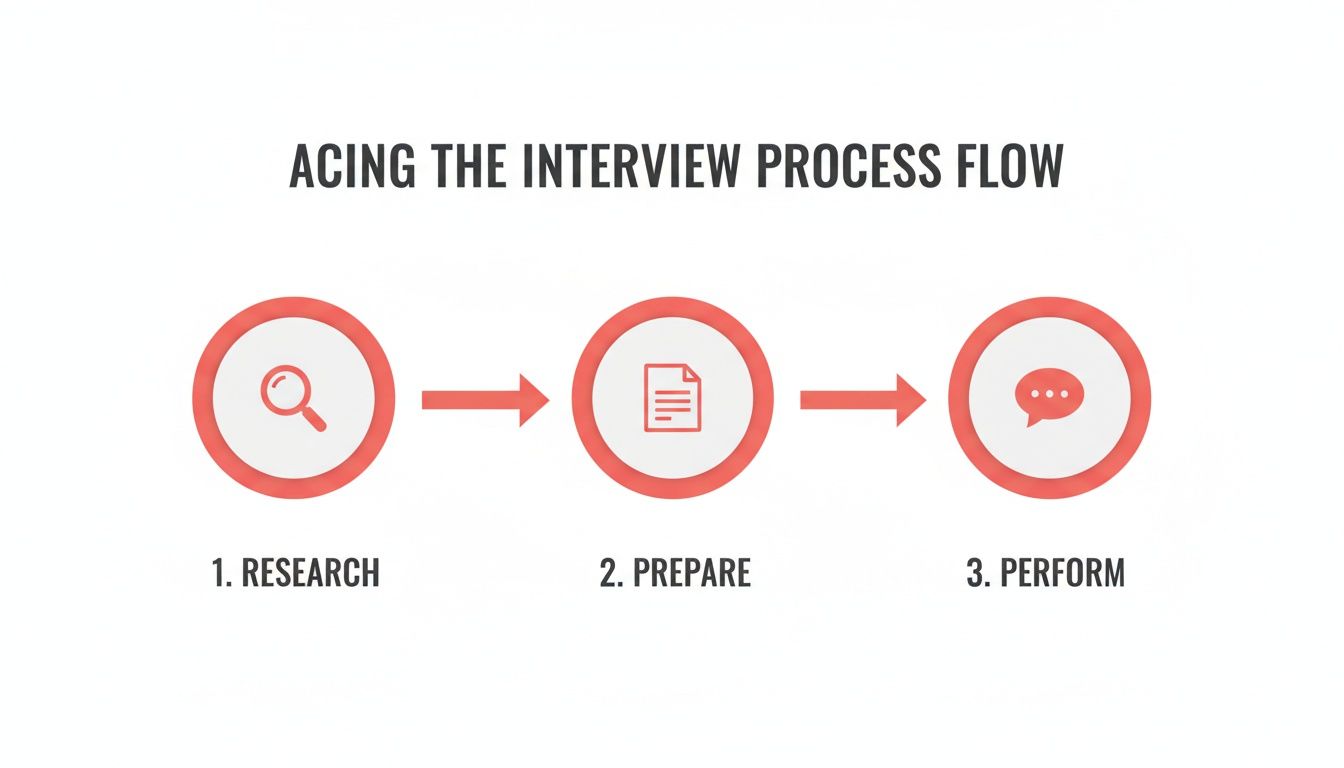
This visual shows that a successful interview is a deliberate process. It is not just about showing up.
- Prepare Three STAR Stories: Write out three powerful success stories using the Situation, Task, Action, Result method. Have them ready.
- Conduct Pre-Interview Research: Never go into an interview blind. Look up the company’s latest news. Check the interviewer's background on Gainrep or LinkedIn.
- Prepare Your Questions: An interview is a two-way street. Write down at least three smart questions to ask them. Ask about the role, the team's challenges, or the company culture. It shows you are genuinely interested.
A Few Common Questions About the Job Search
The job search can feel like a maze. It has tricky questions and unspoken rules. Getting straight answers can help you move forward with more confidence. Let's tackle some common worries.
How Long Should I Wait to Follow Up After an Application?
Patience is important, but do not wait forever. A good rule is to wait one to two weeks after you apply. If the job posting gives a timeline, follow it.
The rules are different after an interview. You should always send a thank-you note within 24 hours. If the recruiter gave you a decision date that has passed, it is okay to send a polite follow-up a day or two later. Keep it brief and professional.
Is It a Bad Idea to Apply for Multiple Jobs at One Company?
No, not at all. Applying for two or three roles can be a smart move, if it makes sense. If your skills fit each position, it shows you want to work for that company.
Just do not go overboard. Applying to dozens of unrelated positions can make you look unfocused or desperate. Keep your applications targeted to roles where your expertise shines.
What Is the Biggest Resume Red Flag for Recruiters?
The generic, one-size-fits-all resume is the biggest red flag. Recruiters can spot it easily. It shows a lack of real interest and effort.
Other major deal-breakers include typos, large unexplained gaps in your work history, and an unprofessional email address.
Using a professionally designed template is the easiest way to avoid these critical mistakes. It ensures your document is clean, easy to scan, and presents you well from the start.
How Do I Explain a Gap in My Employment History?
Own it with honesty and confidence. Do not be defensive. Frame the time off positively. Focus on what you were doing. This could be professional development, volunteering, or family care.
Have a short, clear explanation ready for your interview. Show that you stayed productive and are now ready to get back to work. Your confidence in explaining the gap is often more important than the gap itself.
Stop wondering "why am I not getting hired" and start building a resume that gets you in the door. With Gainrep, you can use professional, ATS-friendly templates to make sure your application actually gets seen. Create your winning resume today.
