

Your resume's education section needs to be clear and professional. Recruiters often look at it first. Let's make sure it is formatted correctly.
How to Structure Your Resume Education Section
The most important rule is to list your newest degree first. This is called reverse-chronological format. You should include the full name of your degree, the university, its location, and your graduation date. Recruiters and hiring software expect this format.

Think of your education section as a key part of your professional story. It gives recruiters a quick look at your background. A well-organized section makes a good first impression. It supports your professional qualifications.
This simple structure helps both people and applicant tracking systems (ATS) read your academic history. This clarity can help you get to the next round of interviews. Understanding how to write a professional resume is important for your whole document. Your education section plays a big role in that.
Core Components of an Education Entry
Each degree you list should have four main pieces of information. This format makes your resume easy to scan. It also prevents confusion.
Here are the required items for each entry:
- Name of Your Degree: Write the full title. For example, use "Bachelor of Science" instead of "B.S." This is important for Applicant Tracking Systems (ATS).
- Name of the Institution: Use the full, official name of your school.
- Institution Location: List the city and state where you attended.
- Graduation Date: Use the month and year you graduated. If you are still a student, use your expected graduation date.
A Table of Essential Education Details
This table summarizes what to include for a clear education section.
| Information Type | What to Include | Example |
|---|---|---|
| Degree | Full degree title (e.g., Bachelor of Arts, Master of Science) | Master of Business Administration |
| Major/Minor | Your field(s) of study | Major in Finance, Minor in Economics |
| University Name | Full official name of the institution | University of California, Los Angeles |
| University Location | City and State | Los Angeles, CA |
| Graduation Date | Month and Year (or expected date) | May 2023 or Expected May 2025 |
| GPA (Optional) | Include only if it’s 3.5 or higher | GPA: 3.8/4.0 |
| Honors (Optional) | Any academic honors like cum laude, Dean's List, etc. | Summa Cum Laude |
| Coursework (Optional) | List 3-5 relevant courses if you're a student or recent grad with limited experience | Relevant Coursework: Corporate Finance, Risk Management, Investment Analysis |
This standard format helps recruiters find information quickly. Consistency is very important here.
Why Reverse-Chronological Order is Standard
The best way to organize your education is in reverse-chronological order. This means you list your most recent degree first. Then you list older degrees.
For example, if you have a Master's degree and a Bachelor's degree, list the Master's degree first. This method highlights your highest level of education. Recruiters prefer this because it saves them time. They can see your most advanced qualification right away.
Your most recent degree is your most relevant one. Putting it first makes sure it gets seen and follows industry standards.
Where to Put Your Education on a Resume
The placement of your education section is a strategic choice. It tells the hiring manager what you offer. The best spot depends on your career stage.
You are guiding the recruiter's eye to the most relevant part of your professional life. When you get this right, your strongest qualifications are seen first.
When Your Education Should Go at the Top
If you are a student or a recent graduate, your education is your most important achievement. Your education section should be at the top of your resume. Place it right after your contact information and summary.
When you have little professional experience, this placement highlights your academic accomplishments. It tells recruiters that your fresh knowledge is your main selling point.
For new graduates, a strong education section can replace a long work history. You can highlight relevant courses, honors, or a high GPA to show you are qualified for the role.
Your degree is your most recent accomplishment, so lead with it. This shows confidence and your readiness for the professional world. Recruiters hiring for entry-level jobs expect to see this.
Situations Where Education Comes First
Putting your education at the top of your resume is the right choice in a few cases.
- You are still in school: Your studies are your main focus. This makes them the most important detail for internships or jobs.
- You graduated in the last 2-3 years: Your degree is still recent. The skills you learned are directly related to the jobs you want.
- You have very little work experience: If your work history is short, your academic record shows your skills and work ethic better.
A great resume shows your strengths immediately. You can create a professional document using a top-notch resume builder. It will help your qualifications get the attention they need.
When to Move Your Education to the Bottom
After you have a few years of professional experience, your work history becomes more important. At this point, you should move your education section to the bottom of your resume.
Recruiters for mid-level or senior roles care more about your work experience. They want to see what you have accomplished on the job. Your degree becomes a basic requirement, not the main highlight.
By putting your work experience first, you show how you have used your knowledge in real-world situations. This is more powerful than an old academic project.
Scenarios for Placing Education Last
Moving your education to the end of your resume is a normal part of career growth. It shows that your professional achievements are more important than your academic ones.
You should move it if:
- You have more than three years of relevant professional experience.
- Your career path has been clear since graduation.
- The jobs you are applying for value practical skills over academic credentials.
This change shows a mature career. It tells recruiters that your value comes from what you have done, not just what you have studied.
How to Position Your Education at Different Career Stages
Your resume should change as your career grows. The way you present your education as a new graduate should be different from how an experienced professional does it.
This is a strategic decision. By customizing this section, you make sure the most relevant information is visible for the job you are targeting.
Let’s look at how to handle this for each career stage.
This decision tree shows the basic rule for placing the education section.
The rule is simple. If you are a recent graduate, your education goes at the top. If you are an experienced professional, it goes at the bottom. This lets your work history stand out.
For Students and Recent Graduates
If you are in school or recently graduated, your education is your biggest asset. With little professional experience, your academic background must show your skills. This is your chance to show your knowledge and work ethic.
Do not just list your degree. Add details that show what you can do.
- High GPA: Include a GPA of 3.5 or higher. It shows you are a dedicated achiever.
- Academic Honors: List any awards like magna cum laude or Dean's List. These help you stand out.
- Relevant Coursework: Add a list of 3-5 advanced courses related to the job description. This proves you have specific knowledge.
- Thesis or Project: Briefly describe any major project. This can highlight research, technical, or analytical skills.
Here is an example for a recent graduate:
University of Michigan, Ann Arbor, MI
Bachelor of Science in Computer Science, May 2024
- GPA: 3.8/4.0
- Magna Cum Laude
- Relevant Coursework: Data Structures and Algorithms, Machine Learning, Web Application Development, Database Management Systems
This detailed approach gives a hiring manager proof of your skills. It shows you are ready to contribute right away.
For Mid-Career Professionals
Once you have several years of relevant work experience, your resume's focus should change. Your work history is more important than your academic history. It is time to simplify the education section.
Your degree is now a basic requirement, not the main attraction. The goal is to be clean and concise.
At this career stage, your education section confirms you meet the job's requirements. Your work experience is what sells you to the employer.
Here are the key changes to make:
- Remove Details: Your GPA and coursework are no longer needed. Your job accomplishments are more important.
- Consider Dropping Dates: Many professionals remove graduation dates to avoid age bias. This is a personal choice but is becoming more common.
- Remove High School: If you have a college degree, your high school diploma is assumed. You should remove it.
A mid-career professional’s education section should be simple:
Northwestern University, Evanston, IL
Master of Business Administration
New York University, New York, NY
Bachelor of Arts in Economics
This simple format keeps the recruiter’s attention on your work history. A professional resume builder can help you adjust your resume for any career stage.
For Experienced Leaders and Career Changers
For senior executives or those changing careers, the education section has a specific purpose. It must support your expertise or validate your new career path.
Experienced leaders should highlight advanced degrees like an MBA or Ph.D. These degrees confirm their qualifications for leadership roles. Career changers should highlight new degrees or certifications relevant to their new industry.
The job market is competitive. Higher education is often a standard requirement. Research shows that 52% of job seekers list a Bachelor's degree or higher. Employers often seek the critical thinking skills gained in college. You can find more resume trends in this research on mind-blowing resume statistics. This makes it important to show your credentials clearly.
Passing the Applicant Tracking System Scan
A machine often reads your resume before a person does. Most companies use Applicant Tracking Systems (ATS) to manage applications. This software is the first gatekeeper.
The ATS scans your resume for keywords and a clean format. If it cannot understand your education section, it might reject your application. Formatting your resume for these systems is a necessary first step.
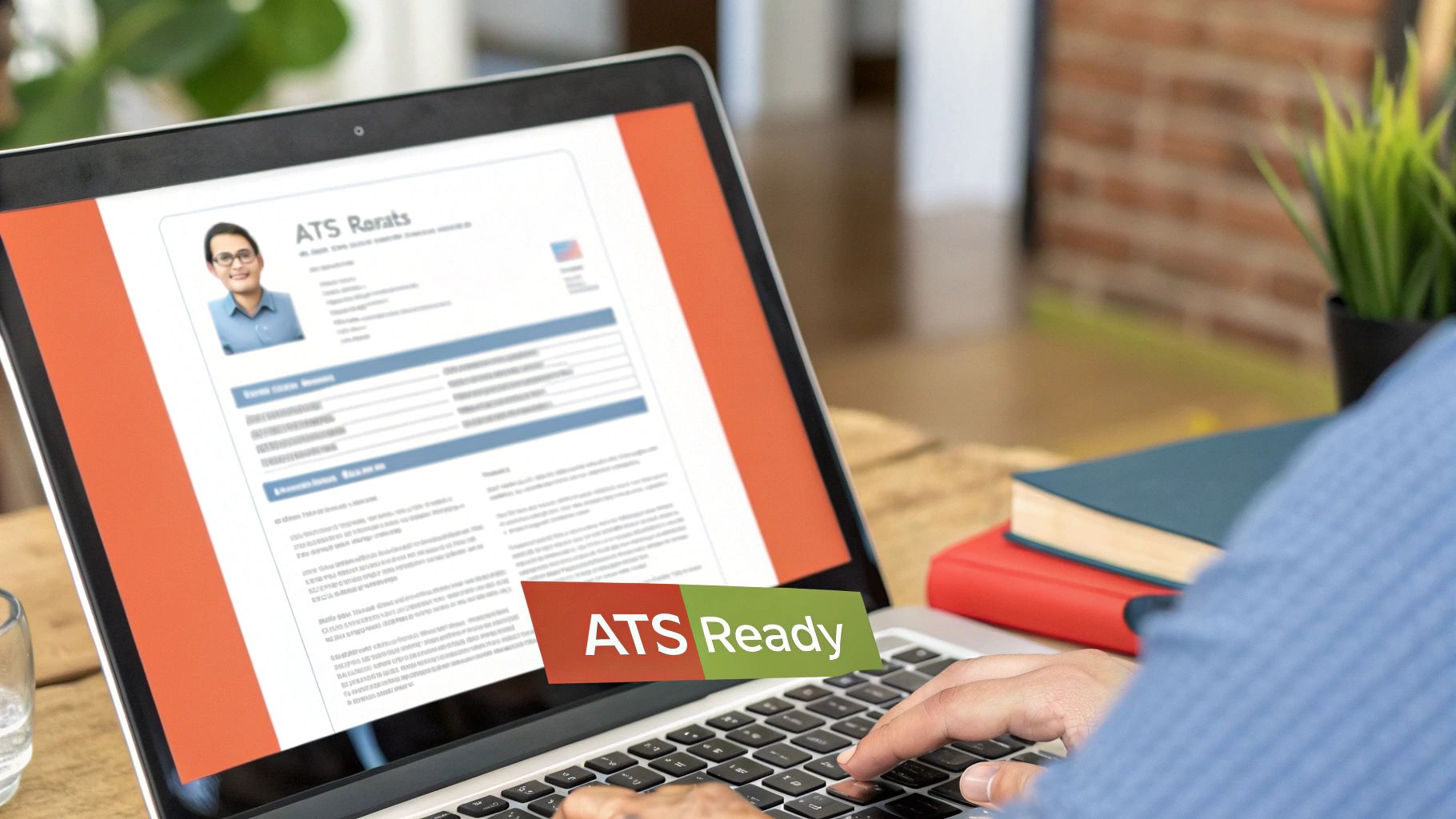
Your goal is to make it easy for the software to read your information. Simple, standard formatting is required to get past the robot.
Use Standard Headings and Full Titles
The ATS looks for common headings. Do not get creative here. Your education section heading should only be "Education". A simple title tells the system where to find your academic history.
The same rule applies to your degrees. You may use "B.A." in conversation, but an ATS might search for the full phrase. Always write out the complete title.
-
Instead of: B.S. in Biology
-
Write: Bachelor of Science in Biology
-
Instead of: MBA
-
Write: Master of Business Administration
This small change increases the chance that the system will correctly read your degree.
Avoid Formatting That Confuses the System
An ATS can be easily confused by complex formatting. This can cause it to misread or ignore important information. Avoid these common mistakes:
- Tables and Columns: Do not put your education details in a table or use columns. The software often reads from left to right, which can jumble your information.
- Images and Graphics: Do not include your university's logo or other images. An ATS cannot read text inside an image.
- Special Fonts or Symbols: Use standard fonts like Arial, Calibri, or Times New Roman. Avoid special characters that the system may not recognize.
Keep your formatting simple. A clean, straightforward layout gives you a better chance of your resume being read correctly.
Mirror Keywords from the Job Description
An ATS often scans for keywords from the job description. You can use this to your advantage. This is especially true if you are a recent graduate.
Read the job posting carefully. Look for specific skills or software it mentions. If you studied these in your classes, add a "Relevant Coursework" subsection.
For example, a job may require experience with Python. Your entry could look like this:
University of California, Berkeley, Berkeley, CA
Bachelor of Science in Data Science, May 2024
- Relevant Coursework: Advanced Python Programming, Statistical Modeling, Machine Learning Algorithms, Big Data Analytics
This tells the ATS that your background matches their needs. This is a key strategy. Up to 90% of employers may use these systems by 2025. About 75% of resumes are rejected by ATS due to formatting or keyword issues. You can find more details on how resumes are statistically analyzed.
Making your resume ATS-friendly ensures your qualifications get seen. Our AI tool at GainRep can find jobs that match your resume and automatically apply for you. This takes the guesswork out of passing the ATS scan.
How to Handle Special Education Cases
Not everyone's education path is a straight line. That is perfectly fine. The goal is to tell your story honestly and effectively. You need to know how to frame situations like an unfinished degree, multiple degrees, or online certifications. This turns a potential issue into a strength.

Present your background with confidence. Highlight the skills and knowledge you gained. Each experience adds value to your professional profile. Let's look at how to frame these situations.
How to List an Unfinished Degree
Sometimes, a degree program is not completed. If your completed coursework is relevant to the job, you should include it. Be transparent and focus on what you did accomplish.
Focus on the credits you earned and the knowledge you gained. Never say you graduated if you did not. That is a major mistake. Instead, present your experience in a positive way.
Here is a clean and honest way to list it:
University of Colorado Boulder, Boulder, CO
Completed 90 credits toward a Bachelor of Science in Business Administration
- Relevant Coursework: Financial Accounting, Principles of Marketing, Business Analytics
This format is honest. It shifts the focus to your completed coursework and relevant knowledge.
Presenting Multiple Degrees
If you have more than one degree, list them in reverse-chronological order. Your most recent degree should be at the top. This lets a recruiter see your highest qualification first.
Make sure the formatting is consistent for each entry. A clean, professional look is important.
For example, if you have a Master's and a Bachelor's degree:
Stanford University, Stanford, CA
Master of Arts in Communication, May 2023
University of California, Los Angeles, Los Angeles, CA
Bachelor of Arts in English, May 2021
This structure is logical and easy to read.
Showcasing Certifications and Bootcamps
Professional certifications and coding bootcamps are very valuable. They are especially important in tech and other specialized fields. They prove you have specific, job-ready skills. You can list them in your education section. If you have several, you can create a separate "Certifications" section.
If you add them to your education section, place them after your formal degrees. Include the program name, the issuing organization, and the completion date.
A relevant certification shows you are proactive and committed to learning. Employers find these qualities very attractive.
For job seekers without a traditional university degree, understanding alternative pathways to higher education can help you represent your qualifications accurately.
Including Study Abroad Programs
Studying abroad shows employers you are adaptable and independent. It also shows you have cross-cultural communication skills. It is a great detail to add to your resume.
The best way to include it is as a single bullet point. Put it under the degree you were pursuing at the time.
Here is an example:
Boston University, Boston, MA
Bachelor of Arts in International Relations, May 2022
- Studied abroad at The London School of Economics, London, UK (Spring 2021)
This keeps your education section organized while highlighting a valuable experience.
Formatting Special Education Scenarios
This table shows how to handle these non-traditional situations.
| Scenario | Recommended Formatting | Key Takeaway |
|---|---|---|
| Unfinished Degree | List university, credits completed, and relevant coursework. Example: Completed 90 credits toward a BS in Computer Science. | Be honest. Focus on the relevant knowledge you gained. |
| Multiple Degrees | List in reverse-chronological order, with the most recent degree first. Maintain consistent formatting. | Highlight your highest level of academic achievement first. |
| Bootcamps/Certs | Place after formal degrees in the Education section OR create a dedicated "Certifications" section. | Shows specific, job-ready skills and professional growth. |
| Study Abroad | Add as a single bullet point under the main degree entry. Example: – Studied abroad at University of Barcelona, Spain. | Shows adaptability and global perspective without clutter. |
These "special cases" can be a powerful part of your story. You just need to know how to list them correctly.
Common Questions About Listing Education
Some tricky questions often come up when you are working on your education section. Your situation might not fit a standard template. That is okay.
Let's go over some of the most common questions from job seekers. Getting these details right can clear up confusion for a hiring manager. It will make your resume as strong as possible.
Should I List My High School if I Have a College Degree?
No, you should not. Once you have a college degree, your high school diploma is assumed. Including it takes up valuable space on your resume.
Recruiters assume that if you have a college degree, you completed high school. Leaving it off makes your resume look cleaner and more professional. It shows you are focused on your higher-level qualifications.
The only exception is if you are a current high school student or a very recent graduate with no college experience. In that case, you should list your high school.
How Should I List an Incomplete Degree?
Listing an unfinished degree requires care. You must be honest but also show the value of your work. Do not mislead a recruiter into thinking you graduated.
The best way is to frame your progress positively. Focus on the number of credits you earned. Mention any relevant coursework. This shows you gained valuable knowledge.
Here is a clear way to format it:
University of Texas, Austin, TX
Completed 75 credits toward a Bachelor of Science in Marketing
- Relevant Coursework: Consumer Behavior, Digital Marketing Fundamentals, Market Research Analysis
This format is honest about your status. It also highlights your job-related skills.
Is It Okay to Leave Off My Graduation Date?
Yes, it is often okay to leave your graduation date off your resume. This is a common strategy for experienced professionals. It helps avoid potential age bias from recruiters.
If you have more than 10-15 years of work experience, your work history is more important than when you went to college. Removing the date keeps the hiring manager’s focus on your recent achievements.
For experienced professionals, removing graduation dates can prevent bias. It ensures your application is judged on your skills and experience.
If you are a recent graduate, you should always include your graduation date. The date shows you have new, up-to-date knowledge. It provides important context that recruiters for entry-level roles expect.
Creating the perfect resume is the first step to your dream job. With Gainrep, our professional resume builder can help you create a document that stands out. Then, our AI Auto-Apply tool can find and apply to the best jobs for you. Start building your future today at Gainrep Resumes.
