Your resume lists the facts. Your cover letter tells your story.
It is your chance to show personality. You can explain your passion. It also connects your school projects to the job you want. Starting with a good cover letter template for students is the first step. It helps turn an application into an interview.
Why a Great Cover Letter Still Matters for Students
Writing a cover letter can feel like a chore. This is especially true when the job site says it is 'optional.' But skipping this step is a big mistake, especially for students.
Think of it as a bridge. It connects your classroom experience to the job description. It is where you explain things to the hiring manager. You can show how a group project prepared you for teamwork. Or you can explain how your final paper sharpened the research skills they need. A resume's bullet points cannot do that.
This story makes you a memorable candidate. You stand out from the pile of other applicants.
The Competitive Edge It Provides
You put yourself ahead when you submit a cover letter and others do not. It shows you have real initiative. It proves you have a real interest in this role, not just any role. Employers notice that.
Data supports this. A study of hiring practices shows that 83% of hiring managers read the cover letters they get. Also, 78% of recruiters prefer you include one. For 25% of them, it is a very important factor in their decision. The message is clear. A thoughtful letter gives you a huge advantage.
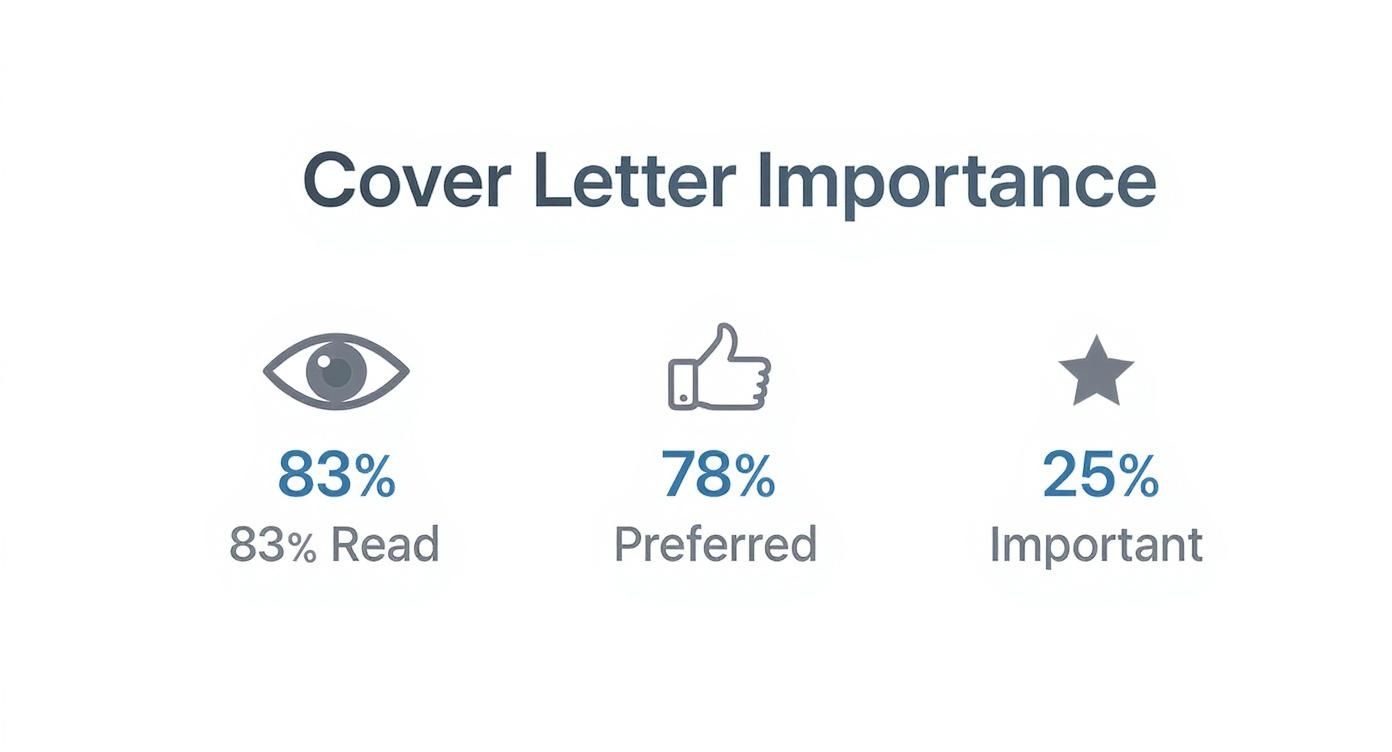
Let's look at what these numbers mean for your job search.
Cover Letter Impact at a Glance
| Statistic | What It Means for You |
|---|---|
| 83% of Hiring Managers Read Them | The time you spend writing a cover letter is not wasted. Most decision-makers will see it. |
| 78% of Recruiters Prefer Them | You give recruiters what they want. This makes their job easier and makes your application look better. |
| 25% Consider It Very Important | A strong cover letter could be the one thing that gets you an interview over someone else. |
These numbers are not just abstract. They show a real chance for you to stand out.
Going Beyond Your Resume
Your resume is a snapshot. It is a simple list of your education, skills, and experience. Your cover letter adds color. It is where you add a human touch to your application. You can show your excitement for the role and your connection to the company's mission.
A cover letter is your unique chance to address the hiring manager directly, show you understand their needs, and prove you are the best person to solve their problems before they even meet you.
This is your space to bring skills to life with real examples. Instead of just listing "communication skills," describe a time you presented a complex topic to a class of 50 people. That kind of proof is much more convincing.
Students who want to enter the professional world need to understand the job search process. This is especially true for fast-paced companies. For more on this, check out this guide on how to get a job at a startup after graduating. By writing a great cover letter, you are not just applying for a job. You are starting a conversation and making a strong first impression.
The Building Blocks of a Winning Student Cover Letter
Before you use a template, you should understand what makes a cover letter work. Think of it like a simple recipe. Each part has a specific job. When they come together, they get a hiring manager's attention.
We will walk through each essential piece. We will break down the process. This will give you a solid base for any internship or job application you write.

Your Professional Header and Salutation
This is the very top of your document. It sets a professional tone right away. It is simple, but getting the basics right is important.
Your header needs your contact information. Keep it clean. Make it easy for a hiring manager to see how to reach you.
- Your Name: Use your full, professional name.
- Phone Number: Use a number you will actually answer.
- Email Address: Use a professional address, like
firstname.lastname@email.com. - LinkedIn Profile URL (Optional): This is a great touch if your profile is up-to-date.
After your info comes the date and the employer's details. Then comes the salutation. Avoid "To Whom It May Concern." A little research on LinkedIn or the company website helps a lot.
If you find a name, use "Dear Mr./Ms./Mx. [Last Name]." If you cannot find a person after a quick search, use "Dear [Department Name] Hiring Team." For example, "Dear Marketing Hiring Team" is a strong choice. It shows you tried.
The Attention-Grabbing Opening Paragraph
You have about three sentences to hook the reader. Do not be boring here. Your opening must clearly state the job you want. It should immediately show your excitement and a hint of your skills.
Do not just say you are applying. Start with something that connects your passion to the company’s work. Mention a project they did. Or talk about something in their mission that you like. It shows you did your research.
A well-crafted opening is your elevator pitch on paper. It quickly tells the reader who you are, what you want, and why they should care, all in a few compelling lines.
This first impression is very important. It separates you from other applicants who sent a generic letter.
The Body Paragraphs That Tell Your Story
This is the heart of your cover letter. It is usually one or two paragraphs. This is where you connect your experiences to what the company needs. You prove you are the right person for the job, even without a long work history.
Look at the key requirements in the job description. For each one, think of a specific example. It can be from a class project, volunteer work, or a personal hobby. Did a group project need strong analytical skills? Did your role in a campus club show your teamwork? Use that.
A great way to structure these examples is the STAR method. It stands for Situation, Task, Action, and Result. It keeps your stories clear and powerful.
- Situation: Briefly describe the context. (e.g., "For my final marketing class project…")
- Task: Explain your goal. (e.g., "…we had to create a social media campaign for a local nonprofit.")
- Action: Detail what you did. (e.g., "I led the research on their target audience and developed the content calendar…")
- Result: Share the outcome with numbers if you can. (e.g., "…which led to a 15% increase in their online engagement.")
Learning to write persuasively will help you in many ways. The same ideas that teach you how to write better essays also apply to making a strong case for yourself in a cover letter.
The Strong Closing and Call to Action
Your final paragraph has two jobs. It restates your interest and asks for the next step. You want to sound confident and polite, not passive.
Summarize your value in one final sentence. Express your excitement about joining their team. Then, add a clear call to action. Politely state that you are eager to discuss your skills in an interview.
End with a professional closing like "Sincerely," or "Best regards." Follow it with your typed full name. A confident and polite finish leaves a good impression. It makes it easier for the hiring manager to move you to the "yes" pile.
Alright, let's get to the main event. Below are four cover letter templates that are proven to work. Each one is for a common situation students face.
I have also added some quick notes. Think of them as my insider tips. They explain why each part is effective. This way, you are not just copying and pasting. You are learning the strategy behind it.
Find the template that fits your situation. Use it as your foundation. Then, replace the placeholder text with your own story. This is your chance to make a real impression.
Template 1: The Internship Hunter
This template is for students looking for internships. The goal is to show you are eager to learn. It also shows your coursework is not just theory. You highlight how you can contribute right away. It frames you as a proactive team member, not just a summer helper.
[Your Name]
[Your Phone Number] | [Your Email Address] | [Your LinkedIn URL (Optional)]
[Date]
[Hiring Manager’s Name or Title]
[Company Name]
[Company Address]
Dear [Mr./Ms./Mx. Last Name],
I'm writing to express my enthusiastic interest in the [Internship Title] position at [Company Name], which I found on [Platform where you saw the ad, e.g., LinkedIn, your university's career portal]. As a second-year [Your Major] student at [Your University], I'm passionate about [Relevant Field or Industry] and have been closely following [Company Name]'s innovative work in [Specific area, e.g., sustainable product design]. I would be thrilled to bring my academic knowledge and strong work ethic to your team this summer.
Why this works: You get straight to the point. It shows you have researched the company. It immediately links your studies to what they do. There is no fluff.
In my [Relevant Course Name] class, I built a solid foundation in [Skill #1, e.g., data analysis using Python]. My final project involved analyzing a dataset to pinpoint consumer trends, which resulted in a presentation that earned top marks for its actionable insights. I'm eager to apply these analytical skills to real-world challenges with your team. On top of that, my experience as treasurer for the [Student Club Name] sharpened my organizational skills, as I was responsible for managing a budget and coordinating events for over 50 members.
Why this works: This paragraph provides proof. Instead of just saying you have skills, you give real examples from classes and clubs. It is a simple way to use the STAR method. It makes your experience feel real.
I'm a quick learner, highly adaptable, and genuinely excited by [Company Name]'s mission to [Mention their mission or a recent achievement]. I'm confident that my dedication and fresh perspective would make me a valuable asset to your team. Thank you for considering my application. My resume is attached for your review, and I look forward to discussing how I can support [Company Name] as a [Internship Title].
Sincerely,
[Your Typed Full Name]
Template 2: The Part-Time Job Seeker
Juggling classes and a job is tough. Employers know this. This template shows them you can handle it. The focus is on your reliability, responsibility, and time management skills. It positions you as someone who can be counted on. That is exactly what a manager needs for a part-time role.
[Your Name]
[Your Phone Number] | [Your Email Address] | [Your LinkedIn URL (Optional)]
[Date]
[Hiring Manager’s Name or Title]
[Company Name]
[Company Address]
Dear [Mr./Ms./Mx. Last Name],
I am writing to apply for the [Job Title] position at [Company Name], as advertised on [Platform]. As a dedicated [Your Year, e.g., junior] at [Your University], I've developed the kind of time management and interpersonal skills that I'm confident would make me a great addition to your team. I’ve always admired [Company Name]'s reputation for [Value or quality, e.g., excellent customer service], and I’m eager for the chance to contribute.
Why this works: It immediately addresses the main concern for a part-time hire: can you manage your time? It also adds a nice, personalized touch about the company.
While maintaining a full course load in [Your Major], I’ve consistently balanced my academic work with extracurriculars, which has taught me how to multitask and prioritize effectively. For example, as a volunteer at [Organization Name], I was responsible for [Your task, e.g., organizing weekly supply drives]. That required careful planning and clear communication with my team, and it’s prepared me to handle the duties of the [Job Title] role while delivering consistent, quality work.
Why this works: You show, not just tell. This section uses non-work experience to prove you have essential skills. Responsibility and follow-through are critical for any part-time job.
I'm a reliable and hardworking person, and I'm available to work [Mention your availability, e.g., evenings and weekends] as needed. I'm excited about the possibility of bringing my positive attitude and strong work ethic to [Company Name]. Thank you for your time and consideration. I’ve attached my resume and am available for an interview at your convenience.
Sincerely,
[Your Typed Full Name]
Template 3: The New Graduate
You are officially a graduate. Congratulations! Now, the challenge is to convince employers that your degree is more than just paper. This template helps you bridge that gap. It frames your academic work as direct preparation for the professional world. It sells the hiring manager on your future potential.
[Your Name]
[Your Phone Number] | [Your Email Address] | [Your LinkedIn URL (Optional)]
[Date]
[Hiring Manager’s Name or Title]
[Company Name]
[Company Address]
Dear [Mr./Ms./Mx. Last Name],
As a recent graduate from [Your University] with a Bachelor of [Your Degree] in [Your Major], I am writing with great interest about the [Job Title] position at [Company Name]. My academic career gave me a strong foundation in [Key Skill #1] and [Key Skill #2], and I am excited by the chance to apply my knowledge and passion for [Your Field] to help your team succeed.
Why this works: This opening clearly states who you are. It immediately ties your degree to the job's needs.
For my senior capstone project, I led a team of four to develop a [Description of project, e.g., comprehensive marketing plan for a local business]. I was responsible for [Your specific action, e.g., conducting market research and creating a content strategy], which led to our project being recognized by the department for its innovative approach. That whole experience really sharpened my [Relevant Skill, e.g., project management] abilities and taught me the value of collaborative problem-solving—skills I'm ready to bring to [Company Name]. Building a solid resume to showcase projects like these is also key. If you're working on yours, I'd recommend exploring the templates on the GainRep resume builder.
Why this works: Your capstone project becomes your "work experience." It is a detailed, specific story that shows what you can do. The link to GainRep also feels like a helpful tip.
I am a driven and resourceful person, ready to hit the ground running in my professional journey. I’m especially drawn to [Company Name]'s work in [Specific area of interest], and I'm confident that my fresh perspective and technical skills will allow me to make a real contribution from day one. Thank you for your consideration. My resume is attached, and I look forward to discussing this opportunity with you.
Best regards,
[Your Typed Full Name]
How to Personalize Your Cover Letter Template
Think of a cover letter template as your starting block, not the finish line. The real magic happens when you add your own experiences and real interest. This is how you turn a good application into an unforgettable one. It will feel authentic to you and the employer.
Your first step is to be a detective. Your mission is to study the job description. Hunt for the specific skills and duties the company wants. Do not just skim it. Read it carefully and find their top three to five requirements. These are your targets.

From Generic Phrases to Specific Examples
Once you have that list of keywords, it is time to replace the generic phrases in your template. This is where you connect the dots for the hiring manager. You prove you have what they need.
For every skill they ask for, think of a specific example from your life. It does not have to be from a paid job. Class projects, volunteer roles, or leadership in student clubs all work. Even a detailed personal project is great.
Let’s see what this looks like.
- Before (Generic): "I have strong teamwork skills and work well with others."
- After (Specific): "In my sociology course, I worked with a team of four on a research project. I led the group by organizing our meetings and assigning tasks. This helped us submit our final report a week early."
See the difference? The "after" example does not just claim a skill. It proves it with a small story that shows collaboration, leadership, and responsibility.
Match Your Tone to the Company Culture
Next, adjust the tone of your cover letter to match the company. Are they a formal, corporate place like a bank? Or are they a casual, new tech startup? A quick look at their website and social media will give you clues. The language in the job description also helps.
A cover letter that mirrors the company's communication style shows you've done your homework and get their culture. It makes you seem like a natural fit before you even walk in the door.
For a more traditional company, stick to classic language. For a startup, you can use more conversational language. Highlight your creativity and ability to adapt.
- Formal Tone Example: "I am writing to express my profound interest in the Financial Analyst internship at Sterling Cooper."
- Casual Tone Example: "I was excited to see the opening for the Marketing Intern role on your careers page—I’ve been a huge fan of how your team uses social media to connect with users."
Weaving in Company-Specific Details
This is the final touch that really sets your cover letter apart. You need to show that this letter is for this company only. Mention a specific project they launched. Talk about a recent success you admire. Or mention a core value from their mission statement that you connect with.
This proves your interest is real. It shows you are not just sending mass applications. For anyone using a cover letter template for students, adding these specific details is the most powerful way to stand out.
Let’s say you are applying to a company that just launched a new app.
- Generic: "I am impressed with your company's work."
- Personalized: "I was particularly impressed with the launch of your new app, [App Name]. The user-friendly design and focus on accessibility are exactly what I'm passionate about in my Human-Computer Interaction course."
That simple change shows you pay attention. It shows you have a real connection to what they do. Replacing generic statements with specific stories makes your cover letter a strong argument for why you are the perfect person for the job. It's a critical step. For those looking to speed things up, tools that help you apply to many jobs at once, like the AI Auto-Apply tool from GainRep, can be a game-changer.
Common Mistakes That Get Student Applications Ignored
Knowing what to avoid is just as important as knowing what to include. A single mistake can be enough for a busy recruiter to toss your application. If you stay away from these common traps, you will instantly boost your chances.
One of the most common mistakes is being too generic. A greeting like "To Whom It May Concern" is an immediate red flag. It shows you have not done basic research. It suggests you are not truly interested in this specific role.
Just Repeating Your Resume
Another big mistake is treating the cover letter like a long version of your resume. Your resume is a quick list of facts. Your cover letter's job is to tell a story around those facts. It should add personality and context.
Do not just say you "led a team project." Tell them a quick story about how you led it. What problem did you solve? What was the outcome? Showing your skills in action is much more powerful than just listing them.
Your cover letter is the bridge between your resume and the job description. It’s your chance to speak directly to the employer's needs and show how your unique experience makes you the perfect solution.
If you do not make that connection, you are missing the entire point. The focus should always be on what you can do for the company. It should not just be about what you want from the job.
Overlooking the Small Details
Simple typos and grammar mistakes can ruin a great application. These small errors suggest you do not pay attention to detail. This is a major red flag for any employer. Always proofread your letter a few times. Even better, ask a friend or mentor to look at it.
Failing to customize your letter for each job is just as bad. Recruiters can spot a generic, copy-pasted letter easily. It tells them you are not that serious about their job.
The quality of your application matters a lot. Research shows that 40% of recruiters reject candidates because of a bad cover letter. On the other hand, nearly 40% of hiring managers say a good cover letter makes them pay more attention to an application. A strong one can truly make all the difference. You can find more resume statistics and insights on Novoresume.
To avoid these manual errors and apply with confidence, technology can help. Tools like GainRep's AI Auto-Apply can make the process easier. The system finds jobs that match your resume. It automatically tailors your applications. This helps you avoid common mistakes and get more interviews. Learn more about how to speed up your job search with AI Auto-Apply.
Your Questions Answered
We have covered a lot, but you might still have a few questions. That is completely normal. Let's look at some of the most common things students wonder about when writing a cover letter.
Think of this as a final check to clear up any doubts before you hit "send."
How Long Should a Student Cover Letter Be?
One page. That is the rule.
Your ideal length is three to four short paragraphs. This is usually between 250 and 400 words. Recruiters are very busy. A letter that is short and to the point shows you respect their time.
If it is too long, it probably will not be read. If it is too short, you might look like you did not put in enough effort. The goal is to make every sentence count.
A great cover letter is like a strong elevator pitch. It’s brief, impactful, and leaves the other person wanting to learn more about you. Aim for that same level of focused energy.
This length gives you enough space to introduce yourself. You can connect your skills to their needs. You can also end with a clear call to action. All of this can be done without overwhelming the reader.
What if I Have No Work Experience to Write About?
This is a very common situation for students. It is nothing to worry about. Your value is not just defined by a job. Instead of focusing on jobs you do not have, focus on the skills you have gained elsewhere.
Think about what you have done:
- Academic Projects: Did you lead a team project? That shows leadership. Did you research a major paper? You have analytical skills.
- Volunteer Work: Volunteering shows commitment and a good work ethic. Talk about your responsibilities and the impact you made.
- Student Clubs: Maybe you managed a club's budget or organized an event. That is direct experience with money, planning, and teamwork.
- Personal Projects: Did you build a website for fun? Start a blog? These projects show initiative and practical skills.
The key is to connect these experiences to the requirements in the job description. Show them you have the skills they want, even if you learned them outside of an office.
Is It Okay to Use an AI Tool to Write My Cover Letter?
Yes. AI tools can be a great help, especially when you feel stuck. An AI can give you a solid first draft. It will be structured correctly and targeted to the job. This saves a lot of time.
But you should never just copy and paste the result. Think of AI as a smart assistant, not a writer.
Here is how to use it correctly:
- Get a Foundation: Let the AI create a draft based on your resume and the job description.
- Make It Sound Like You: Go through and rewrite sentences. Add your own voice and phrases.
- Add Your Stories: The AI does not know the details of your experience. This is where you come in. Add the personal examples and specific details that only you know. That is what makes a letter memorable.
Using AI as a starting point is a great strategy. Just make sure the final letter truly sounds like you.
Do I Need a New Cover Letter for Every Job I Apply To?
Yes. You absolutely need a new one for every job. This is not optional.
Recruiters can spot a generic, copy-pasted letter very easily. It immediately shows that you are not very interested in this specific job.
You can have a base cover letter template for students to work from. But you must change it for every single application.
Here is a quick checklist for customizing it:
- Always use the correct company name and job title.
- Address it to a real person if you can find their name.
- Find two or three key requirements in the job description and explain how you meet them.
- Mention something specific about the company that you like, such as a recent project or one of their core values.
This small amount of extra effort shows you have done your research. It proves you are serious about the role.
Feeling ready to tackle your job search? Let GainRep help you stand out. Use our professional resume builder to craft a polished resume, and then let our AI Auto-Apply tool find and apply to the best jobs for you. Start building your future today at https://www.gainrep.com/ai-auto-apply.
